


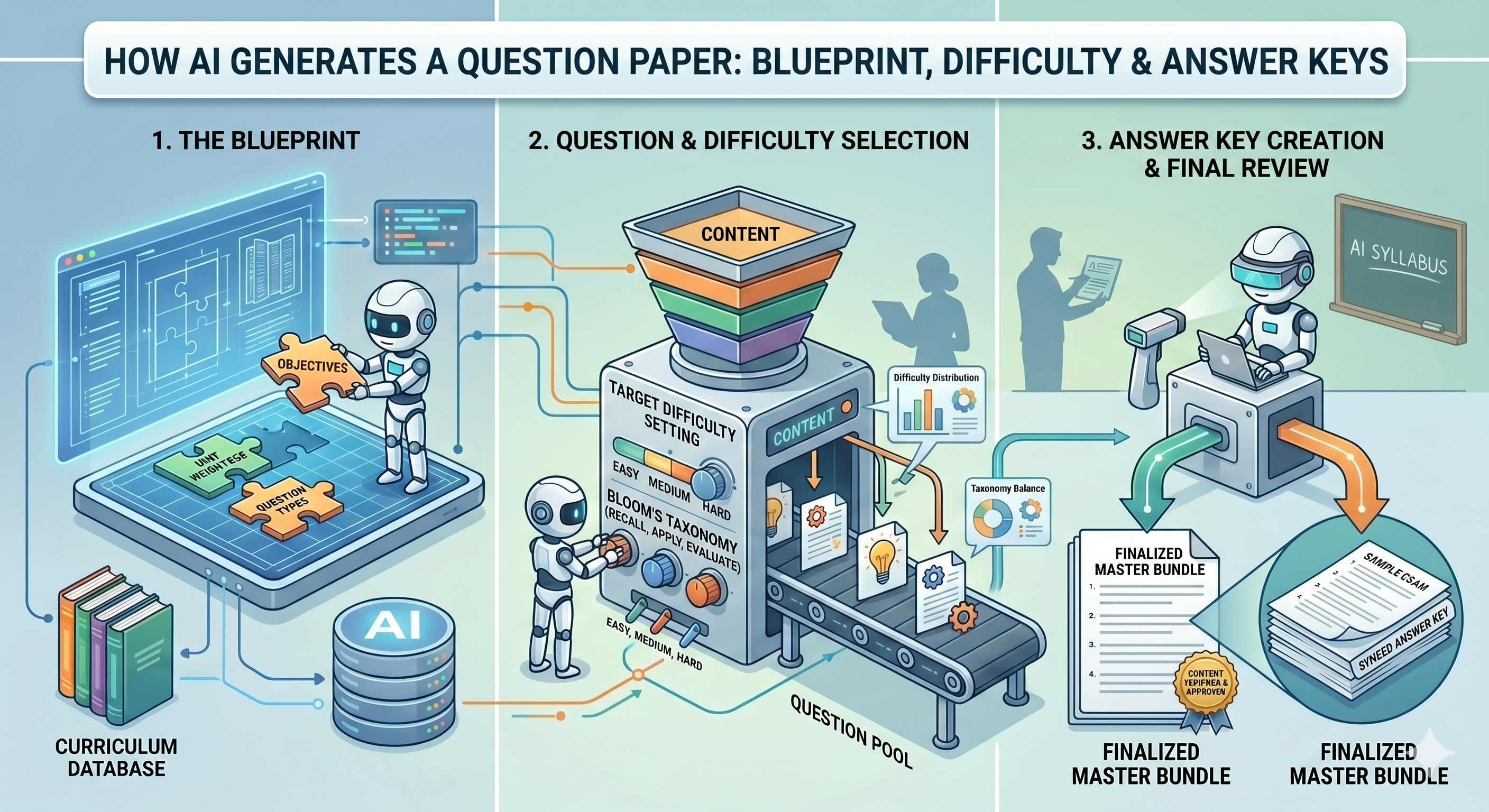
A plain-English look at how an AI question paper generator actually works — from reading the exam blueprint to balancing difficulty and producing the answer key.
An AI question paper generator turns a few inputs — board, class, subject, chapters and difficulty — into a complete, formatted paper with a matching answer key. Under the hood it follows the same logic a careful teacher does: read the blueprint, map questions to the syllabus, balance the difficulty mix, then format to the exam's structure. The difference is it does in minutes what manually takes an evening. Here's how each step works.
Step 1: Reading the blueprint
Every board exam has a blueprint — the rule that says how many marks go to which question type and section. A CBSE Class 10 paper follows an 80+20 split with defined 1-mark, 2-mark and long-answer sections; Tamil Nadu's SSLC uses a Part I–IV structure (14×1, 10×2, 10×5, 2×8); NEET is 180 MCQs at +4/−1. A good generator starts by loading the correct blueprint for the board and class you pick, so the output mirrors the real exam rather than a generic quiz.
Step 2: Mapping to the syllabus
Next it constrains questions to the chapters you select. This matters for two reasons: a monthly test should only cover what's been taught, and questions should be anchored to the prescribed textbook (NCERT, Samacheer Kalvi, or the relevant board text) rather than drifting off-syllabus. Syllabus mapping is what separates a usable school paper from a random question dump.
Step 3: Balancing difficulty
A realistic paper isn't all easy or all hard. Boards typically aim for a spread — broadly, a majority of straightforward and average questions with a smaller share of higher-order, application-based ones. The generator distributes questions across that difficulty curve so the paper discriminates between students fairly, instead of producing a flat test where everyone scores the same.
Step 4: Building the answer key and solutions
For each question generated, the system also produces the answer — and for subjects like Maths, Physics and Chemistry, step-by-step solutions rather than just final answers. This is the step that saves teachers the most time: correction can start immediately, and the worked solutions double as a revision resource for students.
Step 5: Formatting and output
Finally it lays everything out to the exam's format — section headers, mark allocations, instructions, and where relevant an OMR sheet for MCQ-based papers — then exports a print-ready document. What you get is a paper that looks and behaves like the real thing.
What good output requires
Not every generator produces exam-faithful papers. The quality markers worth checking: correct, current blueprints; genuine syllabus anchoring; a real difficulty spread; accurate answer keys with solutions; and proper formatting. Thin tools that ignore the blueprint produce papers that don't match what students will actually sit.
SchoolDeck's AI question paper generator is built around these steps — supporting CBSE, State Board, NEET, JEE and other formats, with answer keys, solutions and OMR sheets included.
See exam-faithful papers generated in under two minutes
From blueprint to answer key, SchoolDeck builds print-ready papers across CBSE, State Board, NEET and JEE formats.
Book a DemoFrequently Asked Questions
How does an AI question paper generator work?
It reads the official blueprint for the chosen board and class, maps questions to the selected syllabus chapters, balances the difficulty mix, generates a matching answer key with step-by-step solutions, and formats a print-ready paper — mirroring the structure of the real exam.
Does AI follow the actual board exam pattern?
A good generator loads the correct blueprint for each board — for example CBSE's 80+20 split, Tamil Nadu's Part I–IV structure, or NEET's 180-MCQ +4/−1 scheme — so the paper matches the real pattern. Always confirm the current official blueprint, as boards revise schemes periodically.
Can it create answer keys and solutions?
Yes. Alongside each paper it produces a matching answer key, and for quantitative subjects like Maths and Physics it generates step-by-step solutions, so correction is immediate and the solutions serve as revision material.
How is question difficulty controlled?
The generator distributes questions across a difficulty spread — mostly straightforward and average questions with a smaller share of higher-order ones — so the paper discriminates fairly between students rather than being uniformly easy or hard.
Is an AI-generated paper ready to print?
Yes. The final step formats section headers, mark allocations, instructions and, for MCQ papers, an OMR sheet, then exports a print-ready document.