


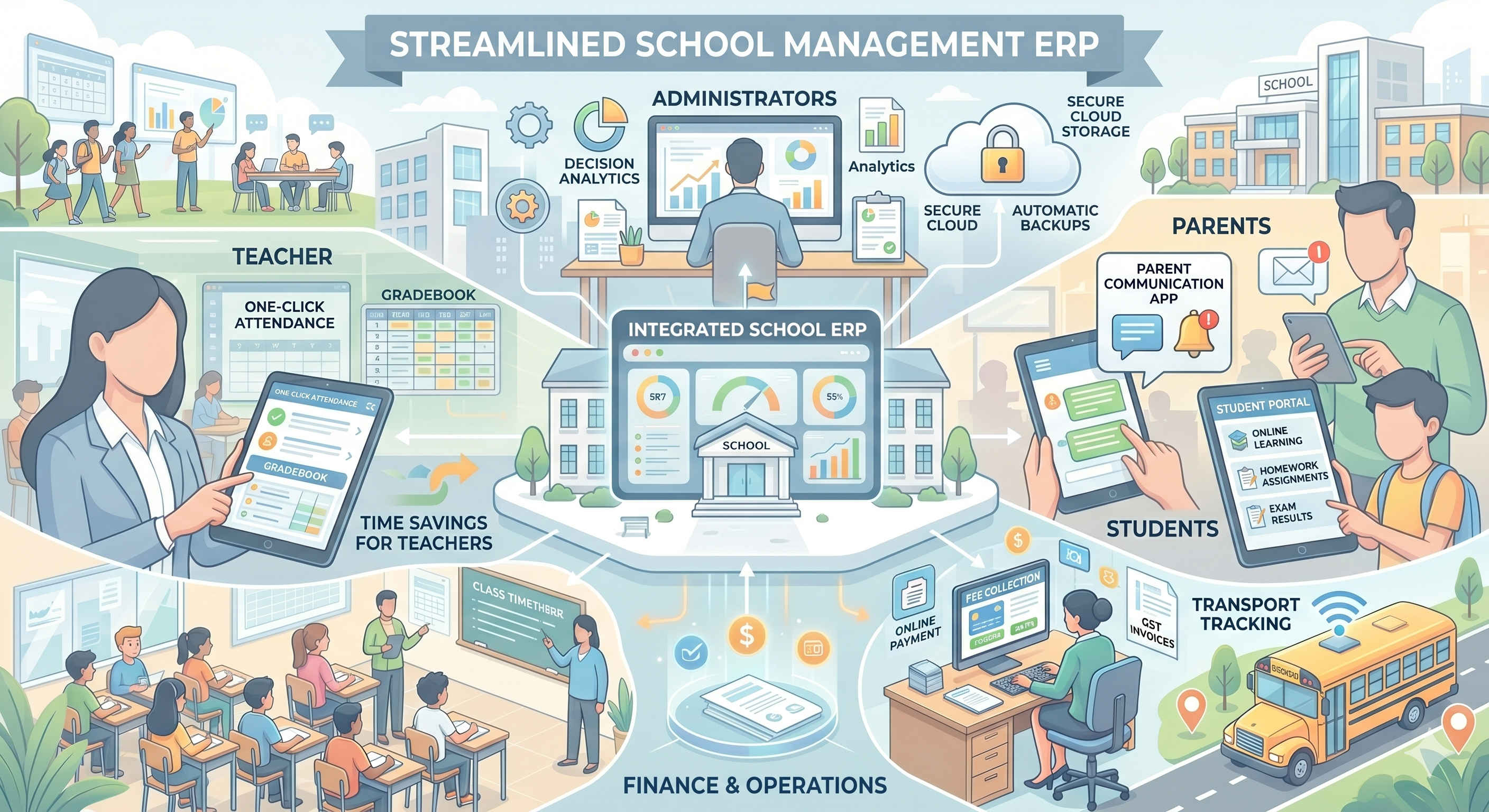
Schools today manage far more than classrooms and examinations. From admissions and fee collection to transport tracking and parent communication, educational institutions handle thousands of daily operations that require speed, accuracy, and transparency. This is where School Management Software becomes essential.
Modern schools are moving away from manual registers, spreadsheets, and disconnected systems toward centralized digital platforms that automate administration and improve academic efficiency.
What is School Management Software?
School Management Software is a digital platform designed to manage and automate school operations from a single dashboard. It helps schools handle:
- Student admissions
- Attendance management
- Fee collection
- Timetable scheduling
- Examination management
- Report cards
- Payroll and HR
- Parent communication
- Transport tracking
- Online learning integration
A cloud-based system allows administrators, teachers, students, and parents to access important information securely from anywhere.
Key Benefits of School Management Software
1. Centralized School Administration
One of the biggest advantages of school ERP software is centralized data management. Instead of maintaining separate systems for fees, attendance, exams, and communication, everything is available in one platform.
This reduces:
- duplicate work
- paperwork
- data inconsistencies
- administrative confusion
School administrators can access student records, academic reports, and operational insights instantly.
2. Faster Fee Collection and Financial Management
Manual fee collection often leads to:
- payment delays
- accounting errors
- reconciliation problems
School Management Software automates:
- online fee payments
- invoice generation
- reminders
- receipts
- pending fee tracking
This improves financial transparency and reduces workload for the accounts department.
Related feature:
- automated fee reminders
- GST invoices
- online payment integration
- transport and hostel fee management
3. Improved Parent Communication
Parents now expect real-time updates from schools.
A modern school communication system helps schools send:
- attendance alerts
- homework notifications
- exam schedules
- circulars
- fee reminders
- event announcements
Communication through mobile apps, SMS, email, and WhatsApp improves parent engagement and trust.
4. Better Attendance Tracking
Traditional attendance registers consume valuable classroom time and increase the possibility of errors.
Digital attendance systems enable:
- one-click attendance marking
- biometric integration
- RFID attendance
- parent alerts for absentees
- attendance analytics
Teachers save time while schools gain accurate attendance records.
5. Simplified Examination and Report Card Management
Managing exams manually is time-consuming for teachers and administrators.
School ERP software automates:
- exam scheduling
- marks entry
- grade calculations
- progress reports
- report card generation
This reduces administrative overhead and ensures faster result publishing.
6. Enhanced Data Security and Backup
Paper records and spreadsheets are vulnerable to:
- accidental deletion
- physical damage
- unauthorized access
Cloud-based School Management Software provides:
- encrypted storage
- automatic backups
- role-based access
- secure login systems
This protects sensitive student and staff information.
7. Time Savings for Teachers and Staff
Teachers often spend significant time on administrative tasks instead of teaching.
Automation helps reduce time spent on:
- attendance
- grading
- report preparation
- communication
- timetable management
This allows educators to focus more on student learning and classroom engagement.
8. Smarter Decision-Making Through Analytics
Modern platforms provide real-time reports and dashboards that help school management make informed decisions.
Schools can analyze:
- student performance trends
- fee collection status
- attendance patterns
- staff productivity
- admission growth
These insights improve operational planning and academic outcomes.
9. Better Student Experience
Students benefit from:
- easy access to schedules
- online assignments
- digital learning materials
- exam results
- communication tools
A connected digital ecosystem improves learning continuity and engagement.
10. Scalability for Growing Institutions
As schools expand, managing operations manually becomes increasingly difficult.
School Management Software supports:
- multi-campus operations
- centralized reporting
- department-wise access
- scalable student databases
This makes it easier for institutions to grow without operational complexity.
Why Schools in India Are Rapidly Adopting School ERP Systems
Indian schools are increasingly adopting digital platforms due to:
- NEP 2020 digital transformation initiatives
- increased parent expectations
- online learning integration
- operational efficiency needs
- competitive academic environments
Cloud-based school ERP systems help institutions modernize while reducing long-term administrative costs.
Features Schools Should Look For
When choosing School Management Software, schools should prioritize:
- cloud accessibility
- mobile apps
- fee management
- attendance automation
- examination management
- transport tracking
- parent communication
- analytics dashboards
- secure data storage
- integration capabilities
Final Thoughts
Educational institutions are no longer evaluated only by academic performance. Operational efficiency, communication quality, and digital readiness also play a major role in building trust with parents and improving student outcomes.
Implementing School ERP Software helps schools automate operations, improve transparency, save time, and deliver a better educational experience for students, teachers, and parents alike.
As education continues to evolve digitally, School Management Software is becoming a necessity rather than an optional upgrade.
Transform Your School Operations with Smart School Management Software
Automate admissions, attendance, fees, exams, communication, and administration with an all-in-one cloud-based School ERP platform designed for modern schools.
Book a DemoFrequently Asked Questions
What is School Management Software?
School Management Software is a digital system that helps schools manage daily operations such as admissions, attendance, fees, examinations, report cards, communication, payroll, and transport from a centralized platform.
How does School Management Software help schools?
It helps schools automate administrative tasks, reduce paperwork, improve communication, manage student data efficiently, and save time for teachers and staff.
What are the main features of School ERP Software?
Common features include: Student information management Attendance tracking Online fee collection Examination management Report card generation Parent communication Timetable scheduling Payroll and HR management Transport tracking Mobile app access
Is School Management Software suitable for small schools?
Yes. Modern school ERP systems are scalable and can be used by small schools, large institutions, colleges, and multi-campus educational organizations.
Can parents access School Management Software?
Most platforms provide parent portals or mobile apps where parents can check attendance, fees, homework, exam results, announcements, and school updates in real time.
How does School ERP Software improve communication?
It enables schools to send instant notifications through mobile apps, SMS, email, and WhatsApp for attendance alerts, circulars, fee reminders, exam schedules, and announcements.
Is cloud-based School Management Software secure?
Yes. Cloud-based systems usually offer: encrypted data storage automatic backups role-based access control secure login authentication to protect student and school information.
Can School Management Software handle online fee payments?
Yes. Most systems support online payment gateways for fee collection, receipt generation, pending fee tracking, and automated reminders.
How does School Management Software help teachers?
Teachers can: mark attendance digitally manage assignments enter marks online generate report cards communicate with parents access academic reports easily This reduces manual work and saves time.
What is the difference between School ERP and School Management Software?
Both terms are often used interchangeably. However, School ERP Software generally refers to a more comprehensive platform that integrates academics, administration, finance, HR, and communication into one system.
Can School Management Software support multiple campuses?
Yes. Many modern platforms support multi-campus management with centralized reporting and administration.
Why are Indian schools adopting School ERP Software rapidly?
Schools in India are adopting digital platforms to improve operational efficiency, comply with modern education requirements, enhance parent communication, and streamline academic management.
How does School Management Software reduce paperwork?
The platform digitizes attendance, fee records, report cards, circulars, and administrative workflows, minimizing manual registers and paper-based processes.
What should schools consider before choosing School Management Software?
Schools should evaluate: ease of use cloud accessibility security mobile app support customization options reporting features customer support pricing integration capabilities