


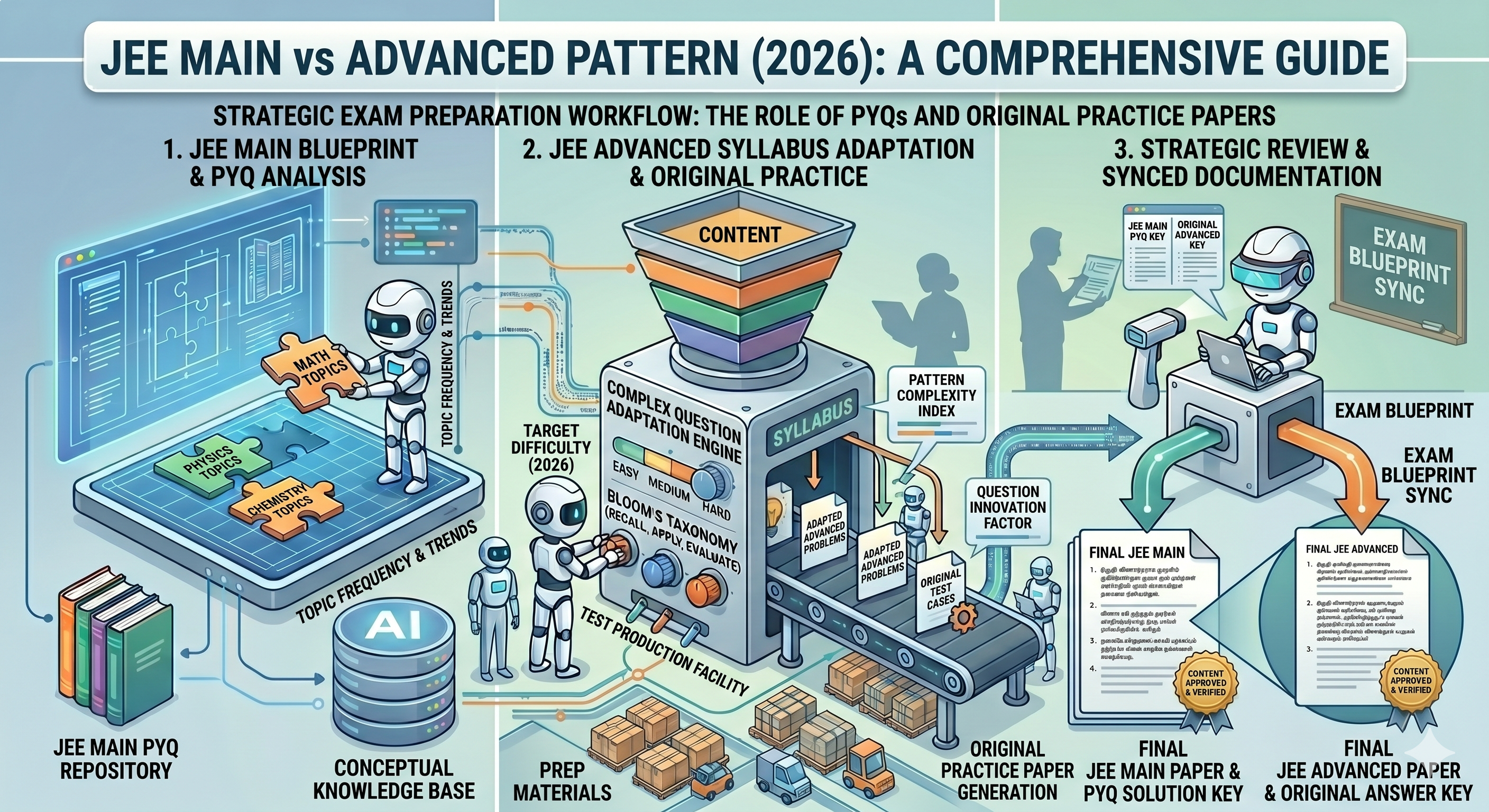
How the two JEE patterns differ, and why original (non-PYQ) practice papers matter more than re-solving past papers — with a fast way to build them.
JEE Main and JEE Advanced test the same three subjects but are structurally different exams. Main is fixed and predictable — 75 questions, 300 marks, +4/−1, the same shape every session. Advanced is deliberately unpredictable — two 3-hour papers with multiple question types and a marking scheme that changes year to year. That difference is exactly why relying only on past-year papers (PYQs) has limits, and why original practice papers earn their place.
JEE Main pattern (the fixed exam)
| Element | Detail |
|---|---|
| Subjects | Physics, Chemistry, Mathematics |
| Questions | 75 (25 per subject: 20 MCQ + 5 numerical) |
| Total marks | 300 |
| Marking | +4 correct, −1 wrong (MCQ and numerical) |
| Mode | Computer-based (CBT) |
| Duration | 3 hours |
Since 2025 the optional numerical questions were removed, so all 5 numericals per subject are compulsory and carry the same +4/−1 as the MCQs. Main rewards speed and accuracy on a known structure.
JEE Advanced pattern (the moving target)
JEE Advanced is intentionally harder to pattern-match. The fixed facts are few: two papers (Paper 1 + Paper 2), 3 hours each, computer-based. Everything else — question types and marking — shifts annually. Across recent years it has used single-correct MCQs, multiple-correct options, integer/numerical answers, matching/matrix questions and paragraph-based sets, with a mix of full negative, partial negative and partial-credit marking that's only confirmed on exam day.
The takeaway: you cannot "memorise" the Advanced format. Preparation has to train adaptability across question types, not just recall of past papers.
PYQs vs original practice papers — why both matter
Past-year questions are essential for calibration — they show the real difficulty ceiling and recurring concepts. But re-solving PYQs alone has three blind spots:
- Familiarity bias. Once a student has seen a PYQ, re-attempting it tests memory, not problem-solving.
- Finite supply. There are only so many past papers; serious aspirants exhaust them mid-prep.
- No coverage of unseen framings. Especially for Advanced, the value is in facing new questions on the same concepts.
This is where original (non-PYQ) practice papers matter: fresh questions, mapped to the same syllabus and difficulty, that test understanding rather than recall. The hard part is producing enough of them at exam-faithful quality.
Generating exam-pattern JEE papers fast
Building original JEE papers by hand — correct 20-MCQ + 5-numerical Main structure, or Advanced's mixed question types, each with proper marking and worked solutions — is slow. An AI JEE mock test generator produces both Mains and Advanced pattern papers (matrix-match, multiple-correct, paragraph-based, integer types) with +4/−1 marking and step-by-step solutions — so coaching staff can generate original, non-PYQ practice sets on demand instead of recycling the same past papers.
For institutes that also run medical batches, the same engine builds NEET pattern papers, and the broader AI question paper generator covers board and other exam formats.
Generate original JEE Main & Advanced papers in minutes
Build non-PYQ practice papers in exact Mains and Advanced patterns — with the right question types, +4/−1 marking and step-by-step solutions.
Book a DemoFrequently Asked Questions
What is the difference between JEE Main and JEE Advanced patterns?
JEE Main has a fixed structure — 75 questions (25 per subject, 20 MCQ + 5 numerical), 300 marks, +4/−1 marking. JEE Advanced has two 3-hour papers with multiple question types (single-correct, multiple-correct, integer, matching, paragraph) and a marking scheme that changes each year.
How many questions are in JEE Main 2026?
JEE Main Paper 1 (B.E./B.Tech) has 75 compulsory questions worth 300 marks — 25 each in Physics, Chemistry and Mathematics, comprising 20 MCQs and 5 numerical value questions per subject.
Is the JEE Advanced marking scheme fixed?
No. JEE Advanced uses partial-credit, partial-negative and full-negative marking that varies by question type and is confirmed on exam day, which is why preparation should cover varied question formats rather than a single pattern.
Are PYQs enough for JEE preparation?
Past-year questions are valuable for calibration but limited — they're finite, and re-solving them tests memory once seen. Original (non-PYQ) practice papers on the same syllabus and difficulty are needed to test genuine problem-solving, especially for Advanced.
How can coaching institutes create original JEE practice papers?
An AI JEE question paper generator builds fresh, non-PYQ papers in the correct Mains and Advanced patterns, with appropriate question types, marking and worked solutions — letting institutes produce unlimited original practice sets quickly.