


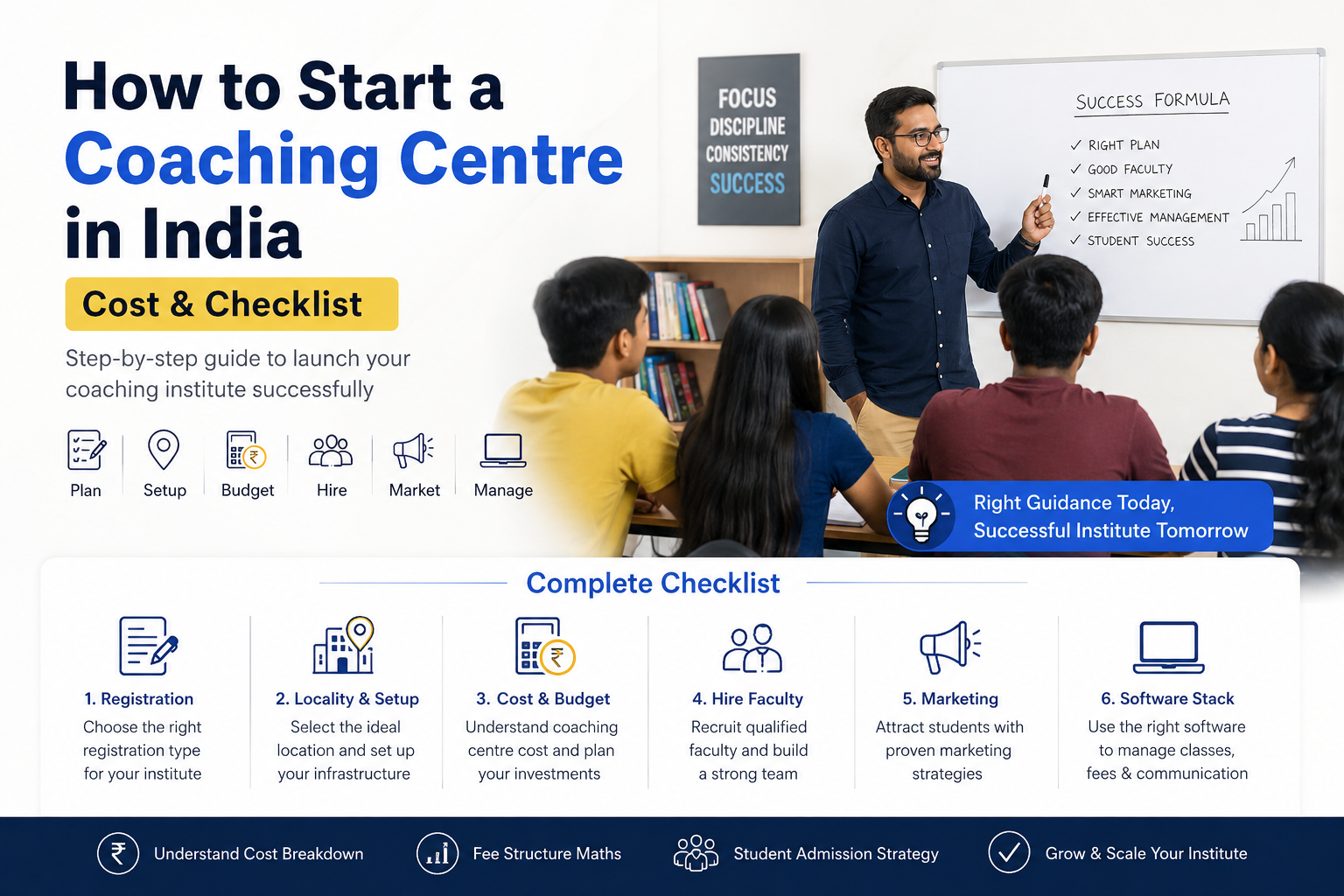
Starting a coaching centre in India is one of the lower-barrier businesses to enter and one of the harder ones to run well. There is no licence exam, no minimum capital, and no franchise you are forced to buy. What separates the centres that fill their batches from the ones that shut in eighteen months is rarely the teaching — it is the boring operational spine underneath: registration done correctly, a locality that actually has students, a fee structure that covers rent before it covers profit, and a system for chasing dues and keeping parents informed.
This guide walks through every step in the order you will actually face it, with realistic cost bands for 2026 and the compliance points most first-time owners miss. Costs below are indicative ranges that vary widely by city and scale — treat them as planning anchors, not quotes.
Quick answer: what it takes to start
A small tuition-style coaching centre can be started for roughly ₹1.5–5 lakh in a tier-2 or tier-3 city, covering a rented room or two, basic furniture, a signboard, and a couple of months of running costs. A mid-sized exam-coaching institute (JEE, NEET, banking, CA) with multiple batches, salaried faculty, and a proper front office typically needs ₹8–25 lakh to launch, largely because of higher rent in a coaching-friendly locality, faculty salaries you must pay before enrolments ramp, and marketing spend to fill the first cohort.
The single biggest cost most people underestimate is not setup — it is the three to six months of running costs you burn before batches are full. Budget for it explicitly.
Step 1: Decide your model before anything else
Everything downstream — locality, cost, hiring, pricing — is decided by this one choice. The common models:
Tuition / academic support centre. School-syllabus help across Classes 6–12, usually subject-wise, often near residential areas. Lower fees, higher volume, steady demand, less marketing needed. Easiest to start solo.
Competitive-exam coaching. JEE, NEET, UPSC, banking/SSC, CA, GATE, defence. Higher fees, longer course cycles, but you compete on faculty reputation and results. Needs more capital and stronger teachers. This is where most of the money — and most of the failures — sit.
Skill / language institute. Spoken English, IELTS, abacus, coding for kids. Level-based progression, shorter courses, high renewal potential.
Online or hybrid. Live classes plus in-person, or fully online. Lower rent, wider reach, but you compete with well-funded national platforms and need a reliable class-delivery setup.
Pick one clearly. "We'll do everything" is the most common early mistake — it dilutes your positioning and confuses parents about why they should choose you.
Step 2: The registration and legal checklist
You do not need a special "coaching licence" to teach, but you do need to register the business and comply with local rules. What applies depends on your scale and state.
Business registration. Choose a structure first:
- Sole proprietorship — simplest and cheapest, fine for a one-person tuition centre. Registered informally via a GST registration, Shops & Establishment registration, or Udyam (MSME) registration.
- Partnership / LLP — if you're starting with a co-founder.
- Private limited company — if you plan to raise money, add branches, or build a brand you may franchise later.
Shops & Establishment Act registration. Almost every commercial premises in India must register under the state Shops & Establishment Act with the local municipal authority. This is usually your baseline registration.
GST registration. Required once turnover crosses the threshold (₹20 lakh in most states, ₹10 lakh in special-category states). Coaching services are generally taxable — check current rates and your turnover position with a CA, since exemptions for certain education services are narrow and often misunderstood.
Udyam (MSME) registration. Free, quick, and useful for opening a current account and accessing MSME benefits.
Trade licence / fire & building safety. Your municipal corporation may require a trade licence, and larger premises need fire-safety clearance and building-safety certification. Do not skip this — it is exactly what gets checked when complaints arise.
PAN, current account, and signage. A business PAN and a dedicated current account keep finances clean from day one. Note the naming rule below before you order a signboard.
The Coaching Centre Guidelines 2024 — what actually applies to you
In January 2024, the Union Ministry of Education issued Guidelines for the Regulation of Coaching Centres. The most-discussed rule: coaching centres should not enrol students below 16 years of age, or only after they have passed the secondary (Class 10) examination. Other provisions include a ban on guaranteeing ranks or marks, a bar on misleading advertising, qualification requirements for tutors (at least a graduate degree), infrastructure and fire-safety norms, a mandatory website disclosing fees and refund policy, and a rule that only the phrase "registered coaching centre" may be used — not "recognised" or "approved."
The status you need to understand before building your plan: these are central-government guidelines, not a directly enforceable central law. Education sits on the Concurrent List, so they become binding only where an individual state adopts them or passes its own coaching regulation act. Enforcement therefore varies sharply by state — and some states have diverged. Rajasthan's Coaching Centres (Control and Regulation) Bill, 2025, for example, is widely reported to have dropped the under-16 enrolment restriction. States including Bihar, Goa, Uttar Pradesh and Manipur already had their own coaching regulations even before the 2024 guidelines.
What this means practically: check your own state's current rules before finalising your target age group and your marketing copy. If your model depends on coaching Class 8–10 students, confirm whether your state enforces the under-16 rule. Do not assume; the picture is still shifting in 2026, and this is the point most first-time owners get wrong. When in doubt, treat the safe-marketing rules — no guaranteed ranks, no "recognised/approved" wording, published fees and refund policy — as things to follow everywhere, because they are cheap to comply with and expensive to be caught violating.
Step 3: Choose the locality (this is a make-or-break decision)
Location determines both your rent and your enrolment ceiling. The trade-off is direct: a prime coaching-hub location fills batches faster but eats margin; a cheaper residential-area spot lowers cost but needs harder marketing.
Evaluate a prospective location on:
- Student catchment. Are there enough schools, colleges, or your target exam aspirants within a realistic travel radius? A NEET centre in an area with no science-stream students is a slow death.
- Competition. Some competition validates demand; being the tenth JEE centre on the same street does not.
- Accessibility. Public transport, parking, and safety for students travelling in evenings — parents weigh this heavily.
- Ground-floor visibility. A visible ground-floor unit is worth paying more for; it markets itself.
- Rent as a percentage of projected revenue. A common planning rule is to keep rent under roughly 15–20% of expected monthly revenue at reasonable occupancy. If the maths only works at 100% full batches, the location is too expensive.
Step 4: Do the fee-structure maths properly
This is where most business plans quietly fail. Work backwards from costs, not forwards from an aspirational fee.
List your monthly fixed costs: rent, faculty salaries, front-office/admin salary, electricity and internet, software, and marketing. Then your variable costs: printing, study material, exam/test costs.
Find your break-even. Divide total monthly cost by your fee-per-student to get the number of students you need just to break even. If break-even is 60 students and your room seats 40, the model is broken before you open.
A worked example for a small competitive-coaching batch:
| Line item | Monthly (indicative) |
|---|---|
| Rent | ₹40,000 |
| Faculty (2 part-time + 1 full-time) | ₹90,000 |
| Front office / admin | ₹18,000 |
| Utilities + internet | ₹8,000 |
| Software (management + comms) | ₹3,000 |
| Marketing | ₹15,000 |
| Total monthly cost | ₹1,74,000 |
At a fee of ₹3,000/month per student, break-even is 58 students. At ₹4,000/month, it drops to 44. That gap — 14 students — is the difference between a stressful first year and a comfortable one, and it comes purely from pricing, not from teaching harder. Price with your break-even in front of you.
Also decide your collection model early: monthly, quarterly, or full-course with instalments. Instalments improve conversion but create dues-chasing work — which is a real, recurring cost in staff time.
Step 5: Hire faculty and support staff
For exam coaching, faculty is the product. Parents and students choose centres on teacher reputation more than facilities. A few realities:
- Start lean. Part-time or per-lecture faculty for subjects with lower initial demand keeps your fixed cost down until batches justify a full-time hire.
- Qualification matters for compliance too. The 2024 guidelines expect tutors to hold at least a graduate degree — a sensible baseline regardless of enforcement.
- You need at least one non-teaching hire early. A front-office person who handles enquiries, follows up with walk-ins, collects fees, and answers parent calls pays for themselves by improving enrolment conversion. Founders who try to teach and run the front desk lose enquiries they never realise they lost.
Step 6: Marketing your centre — how to actually fill batches
Early marketing is local and trust-based, not clever:
- Google Business Profile. Free, and the first thing a parent finds when searching "coaching near me." Set it up before your signboard goes up.
- A simple website with fees and refund policy published. The 2024 guidelines effectively expect this, and parents increasingly research online before visiting.
- Local presence. Signage, pamphlet distribution near schools, and — most powerful of all — a free demo class. The demo converts far better than any ad because it lets teaching sell itself.
- WhatsApp for follow-up. Most enquiries don't enrol on the first contact. Structured follow-up — demo reminder, fee details, a nudge before the batch starts — is where enrolments are won or lost. Note that bulk promotional messaging in India runs through TRAI's DLT framework; keep marketing sends compliant rather than blasting from a personal number.
- Referrals and results. Once you have a first cohort, satisfied parents and visible results become your cheapest and best channel.
The recurring theme: the enquiries you lose are almost never lost because your teaching was bad. They're lost because nobody followed up.
Step 7: Set up your software and operations stack
Running batches on WhatsApp groups, a fee register, and a spreadsheet works for the first twenty students. It breaks somewhere around fifty — when you can no longer remember who paid, which batch is short a teacher today, and which parents haven't heard from you in three weeks.
A coaching management platform consolidates the operational spine: batch and timetable scheduling, digital fee collection with automatic reminders, attendance, test and progress records, and structured parent communication. The point isn't the software for its own sake — it's that the two things that quietly kill coaching centres are uncollected dues and parents who feel out of the loop, and both are exactly what a management system is built to prevent.
If you're evaluating tools, TutorDesk is built specifically for Indian coaching centres and tuition institutes — batch scheduling, UPI fee collection with automatic dues reminders, attendance and test tracking, and a parent app that sends progress updates without your office staff compiling them by hand. It's worth looking at the fee collection and admission enquiry CRM modules in particular, since dues and enquiry follow-up are the two operational leaks that cost the most in a centre's first year. Exam-specific setups are covered under the coaching institute management solution.
The realistic first-year timeline
- Months 1–2: Decide model, scout and lock the location, complete registrations, hire initial faculty, set up your website and Google Business Profile.
- Months 2–3: Run demo classes, market locally, enrol your first batch. Expect this to be slower than you hope.
- Months 3–6: Deliver well, collect fees on time, keep parents informed, and start building referral momentum. This is your burn period — the running-cost buffer from Step 1 keeps you alive here.
- Months 6–12: With a proven first cohort and visible outcomes, batches fill faster, referrals kick in, and unit economics turn positive.
Common first-year mistakes to avoid
- Underbudgeting the burn period. You will pay rent and salaries for months before batches are full. Fund this explicitly.
- Overpaying for a prime location when a good residential-area spot plus better follow-up would have worked.
- Pricing on gut feel instead of break-even maths.
- Guaranteeing ranks or results in ads — banned under the 2024 guidelines and a fast way to lose credibility.
- Ignoring dues until the gap is unrecoverable.
- No follow-up system for enquiries — the quiet, invisible cause of empty batches.
Filling batches is the easy part. Keeping fees and parents on track is what breaks centres.
See how TutorDesk handles UPI fee collection, automatic dues reminders and parent progress updates — built for Indian coaching centres. 20-minute demo on your own data, no card needed.
Book A DemoFrequently Asked Questions
How much does it cost to start a coaching centre in India?
Roughly ₹1.5–5 lakh for a small tuition-style centre in a smaller city, and ₹8–25 lakh for a mid-sized exam-coaching institute with salaried faculty and a proper front office. The most underestimated cost is the running-cost buffer for the three to six months before batches fill.
Do I need a licence to open a coaching centre?
There is no dedicated central "coaching licence." You do need business registration (proprietorship, LLP, or company), Shops & Establishment registration, GST if you cross the turnover threshold, and any trade licence or fire-safety clearance your municipality requires. Some states also have their own coaching-regulation acts.
Can I enrol students below 16 years of age?
The Union Ministry of Education's 2024 guidelines say coaching centres should not enrol students under 16. However, these are guidelines that become binding only where a state adopts or legislates them, and enforcement varies by state — some states have diverged from the rule. Confirm your own state's current position before finalising your target age group.
How do I decide my fees?
Work backwards from your total monthly costs to find how many students you need to break even, then check that number against how many your space and locality can realistically hold. Price so the model works at reasonable occupancy — not only at full batches.
What software do I need to run a coaching centre?
At minimum you need to manage batches and timetables, collect fees and chase dues, track attendance and tests, and keep parents informed. A coaching-specific platform such as TutorDesk consolidates these so you're not stitching together WhatsApp groups, a fee register, and spreadsheets once you pass fifty students.