


The NAAC Grading System Explained: A++ to C, the CGPA Bands, and What's Changing
If you have ever seen a college advertise itself as "NAAC A++ accredited" and wondered whether that actually means anything — it does. It is the highest grade a college could earn under India's main quality-assurance system, and for two decades it has been the single number students, parents and employers used to judge an institution.
But there is a complication you need to know before anything else: the grading system you are searching for is mid-transition. The familiar A++ to C scale was formally replaced in February 2025, yet as of mid-2026 the new system's portal still hasn't fully launched, and existing grades remain valid in the meantime. So this guide does two jobs. First, it explains the CGPA-based A++ to C system — because that is still what nearly every accredited college holds today, and it is what your search was probably about. Second, it explains the reform that is replacing it, so you are not caught out when a college's "grade" stops being a grade at all.
What NAAC is
NAAC is the National Assessment and Accreditation Council — an autonomous body under the University Grants Commission, established in 1994 and headquartered in Bengaluru. Its job is to assess whether a higher education institution meets defined quality benchmarks and to certify it accordingly. Think of it as the quality stamp for Indian colleges and universities.
Accreditation is voluntary in principle but matters enormously in practice: it affects a college's eligibility for grants, its credibility with students, and increasingly its access to autonomy and funding schemes. A good grade is a marketing asset; the absence of one is a red flag.
The legacy system: the 4-point CGPA scale and A++ to C
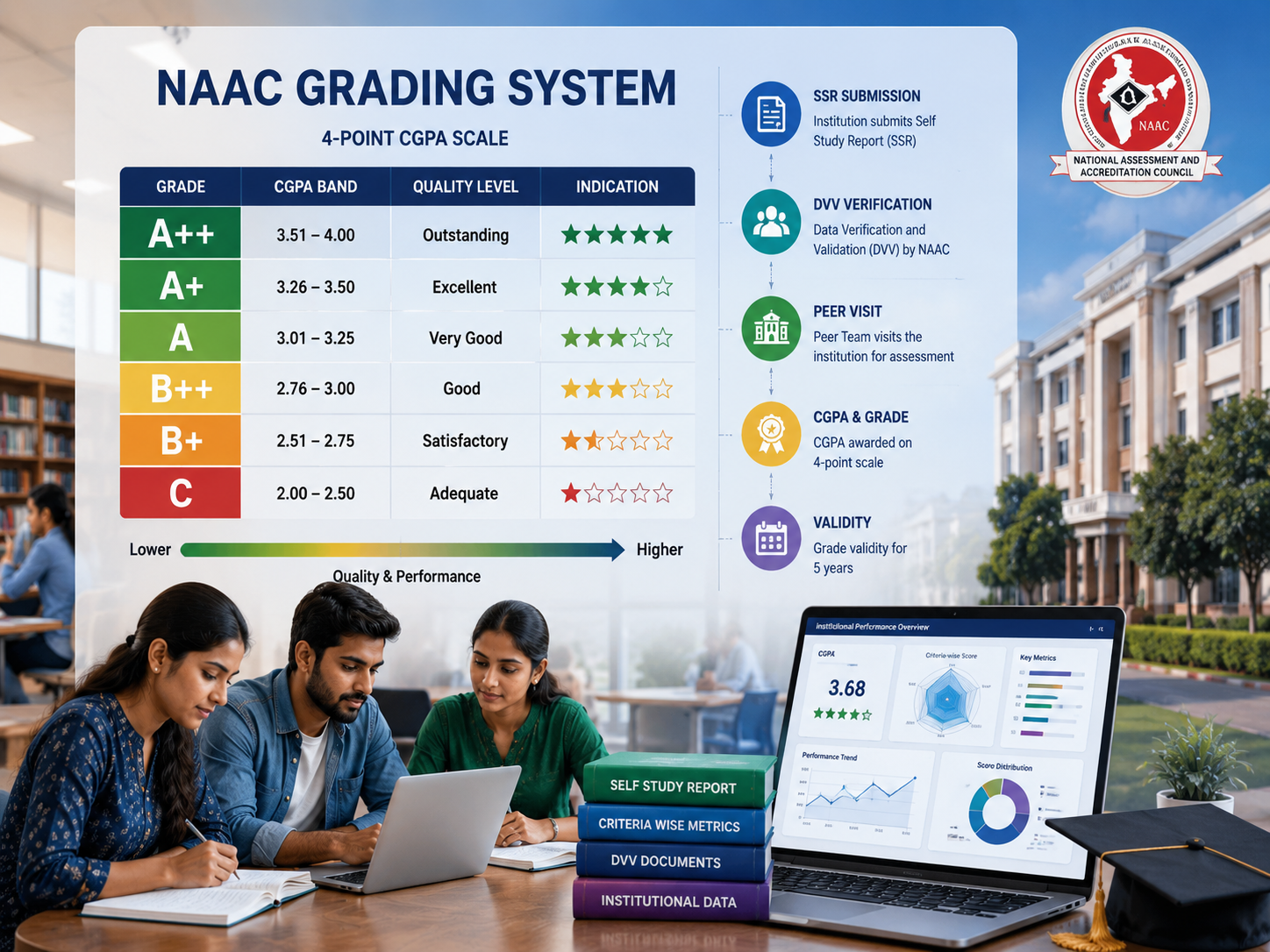
For the system most colleges are still graded under, NAAC evaluated institutions against a set of criteria, scored them, and converted the result into a Cumulative Grade Point Average (CGPA) on a 4-point scale. That CGPA then mapped to a letter grade. Here is the full ladder:
| Grade | CGPA range | Status |
|---|---|---|
| A++ | 3.51 – 4.00 | Highest |
| A+ | 3.26 – 3.50 | |
| A | 3.01 – 3.25 | |
| B++ | 2.76 – 3.00 | |
| B+ | 2.51 – 2.75 | |
| B | 2.01 – 2.50 | |
| C | 1.51 – 2.00 | Lowest accredited |
| D | ≤ 1.50 | Not accredited |
So when a college says it is "NAAC A++," it means it scored a CGPA of 3.51 or above — the top band. A grade of D meant the institution was not accredited at all; it had been assessed and fallen below the threshold.
This is the answer to the most common search behind this page: A++ is the best, C is the lowest passing grade, and D means failed. The whole scale sits on that single 4-point CGPA.
The seven criteria behind the score
The CGPA wasn't a guess — it was built from weighted scores across seven criteria that, together, describe institutional quality:
- Curricular Aspects
- Teaching-Learning and Evaluation
- Research, Innovations and Extension
- Infrastructure and Learning Resources
- Student Support and Progression
- Governance, Leadership and Management
- Institutional Values and Best Practices
Each criterion carried metrics, some quantitative (data you report) and some qualitative (described and evidenced). Their weighted sum produced the CGPA.
How the assessment process works: SSR and DVV
Two acronyms dominate every NAAC conversation, and they are worth understanding because they are where most of a college's effort goes.
SSR — Self Study Report. This is the institution's own comprehensive account of itself, submitted against the criteria above. The college compiles data, narratives and evidence — enrolment, faculty qualifications, research output, infrastructure, student outcomes — into a single structured report. It is the foundation document of the entire exercise, and assembling it accurately is the single biggest internal task an Institutional Quality Assurance Cell (IQAC) faces.
DVV — Data Validation and Verification. After the SSR is submitted, NAAC runs the quantitative claims through validation. The institution must back each data point with documentary proof; discrepancies are flagged, the college responds, and only validated data carries forward to scoring. DVV is where weak record-keeping gets exposed — a claim you cannot evidence is a claim that gets struck.
In the legacy flow, validated data fed a quantitative score, a peer team conducted a visit, and the combined result produced the CGPA and grade.
The DVV stage is precisely why colleges that keep clean, year-round records sail through and colleges that scramble at submission time suffer. Every metric — student progression, faculty data, event participation, research — has to be evidenced at source. CampusAlly's accreditation module is built to hold this evidence as it accumulates across the academic year, so that when the SSR is due the data is already validated-ready rather than reconstructed from scattered files under deadline pressure.
Validity period
A NAAC accreditation is not permanent. Under the legacy framework an accreditation grade was typically valid for five years, after which the institution had to undergo re-assessment in a fresh "cycle" (Cycle 1, Cycle 2, and so on). Letting a grade lapse without completing the next cycle means losing accredited status — which, under the new transition rules, can be costly (see below).
What's changing: Binary Accreditation and MBGL
Here is the part that makes everything above provisional.
On 10 February 2025, acting on the recommendations of the Dr. K. Radhakrishnan Committee, NAAC announced the biggest overhaul of its method since 2007. The single CGPA grade (A++ to C) is being replaced by a two-tier model:
Tier 1 — Binary Accreditation Framework. Instead of a letter grade, an institution is simply marked Accredited or Not Accredited, based on an AI-supported, document-verification-driven assessment. The intent is to reduce subjectivity and bias, speed up the process, and bring more institutions — especially smaller and regional colleges — into the fold.
Tier 2 — Maturity-Based Graded Levels (MBGL). This is optional and progressive. Already-accredited institutions can climb a five-level ladder describing institutional maturity:
| Level | Meaning |
|---|---|
| Level 1 — Basic | Meets minimum requirements |
| Level 2 — Developing | Shows progress and improvement |
| Level 3 — Established | Stable systems, consistent results |
| Level 4 — Advanced | Strong innovation, national leadership |
| Level 5 — Global Excellence | International standard, worldwide recognition |
The new process runs as a workflow — IIQA → SSR → DVV → AI-based assessment — across an expanded criteria set, leaning heavily on data validation rather than peer-visit subjectivity. SSR and DVV, notably, survive the reform; the grade is what disappears.
Where things actually stand in mid-2026
This is the honest, current picture — and it matters, because the gap between "announced" and "operational" is wide:
- The A++ to C CGPA grading is officially being phased out, but as of June 2026 the new system's portal has not fully launched and no confirmed national go-live date had been announced at the time of writing.
- Existing grades remain valid. Institutions in Cycle 2 and beyond under the Revised Accreditation Framework were allowed to retain their current grade until Binary Accreditation and MBGL are fully operational. So a college legitimately advertising "A++" today is not wrong — it holds a valid legacy grade.
- The transition has teeth. Under the changeover rules, an institution that lets its existing grade expire before completing the new accreditation can lose its accredited status entirely and have to start fresh — losing years of accumulated quality work. Colleges with grades expiring in 2026–27 are in a genuinely tight window.
The practical takeaway: for now, you will encounter both systems in the wild — colleges flaunting legacy A++/A+ grades, and the new Accredited/Not-Accredited-plus-MBGL language arriving as institutions re-accredit. Both are "NAAC." Neither is wrong. The letter grade is simply on its way out.
What each grade means for students
Cutting through it all, here is how to read a NAAC status when choosing a college:
- A++ / A+ (legacy): Top-tier quality assurance. Strong infrastructure, faculty, research and student support — the institution scored in NAAC's highest bands.
- A / B++ (legacy): Solidly accredited, good quality, just below the top.
- B+ / B (legacy): Accredited and meeting benchmarks, with clear room to improve.
- C (legacy): Accredited but at the lowest band — meets the minimum bar.
- D (legacy): Not accredited. The institution was assessed and did not clear the threshold.
- "Accredited" (new binary): The institution clears NAAC's quality benchmark. With no letter grade, look to its MBGL level (if it has opted in) to gauge how far beyond the minimum it goes.
- No NAAC status at all: The college has never been assessed, or its grade has lapsed. Worth asking why.
One caution for prospective students: a grade reflects the institution at its assessment date, and grades are valid for years. Always check when the grade was awarded and when it expires — an A+ from six years ago tells you less than an A from last year.
Quick reference
| Question | Answer |
|---|---|
| What does NAAC stand for? | National Assessment and Accreditation Council |
| Legacy scale | 4-point CGPA → letter grade, A++ (3.51–4.00) down to C (1.51–2.00); D = not accredited |
| Highest grade | A++ (CGPA 3.51–4.00) |
| Lowest accredited grade | C (CGPA 1.51–2.00) |
| SSR | Self Study Report — the institution's evidence-backed self-assessment |
| DVV | Data Validation and Verification — proof-checking of the SSR's data claims |
| Validity | Typically 5 years, then re-assessment in a new cycle |
| New system (Feb 2025) | Binary Accreditation (Accredited / Not Accredited) + optional MBGL Levels 1–5 |
| Status as of mid-2026 | Reform announced; portal not fully launched; existing grades still valid |
See CampusAlly run on your institution's data
A 30-minute walkthrough of NAAC AQAR documentation, semester exam management and the student portal — on your departments, your records. Free, no commitment.
Book A DemoFrequently Asked Questions
What is the highest NAAC grade?
A++, awarded for a CGPA between 3.51 and 4.00 on the legacy 4-point scale. Under the new binary system there is no letter grade — the top signal becomes MBGL Level 5 (Global Excellence).
Is NAAC A++ better than A+?
Yes. A++ (CGPA 3.51–4.00) sits above A+ (3.26–3.50), which sits above A (3.01–3.25). A++ is the top band.
What does NAAC grade D mean?
D meant the institution scored 1.50 or below and was not accredited — it was assessed and did not meet the benchmark.
How long is a NAAC grade valid?
Typically five years, after which the institution re-applies for a fresh assessment cycle. Letting a grade lapse during the current transition can mean losing accredited status entirely.
Is the A++ to C system still used?
It is being phased out as of February 2025 in favour of a binary Accredited/Not-Accredited model plus optional MBGL levels — but as of mid-2026 the new portal had not fully launched, and existing legacy grades remain valid. You will see both systems in use during the transition.
What's the difference between SSR and DVV?
The SSR is the report a college writes about itself; DVV is NAAC's process of verifying the data in that report against documentary proof. SSR is what you submit; DVV is what gets checked.