


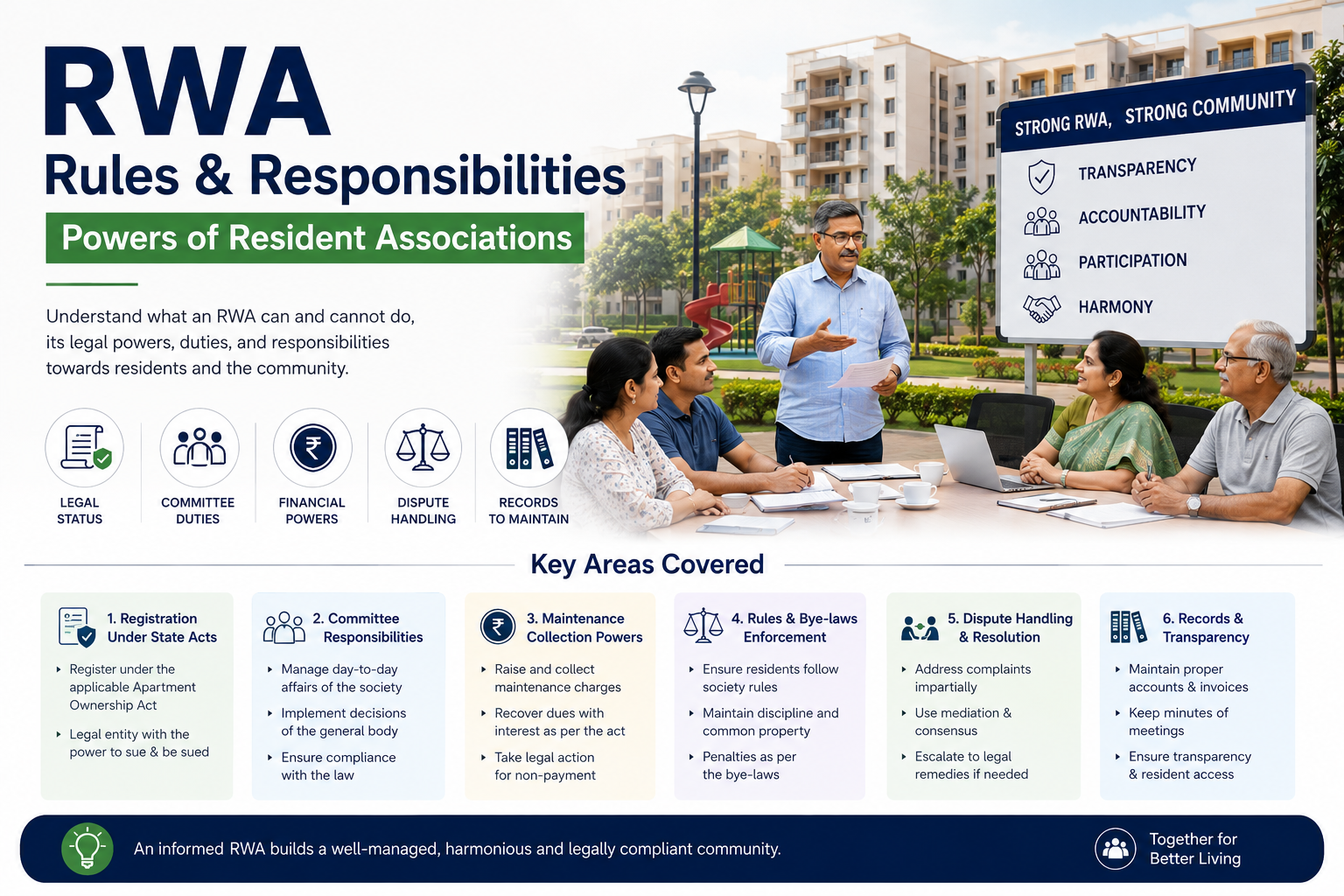
Almost every apartment complex and residential colony in India runs on a Resident Welfare Association — yet most residents, and even many of the office bearers who run them, are unclear on what an RWA is actually allowed to do. Can it cut off your water for unpaid maintenance? Can it stop your tenant from moving in? Can it ban pets, fine you for parking, or refuse you a No-Objection Certificate? The answers matter, because an RWA that overreaches invites disputes, and one that underperforms leaves the community poorly run.
This guide sets out what an RWA legally is, how it is registered, the real duties of its committee, the powers it does and does not hold, and the records it is obliged to keep. Because housing law in India is largely state-specific, the boundaries shift somewhat depending on where you live — but the core framework below applies broadly.
Quick answer: what an RWA can and cannot do
An RWA can: collect maintenance charges as per its bye-laws, maintain common areas and amenities, frame reasonable rules for shared spaces, enter into contracts with vendors and staff, hold and manage common funds, and sue or be sued as a body through its office bearers.
An RWA cannot: override a resident's fundamental rights, interfere with lawful ownership or possession of a flat, disconnect essential services like water as a penalty (courts have repeatedly frowned on this), unreasonably block a sale or tenancy, or act outside the powers written into its own bye-laws. An RWA is a voluntary body with contractual and administrative authority — not a government or a police force.
The single most important thing to understand: an RWA's powers come from its registered bye-laws and the state act it is registered under — not from what the committee decides in a WhatsApp group. If a rule isn't in the bye-laws and doesn't follow due process, its enforceability is shaky.
What exactly is an RWA?
A Resident Welfare Association is a body formed by the residents of a colony, apartment complex, or gated community to manage common affairs — maintenance of shared areas, security, utilities, amenities, and community matters. Once registered, it becomes a distinct legal entity: it can hold property, enter contracts, open bank accounts, and sue or be sued in the name of its office bearers.
It's important to distinguish three overlapping structures, because they carry different powers:
Resident Welfare Association (RWA) — typically registered under the Societies Registration Act, 1860 (as amended by individual states). It is a voluntary, resident-driven body. Common in colonies, plotted developments, and many apartment complexes.
Cooperative Housing Society — registered under a state Cooperative Societies Act (for example, the Maharashtra Cooperative Societies Act, 1960). These generally have a more structured and stronger control mechanism than a plain RWA, including over transfer of membership.
Apartment Owners' Association (AOA) — registered under a state Apartment Ownership Act, designed specifically for apartment buildings where owners hold their individual flats plus an undivided share in common areas.
People loosely call all three "the RWA," but the governing act determines what powers actually exist. Check which one your community is registered under — it's usually on the registration certificate — before assuming what the committee can do.
How an RWA is registered
Registration is what gives the association legal teeth. An unregistered residents' group has no standing to enforce decisions or hold funds cleanly.
The broad process under the Societies Registration Act, 1860:
- Minimum members. Generally at least seven persons must subscribe to form the society (some states and apartment acts specify different minimums).
- Memorandum of Association (MOA) and bye-laws. These founding documents state the association's name, objectives, and rules — including how committees are elected, how meetings run, how funds are handled, and how charges are levied. The bye-laws are the RWA's constitution; almost every power dispute traces back to them.
- Application to the Registrar of Societies. Documents are filed with the Registrar (or Assistant Registrar) of Societies in your jurisdiction, with the prescribed fee.
- Registration certificate. On approval, the Registrar issues a certificate and the association becomes a legal entity.
Two points worth knowing: under the Real Estate (Regulation and Development) Act, 2016 (RERA), a builder is generally required to facilitate formation of the association within a specified period after a majority of units are booked or handed over — so owners can insist on it rather than leaving the builder in perpetual control. And requirements genuinely differ by state, so confirm the exact minimum members, documents, and applicable act for your location before filing.
The committee: office bearers and their duties
An RWA is run by an elected Managing Committee (MC), usually comprising a President, Vice-President, Secretary (Honorary Secretary), Treasurer, and executive members. Their duties, in practice:
- President — presides over general body and committee meetings, provides leadership, and often has a casting vote in a tie.
- Secretary — the operational and legal face: convenes meetings, records and maintains minutes, handles correspondence, and files statutory returns such as the list of office bearers with the Registrar.
- Treasurer — maintains accounts, oversees collection of maintenance and funds, manages the bank account, and presents financial statements to members.
- Committee members — share responsibility for decisions, oversight of vendors and staff, and community matters.
Committees are elected by the general body — the full set of members — usually at the Annual General Meeting (AGM), for terms defined in the bye-laws. The office bearers act as trustees of the community's money and interests; they are accountable to the general body, not above it.
Powers an RWA does have
Within the four corners of its bye-laws and the governing act, an RWA can legitimately:
Collect maintenance and levy charges. The RWA determines and collects maintenance (often called Common Area Maintenance or CAM), sinking fund, and repair fund contributions from members as per its bye-laws. It can charge interest or late fees on defaults if the bye-laws provide for it.
Maintain and manage common areas. Lifts, corridors, lighting, water supply lines, drainage, gardens, security, and amenities like the clubhouse or pool fall under its charge.
Frame reasonable rules for shared spaces. Rules on the use of common areas, guest parking, amenity timings, noise, and similar matters — provided they are reasonable, applied uniformly, and grounded in the bye-laws.
Enter contracts and hire. Appoint and pay security agencies, housekeeping, and maintenance vendors and staff, and hold them accountable — while itself complying with labour and tax rules (minimum wages, ESI, EPF, GST where applicable).
Hold and manage funds and property. Operate bank accounts and manage common funds and assets on behalf of members.
Take and pursue legal action. As a registered entity, sue or be sued through its office bearers to protect community interests.
Powers an RWA does NOT have (the common overreach)
This is where most disputes arise. An RWA generally cannot:
Disconnect essential services as punishment. Cutting off a resident's water or other essential supply to force payment of dues has been repeatedly disapproved by courts and consumer forums. Recovery of dues has to go through proper channels, not coercion.
Override ownership or block a sale. An RWA cannot stop an owner from selling their flat. On No-Objection Certificates, its role is generally limited to confirming dues status — it cannot indefinitely withhold an NOC to obstruct a legitimate transaction, though bye-laws may require dues to be cleared.
Unreasonably bar tenants. While an RWA can ask for tenant registration and police verification for security and record-keeping, a blanket refusal to allow renting, or discrimination on grounds like religion, diet, or marital status, is on weak legal ground and has drawn court criticism.
Infringe fundamental rights. An RWA cannot curtail a resident's right to privacy, free speech, or lawful use of their own property. It is a welfare body, not a regulator of personal conduct inside private homes.
Act outside its bye-laws or without due process. Fines, penalties, and rules that aren't provided for in the bye-laws, or that are imposed without notice and a fair hearing, are difficult to enforce. "The committee decided" is not, by itself, a legal basis.
Make decisions that need the general body. Major matters — significant expenditure, bye-law amendments, large contracts — typically require general body approval, not just a committee resolution. Bye-law amendments themselves follow the procedure set out in the governing act.
How RWA disputes are handled
When a resident and the RWA clash, the escalation path generally runs:
- Internal grievance. Raise it in writing with the committee and, if unresolved, before the general body.
- Registrar of Societies. Complaints about mismanagement, misuse of funds, or improper conduct of office bearers can be taken to the Registrar under whose jurisdiction the society is registered.
- Consumer forum. Where the RWA provides deficient service (for example, wrongful disconnection), residents have approached consumer forums.
- Civil court. Residents can seek injunctions or other relief; suits are filed against the President or Secretary in their capacity as office bearers.
- Police / criminal complaint. Where there is theft, misappropriation, or fraud in handling funds, a police complaint and criminal proceedings are possible.
The recurring lesson from disputes: associations that keep clean records, follow their bye-laws, give proper notice, and decide through the general body rarely lose these fights. Those that act arbitrarily usually do.
Records an RWA is required to keep
Good record-keeping is both a legal obligation and the RWA's best protection in any dispute or audit. At minimum, an association should maintain:
- Registration certificate, MOA and bye-laws (and any amendments filed with the Registrar).
- Register of members and current office bearers, with the statutory list filed with the Registrar as required.
- Minutes of general body and committee meetings, including AGM minutes and resolutions.
- Books of account — maintenance collection, expenses, sinking and repair funds, bank statements — and audited financial statements.
- Vendor and staff records — contracts, AMCs, wage and statutory compliance (ESI/EPF) records.
- Notices and correspondence, including AGM notices issued within the bye-law notice period.
- Grievance and complaint records with how each was resolved.
Poor records are the most common reason RWAs struggle at audit, lose disputes, or face allegations of fund mismanagement. Reconstructing three years of accounts from a shoebox of receipts the week before an audit is a familiar and avoidable ordeal.
Running an RWA well: from paperwork to platform
Most of the failures above — unenforceable rules, dues disputes, missing minutes, opaque accounts — are record-keeping and communication failures dressed up as legal problems. An RWA that bills maintenance transparently, sends proper notices, records every AGM decision, and can produce clean accounts on demand is one that rarely ends up in front of the Registrar.
That operational spine is exactly what a society management platform is built to hold. EstateDeck's RWA and apartment association software brings maintenance billing, AGM and committee records, complaint tracking, and society accounting into one system — so the association's decisions and money leave a clean, defensible trail rather than living in WhatsApp groups and paper registers. The maintenance billing module handles per-unit invoices, fund splits, and reminders, while governance keeps AGM notices, minutes, and voting records audit-ready. For committees that dread the annual audit, that trail is the difference between a smooth sign-off and a scramble.
Run your association without the shoebox of receipts.
See how EstateDeck handles UPI maintenance collection, dues reminders, complaint tracking and AGM records — built for Indian RWAs and apartment associations. 20 minutes, no commitment.
Book A DemoFrequently Asked Questions
Can an RWA cut off water or power for non-payment of maintenance?
Disconnecting essential services as a penalty has been repeatedly disapproved by courts and consumer forums. An RWA should recover dues through proper channels — reminders, interest/late fees if the bye-laws allow, and legal action — not by cutting off water or electricity.
Can an RWA stop me from selling or renting my flat?
No. An RWA cannot bar an owner from selling. For an NOC, its role is generally limited to confirming dues status. It can require tenant registration and police verification, but a blanket ban on renting, or discrimination against tenants, stands on weak legal ground.
Under which law is an RWA registered?
Most RWAs register under the Societies Registration Act, 1860, as amended by individual states. Cooperative housing societies register under a state Cooperative Societies Act, and apartment owners' associations under a state Apartment Ownership Act. Requirements vary by state.
Are RWA rules and fines legally binding?
Only if they are provided for in the registered bye-laws and imposed with proper notice and due process. Rules invented by the committee that aren't in the bye-laws, or penalties imposed without a fair hearing, are difficult to enforce.
Who can I complain to about my RWA?
Depending on the issue: the general body internally, the Registrar of Societies for mismanagement or fund misuse, a consumer forum for deficient service, a civil court for injunctive relief, or the police where there is theft or misappropriation of funds.
Is it mandatory to form an RWA?
Under RERA 2016, builders are generally required to facilitate forming an association within a set period after a majority of units are handed over. It is strongly advisable, since only a registered body can hold funds, enforce decisions, and represent residents legally.