Databus Logo
Blog Login →
The Fee Cash-Flow Playbook for Coaching Institutes

Half the batch on instalments, a quarter overdue, and the accounts head couldn't say which dues were oldest.

This is the playbook that turns a fee mess into a cash-flow you can read — instalment plans per batch, dues aged current / 30 / 60 / 90, the oldest chased first — and it does it without ever locking a student out of class over money.

For the accounts head · cut defaults · receivable aging · consent-based reminders · funds settle to your own account, not ours.
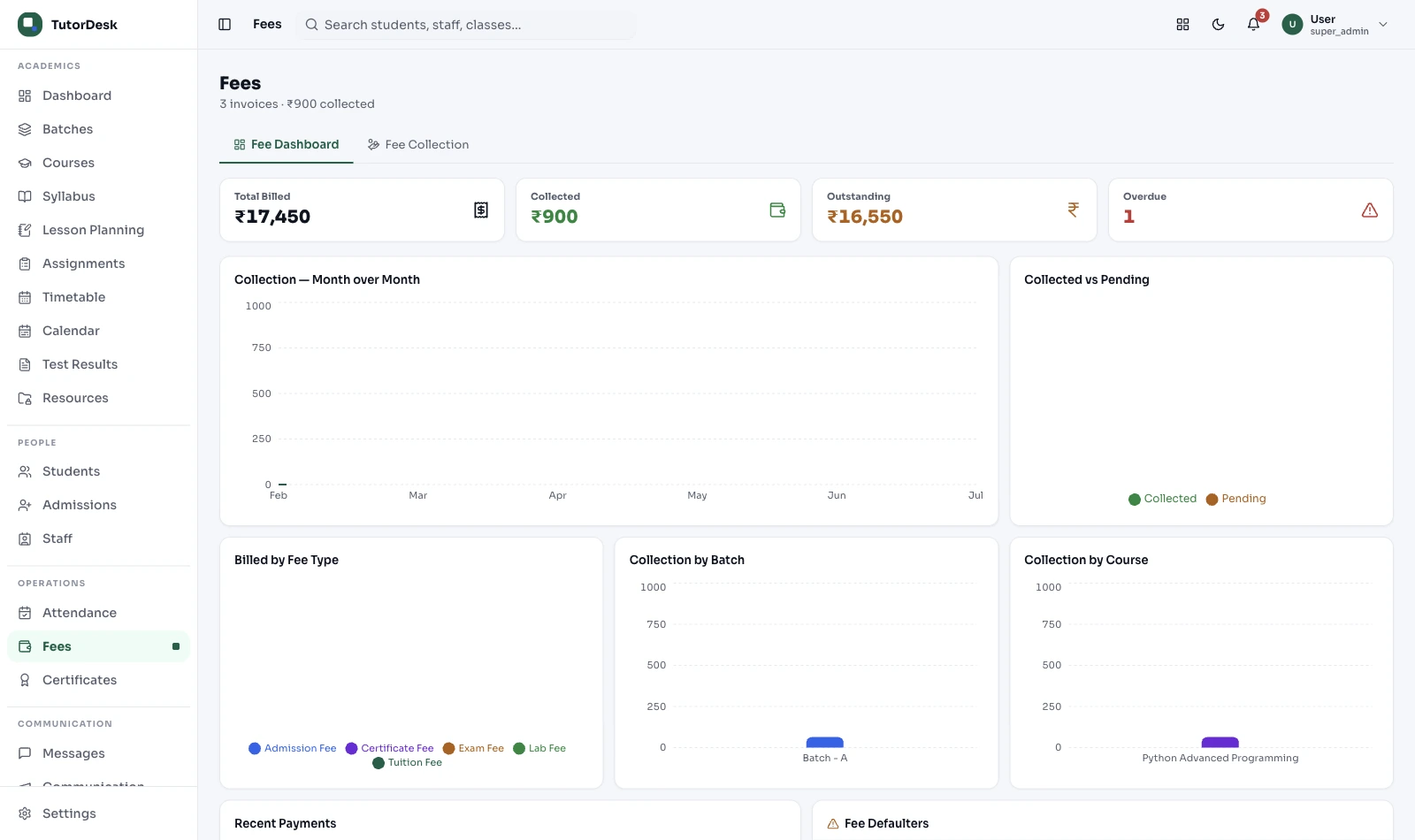
See the aging view →
In plain English

Coaching fee & finance management is how an institute structures fee plans, tracks who owes what, recovers overdue dues, and protects its cash-flow across a session. This page is the buyer-outcome playbook for the accounts head — instalment plans per batch, ageing dues current / 30 / 60 / 90 days (the RBI receivable-aging convention) to chase the oldest first, and consent-based DLT reminders that nudge rather than harass. On the money itself: payments run through an integrated RBI-authorised aggregator (PA-O), funds settle to your institute's own bank account, and TutorDesk records and reconciles but never holds or settles your money. The underlying payment rail — UPI/card acceptance, receipts, the gateway — is the Payments feature. School fees are a separate SchoolDeck solution; society finance is a separate EstateDeck solution.

30 / 60 / 90
dues aged by bucket
chase the oldest first
Per batch
instalment plans
that match how families pay
Your account
funds settle to you, not us
RBI-authorised gateway (PA-O)
Never gated
an unpaid fee never locks
a student out of learning
A real month-end · NEET + Foundation batches · receivable aging

The view that turns one scary "pending" number into a plan.

Mrs Verma's institute had ₹6.4 lakh "pending" on the dashboard — a number that told her nothing. Aged into buckets, the same figure becomes a plan: most of it is current and will clear on schedule; the real risk is a small, old tail that needs a personal call today.

Receivable aging · As on month-end · All active batches Reconciled
Age bucketOutstandingWhat it meansAction
Current (not yet due)₹3,80,000Instalments due next cycle · on schedule✓ Let reminders run
1–30 days overdue₹1,42,000Recently slipped · usually clears with a nudge✓ DLT due-date nudge
31–60 days overdue₹68,000Needs attention before it hardens⚠ Personal follow-up
61–90 days overdue₹34,000At real risk of becoming a write-off▲ Call this week
90+ days overdue₹16,000Oldest tail · highest write-off risk▲ Chase first, in person
Total outstanding₹6,40,000Same number — now with a priority order→ Work bottom-up
The ₹6.4 lakh never changed. What changed is that Mrs Verma now works the ₹16,000 90-day tail before the ₹3.8 lakh that will clear on its own — recovery effort goes where the actual risk is, and no student was threatened with being pulled from class to make it happen.
Where coaching cash-flow quietly bleeds

Four ways a healthy-looking institute runs short of cash.

One undifferentiated "pending"

The dashboard says ₹6 lakh pending. Is that mostly next week's instalments, or year-old write-offs? Without aging, you can't tell — so you either panic or ignore it, and both are wrong.

The rigid lump-sum that backfires

Demanding the full year's fee up front feels safer. In practice it pushes a family that could have paid monthly into avoidance — and a silent parent pays nothing at all.

The reminder that became harassment

A daily auto-message to every defaulter feels like action. It isn't DLT-compliant, it annoys the parents who'd have paid anyway, and it makes the institute look desperate.

The fee used as a weapon on a child

Locking a student out of class or a test over an unpaid instalment punishes the child for an adult's cash-flow — and it's the fastest way to lose the family entirely.

The playbook

Five steps, run every collection cycle.

1

Structure instalments per batch

Set a fee plan per batch — full payment, two or three instalments, or monthly — with clear due dates. A realistic plan that matches a family's cash-flow collects more than a rigid lump-sum demand. The rail that actually accepts the payment is the Payments feature; this playbook is how you use it.

2

Age every pending due

Group outstanding fees by age — current, 30, 60, and 90+ days — using the RBI receivable-aging convention. This one view tells the accounts head where the real risk sits, instead of one undifferentiated "pending" pile.

3

Chase the oldest first

Work the 90-day bucket before the 30-day one. The oldest dues are the most likely to become write-offs, so they get a personal follow-up, not just an automated nudge.

4

Remind with consent, not harassment

Routine reminders go out on consent-based, DLT-registered templates under TRAI TCCCPR 2018 — a due-date nudge and a measured overdue note, delivered over the Secure Chat channel, never a daily barrage.

5

Reconcile monthly, keep learning open

At month-end, reconcile what came in against what was due, by batch. An unpaid instalment never locks a student out of class, materials, or a test — the fee schedule and the student's learning stay two separate conversations.

How the money actually moves

TutorDesk records your fees. It never holds them.

Step 1

Parent pays

The parent pays online through an integrated RBI-authorised payment aggregator (under the RBI PA-O framework), or in cash/cheque recorded at the desk.

Step 2

Gateway settles to you

For online payments, the licensed aggregator processes the transaction and settles the funds into your institute's own bank account on its settlement cycle.

Step 3

TutorDesk reconciles

TutorDesk records the payment against the fee due, updates the aging view, and reports on it — but does not hold, route, or settle your money.

Plainly: the regulated payment aggregator moves the money; TutorDesk is the record and the reconciliation. Online gateway transaction charges are the payment provider's, disclosed up front — not a TutorDesk fee. The deeper mechanics of acceptance and receipts live on the Payments feature.
What this playbook owns · what it deliberately doesn't

Four pages meet around fees.
This one owns the cash-flow playbook; the rail, the record, school fees, and society finance live elsewhere.

TutorDesk keeps the finance outcome and its underlying payment rail as separate pages on purpose — and keeps coaching cash-flow distinct from the school and society finance pages that share the slug.

This page owns

  • The cut-defaults / cash-flow playbook for the accounts head of a coaching institute.
  • Instalment-plan strategy per batch — matching how families actually pay.
  • Receivable aging (current/30/60/90) and the chase-oldest-first method.
  • Reminder strategy — consent-based cadence vs harassment.
  • RBI PA-O money-flow transparency — funds settle to your account; TutorDesk reconciles, doesn't hold.
  • The never-gate-learning-on-fees principle.

This page defers to

  • The payment rail — UPI/card/net-banking acceptance, receipt generation, the gateway integration — lives in TutorDesk Payments (feature). This page is the playbook; that page is the rail.
  • The canonical student record each fee status attaches to — lives in Student CRM.
  • K-12 school fees — term fees, transport, board-linked structures, Tally sync — is a different workflow in SchoolDeck Fee & Finance. This page is coaching only.
  • Society / property finance — maintenance billing, sinking funds, owner statements — is a different workflow in EstateDeck Accounting & Finance.
Three cash-flow realities in Indian coaching

The same playbook, at three different scales.

The method holds; the size of the receivable and the depth of the reconciliation scale with the institute.

Single tutor / small centre

The tutor is also the accountant

A handful of batches, fees mostly monthly. A light version — set instalments, let due-date reminders run, glance at the 60+ bucket once a month — keeps cash-flow steady without a finance team.

Single-exam institute

NEET/JEE batch on instalments

High-ticket annual fees split across the session. Receivable aging is the core tool here — a few large dues sliding into the 90-day bucket is exactly the risk that aging surfaces before it becomes a write-off.

Multi-branch institute

An accounts head across centres

Several branches, hundreds of students, a real receivables book. The full playbook with per-branch aging and monthly reconciliation lets the accounts head see which branch is leaking cash — feeding the multi-branch oversight view.

From the field

Surat, Gujarat · multi-subject tuition · two sessions in.

"I'm the accounts head, and for years 'pending fees' was a single number I was scared to look at. It was always large and I could never tell whether it was about to clear or already lost. The first time I saw our dues aged into buckets, the fear went away — most of it was current, and the part that actually mattered was a small tail of old dues I could fit on one screen. I started calling those families personally and letting the system send the gentle reminders to everyone else. The other thing I want to say, because a salesman once pitched me the opposite: we never stop a child from sitting a test because a parent is late on a payment. This platform doesn't push you to. The dues are tracked, the oldest get a real conversation, and the money lands in our own bank account — TutorDesk never touches it. Two sessions in, my write-offs are down and, honestly, so is my blood pressure."
Anjali Verma Accounts Head · multi-subject tuition institute · Surat-395007, Gujarat
RBI PA-O money-flow (funds settle to institute account) · receivable aging current/30/60/90 · consent-based DLT reminders · two sessions on TutorDesk
Quick answers

Coaching fees & cash-flow, asked and answered.

What every accounts head and centre director asks before they change how fees are run.

What is coaching fee & finance management?
It is how an Indian coaching institute structures fee plans, tracks who owes what, recovers overdue dues, and protects its cash-flow across a session. This solution page is the buyer-outcome playbook for the accounts head — instalment plans per batch, ageing dues current/30/60/90, chasing the oldest first, consent-based reminders, and a monthly reconciliation view. The underlying payment rail that actually accepts UPI/card/net-banking and generates receipts is the separate TutorDesk Payments feature.
How is this different from the TutorDesk Payments feature?
The Payments feature is the rail — how UPI, card, and net-banking acceptance work, how receipts are generated, how the gateway integration is wired. This solution page is the playbook — how an accounts head uses that rail to actually cut defaults: how to structure instalments, how to read receivable aging, which dues to chase first, how to reconcile a month. If you want to see how the payment mechanism works, read the Payments feature; if you are responsible for the institute's cash-flow and bad-debt, this is the page.
Does TutorDesk hold or settle our fee money?
No. Online payments are processed through an integrated RBI-authorised payment aggregator (under the RBI PA-O framework). The funds settle directly into the institute's own bank account on the payment provider's settlement cycle. TutorDesk records the transaction, reconciles it against the fee due, and reports on it — but TutorDesk does not hold, route, or settle your money. The online gateway's transaction charges are the payment provider's, disclosed up front, not TutorDesk's.
What is receivable aging and why does it matter for a coaching centre?
Receivable aging groups your outstanding fees by how long they have been overdue — current, 30 days, 60 days, and 90+ days — following the RBI receivable-aging convention. It matters because not all "pending" fees are equal: a due that has aged past 90 days is far more likely to become a write-off than one that is two days late. Seeing dues bucketed by age lets the accounts head spend recovery effort where the actual risk is, instead of treating one large undifferentiated "pending" figure.
Can we split fees into instalments per batch?
Yes. Each batch can carry its own fee plan — full payment, two or three instalments, or monthly — with defined due dates. A realistic instalment plan that matches how families actually pay collects more reliably than a rigid lump-sum demand, which is often what pushes a parent into avoidance. The plan you set is what the reminders, the aging view, and the monthly reconciliation all work from.
How do reminders work without harassing parents?
Reminders run on consent-based, DLT-registered transactional templates under TRAI TCCCPR 2018 — a due-date nudge and a measured overdue note, not a daily barrage. The parent has agreed to receive them, and the cadence is deliberately light. The point of the playbook is to make paying easy and the due visible, never to shame or pressure a family. For the oldest dues, the playbook favours a personal conversation over more automated messages.
Will a student be blocked from class if a fee is unpaid?
No — and the playbook is explicit about this. A coaching institute should never gate a child's classes, study materials, or tests purely on an unpaid instalment. The fee schedule and the student's learning are kept as two separate conversations: dues are tracked and recovered through reminders and follow-up, but a student is not locked out of learning over money. Withholding a minor's education as leverage for a payment is a line the platform does not help cross.
Is this for school fees or society maintenance too?
No. This page is specifically for coaching and tuition cash-flow — batch-based fee plans, coaching dues, the accounts head of an institute. K-12 school fees (term fees, transport, board-linked structures, Tally sync) are a separate SchoolDeck solution, and society or property finance (maintenance billing, sinking funds, owner statements) is a separate EstateDeck solution. The three are kept apart because a coaching batch instalment, a school term fee, and a society maintenance charge are genuinely different financial workflows.
Where does the collected fee data live afterwards?
Each student's fee status — what was due, what was paid, what is outstanding — attaches to their record in the TutorDesk Student CRM, the canonical post-admission student profile. The fee plan and the aging view here read from and write to that record. Reminder messages are delivered over the Secure Chat channel. This solution owns the cash-flow playbook; the student record and the message channel are separate modules it works with.

Stop staring at one scary "pending" number.
Start working the cash-flow.

We'll walk you through instalment plans, the receivable-aging view, the consent-based reminder cadence, and exactly how the money settles to your account — in a 20-minute demo built for your institute's fee structure.

Book the Fee & Finance Demo →