


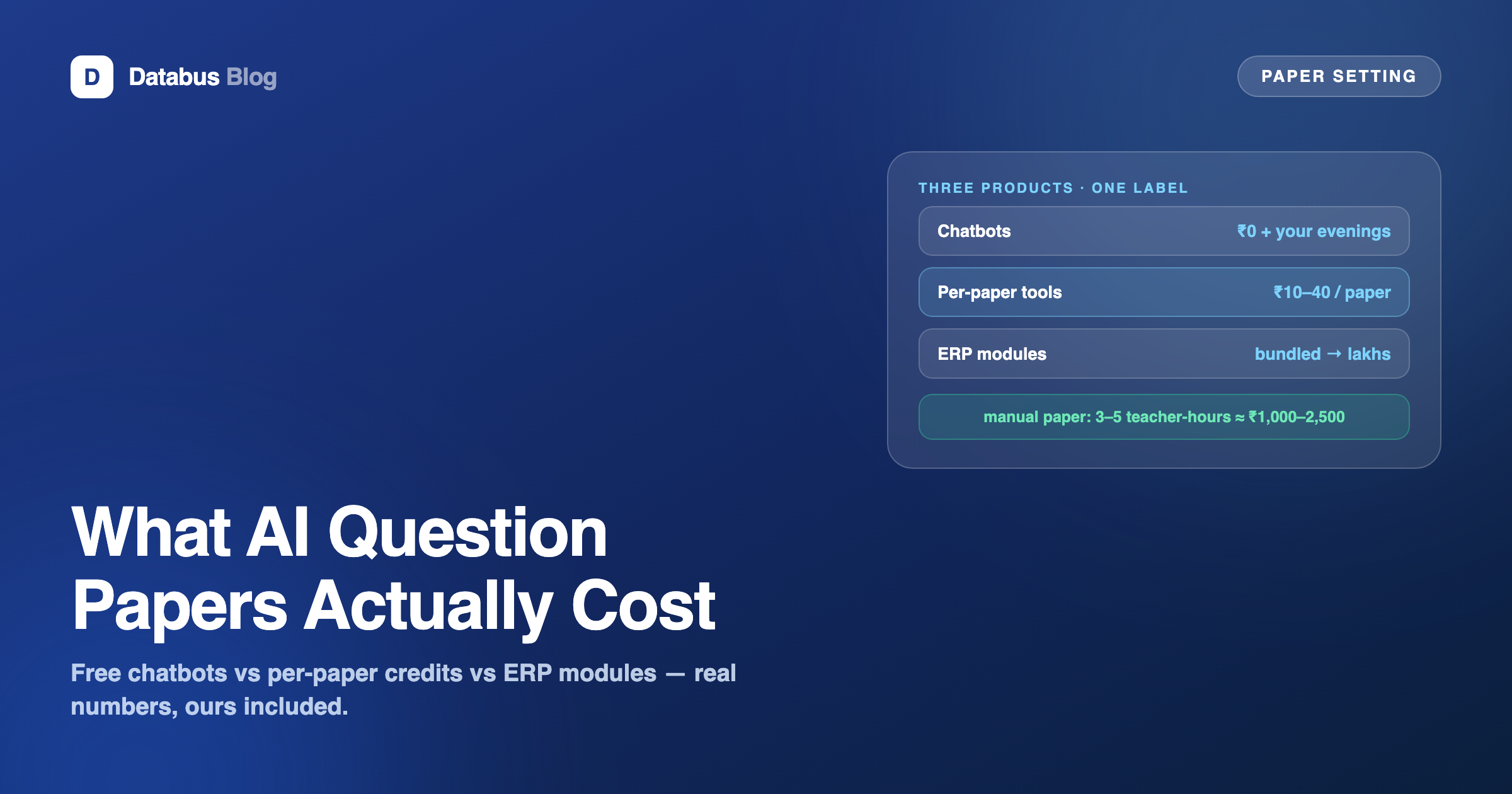
Ask "what does AI question paper generation cost" and you will get answers from free to lakhs a year — and all of them are technically true, because they describe different things. A chatbot subscription, a per-paper tool and an institutional ERP module are three different products wearing one label. Since we sell one of these ourselves, this piece shows real numbers — including our own — and where each option honestly fits.
Option 1: general-purpose chatbots — ₹0 to ₹2,000/month
ChatGPT and its peers will draft questions free, or under a general subscription. For a teacher who wants ten practice questions, this is genuinely fine and genuinely free. The costs are hidden in time and structure: no syllabus grounding (it doesn't know your board's chapter split unless you paste it), no blueprint enforcement, no mark-scheme consistency, formatting by copy-paste, and quality that depends entirely on your prompting. For a full formal paper, teachers typically spend nearly as long structuring, checking and formatting the output as writing from scratch — the draft is free; the paper isn't. We wrote up the differences honestly in PaperDeck vs ChatGPT.
Option 2: dedicated paper-generation tools — pay per paper or per month
Purpose-built tools carry the syllabus, blueprint and formatting inside the product, priced per paper (credits) or as a subscription. Here are our own numbers as a concrete reference — PaperDeck's published rate card:
- Platform fee: ₹100 per staff login per month.
- AI credits, deducted only when you generate: a quiz costs 5 credits, a standard paper 10, a full exam paper 20; a Bloom's-taxonomy answer key adds 5.
- Credit packs: 100 credits for ₹199 (₹1.99/credit) down to ₹1.40/credit at the 5,000 pack.
Translated to paper terms at the entry pack: a quiz ≈ ₹10, a standard paper ≈ ₹20, a full exam paper ≈ ₹40 — under ₹28 at volume rates. A tutor generating six papers a month spends roughly ₹220–350 all-in; a school department running fifty papers a term still lands in the low thousands. (Two honesty notes from our own rate card: per-paper figures depend on which pack you bought, and AI-provider costs can move prices — the pricing page is the source of truth.)
Option 3: ERP-bundled exam modules — bundled, or lakhs standalone
School and college ERPs increasingly bundle question-bank and paper modules. If your institution already runs one, the marginal cost may be zero — check what you already own before buying anything. Standalone institutional deployments (custom question banks, integration, training) are quoted per institution and can run to lakhs annually; that scale makes sense for boards-level volume, central question banks and multi-campus standardisation, not for individual teachers.
The comparison that actually matters: your time
A formal paper written well — blueprint-balanced, distractors built from real misconceptions, clean formatting, answer key — takes an experienced teacher 3–5 hours. Value that time at even ₹300–500/hour and the manual paper costs ₹1,000–2,500 in labour, every time. That is the number every option above should be judged against: the chatbot saves drafting but returns much of the time in structuring; dedicated tools compress the loop to generation-plus-curation (the curation is the part worth keeping human); ERP modules add institutional consistency on top. The honest rule: match the tool to your paper volume. A few questions a week — use a free chatbot. Regular formal papers — per-paper pricing beats both the subscription you underuse and the evenings you lose. Institutional scale — evaluate the ERP route with the volume maths above.
A note on accuracy: our own prices are current as published and linked above; competitor and ERP figures are indicative market ranges, not quotes. Where we compare, remember we sell one of the options — check the free trials and judge outputs on your own syllabus.
Frequently Asked Questions
How much does AI question paper generation cost?
Three tiers: general chatbots (free–₹2,000/month, but unstructured), dedicated tools priced per paper (PaperDeck, for example: ₹100/staff login/month plus credits — roughly ₹10 a quiz, ₹20 a standard paper, ₹40 a full exam paper at entry rates), and institutional ERP modules (bundled, or lakhs annually standalone).
Isn't ChatGPT free for making question papers?
For drafting questions, effectively yes. For a formal paper it returns the time elsewhere: no syllabus grounding, blueprint or mark-scheme enforcement, and formatting by copy-paste — teachers typically spend nearly the drafting time again on structuring and checking.
What does a full exam paper cost on PaperDeck?
20 credits — about ₹40 at the ₹1.99 entry pack, under ₹28 at volume rates — plus the ₹100/month staff login. A Bloom's-taxonomy answer key adds 5 credits. The pricing page carries the current rate card.
Is AI paper generation cheaper than writing papers manually?
Judged on labour, yes by an order of magnitude: a well-made manual paper takes 3–5 teacher-hours (₹1,000–2,500 at modest hourly value), versus tens of rupees in credits plus curation time. The teacher's review remains essential — the saving is in drafting and formatting, not judgement.
Should a school use a per-paper tool or its ERP's exam module?
Check what the ERP already includes first — bundled may mean already-paid-for. Choose per-paper tools for teacher-level flexibility and cost that tracks usage; choose ERP modules where institutional standardisation and central question banks matter more.