


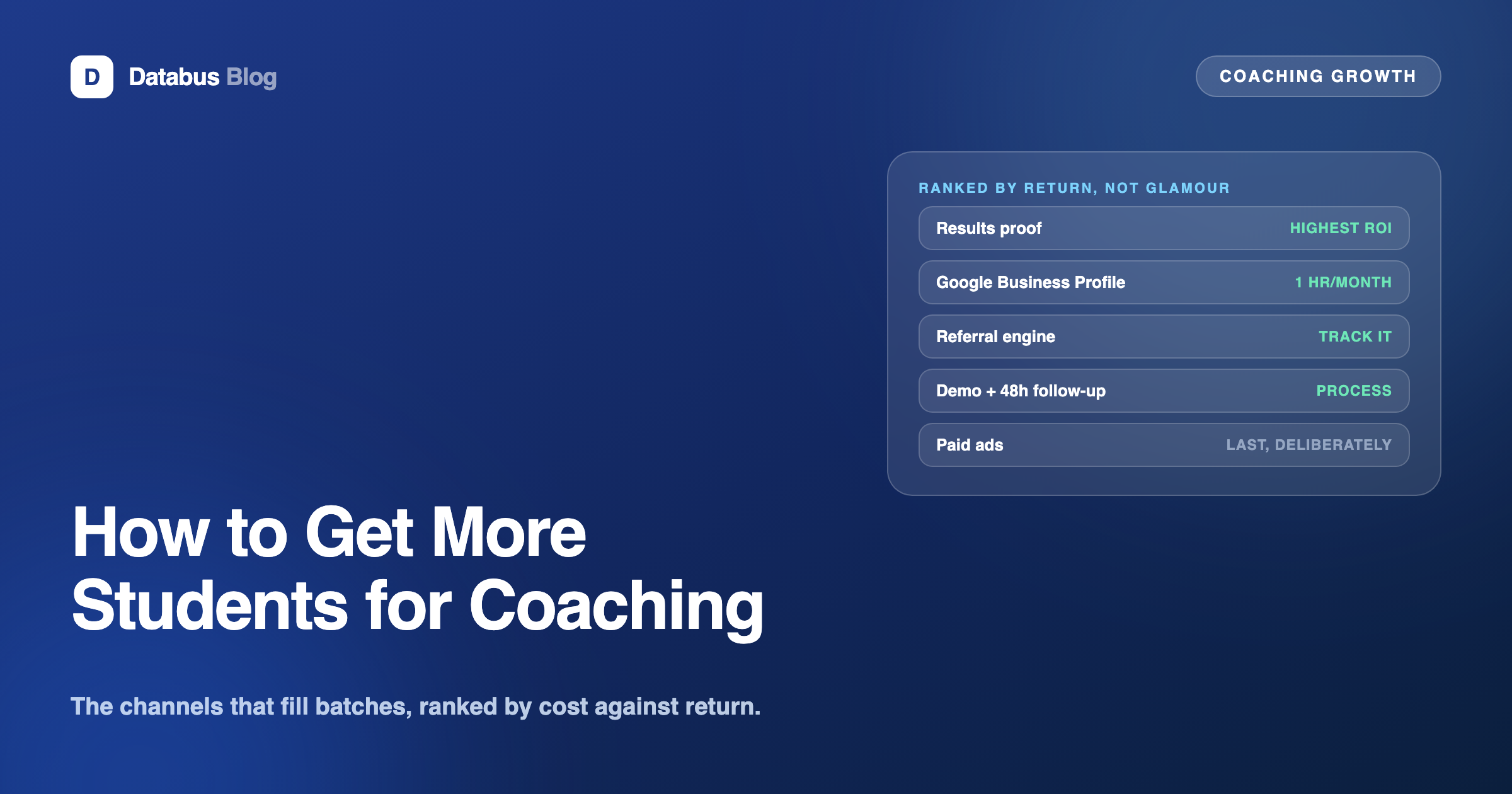
Every coaching owner has watched a competitor with worse teaching and better marketing fill batches. The instinct is to conclude marketing is a trick you haven't learned. It mostly isn't — coaching is a trust purchase, decided locally, on evidence and word of mouth. The channels below are ranked by what they cost against what they return for a typical local institute, and the honest first observation is that the highest-return channels are the least glamorous ones.
1. Results proof — the channel everything else amplifies
Parents buy outcomes. Before spending on reach, make your outcomes legible: named toppers (with consent), score improvements ("from 61% to 84% in one year" persuades more than a 95th-percentile outlier), board/exam-wise counts, and where they came from ("14 of our 23 students crossed 90% in maths"). Two rules keep this powerful: be specific and be honest — under the 2024 coaching guidelines, misleading claims and rank guarantees are violations, not just bad taste. A modest true claim placed everywhere beats an inflated one that invites scrutiny.
2. Google Business Profile — the highest-ROI hour of the month
"Physics coaching near me" is decided on the map pack, and most institutes' listings are half-empty. Complete every field (categories, hours, photos of actual classrooms, fee-range indication), post results and batch announcements monthly, and — the part that moves rank and conversions — ask every satisfied parent for a review at the moment of a good result, not at random. Reply to every review, including the bad ones, factually and calmly; prospective parents read the replies more than the reviews.
3. Referrals — engineered, not hoped for
Word of mouth is already your biggest channel; the question is whether it is engineered. What works: a stated, simple incentive (a month's fee discount per successful referral is common), asked for at the two right moments — after a visible win (test result, rank improvement) and at re-enrolment. Track referrals like revenue: who referred, who converted, who got the reward. Institutes that track referrals per family discover 10–20% of families generate most referrals — treat those families accordingly.
4. Demo classes and score-improvement guarantees done right
A free demo class converts because it de-risks the trust purchase — but only if the demo is your best teacher on a real topic, followed up within 48 hours. A batch of demo attendees who never hear back is marketing spend converted to nothing by process failure. The follow-up discipline — who attended, who was called, who enrolled, why not — is a pipeline, and it belongs in a system, not a teacher's memory: this is exactly the enquiry-to-admission funnel TutorDesk tracks, and the operational playbook for it is in filling empty batch seats.
5. Retention — the growth channel disguised as operations
Acquiring a student costs 5–10× keeping one, and every departure exports a negative story into your catchment area. The highest-leverage "marketing" for most institutes is systematic retention: attendance follow-ups the same day, monthly parent updates with actual data (tests taken, scores, trend), and deliberate re-enrolment conversations before results season — the fortnight after results is when quiet churn happens, and the post-results retention playbook covers it. A parent who receives a monthly progress report has been given a reason to stay and a story to tell.
6. Paid ads — last, deliberately
Paid works when the machine behind it works: a clear offer (demo/scholarship test), a landing point that converts (your GBP or a page with results proof), and follow-up within hours. Run small local campaigns (3–5 km radius, exam-season timing), measure cost per enrolment — not per click — and kill what doesn't convert. An institute that hasn't fixed items 1–5 will pay to send prospects to an empty shop window.
The pattern
Nothing above is a growth hack; it is evidence, visibility, and follow-through, compounded by term after term of delivery. The institutes that grow steadily run these as processes with owners — someone owns reviews, someone owns demo follow-ups, someone owns the referral ledger — rather than as bursts of enthusiasm each admission season. Codify the processes once and admissions season becomes execution, not reinvention.
Frequently Asked Questions
What is the best way to get more students for a coaching institute?
In return-per-rupee order for most local institutes: make results proof specific and visible, complete and actively manage your Google Business Profile, engineer referrals with a stated incentive asked at the right moments, run demo classes with 48-hour follow-up, fix retention — and only then add paid ads.
Do free demo classes actually convert?
Yes, when the demo is your best teacher on a real topic and every attendee is followed up within 48 hours. The conversion loss is almost always in follow-up process, not the demo itself — track attendees as a pipeline.
How do I get more Google reviews for my coaching institute?
Ask at the moment of a good result — a strong test score or rank improvement — rather than at random, make it a one-tap link, and reply to every review. Prospective parents judge the replies as much as the ratings.
Can I advertise rank guarantees to attract students?
No — the 2024 coaching guidelines treat rank/marks guarantees and misleading claims as violations with escalating penalties. Specific, verifiable results claims are both compliant and more persuasive.
Why is retention considered a marketing channel?
Because acquisition costs 5–10× retention, and every departing family exports a negative story into your local market while every retained one compounds word of mouth. Monthly data-backed parent updates and pre-results re-enrolment conversations are the cheapest growth spend available.