Databus Logo
Blog Login →
For principals · For comms heads · TRAI DLT & DPDP ready

School Parent Communication & Broadcast Platform

One message. Every parent. Three channels.

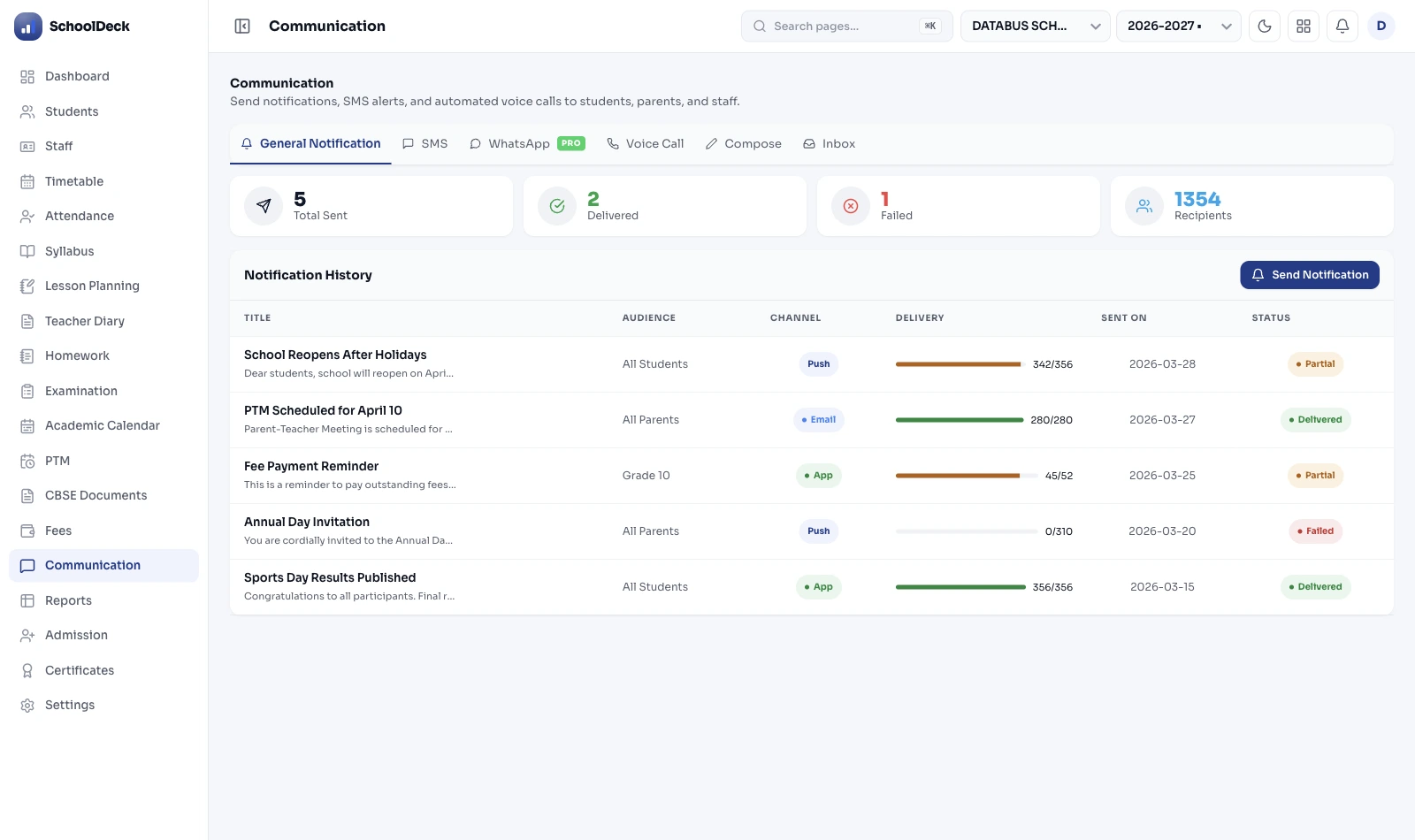
The principal types a school-closure alert at 7:42 AM. App push fires at 7:43 for parents with the app installed. WhatsApp Business API delivers at 7:44 to parents on WhatsApp. DLT-registered SMS reaches at 7:45 for everyone else. One message. Three regulatory channels. No WhatsApp group required.

TRAI TCCCPR 2018 compliant · DPDP Act 2023 aligned · Hindi, Tamil, Marathi & 8+ regional languages.

💡 Looking for homework assignment workflow (photo submissions, teacher reviews, digital diary)? See LMS & E-Learning →
📱 App push (free) 💬 WhatsApp Business API ✉️ DLT-registered SMS 🌐 10+ Indian languages 📊 Read receipts per channel
95-98%
parents reached across 3 channels
DLT
templates registered for school
₹0.20-0.30
per DLT SMS · app push free
24-48 hr
template approval timeline

Quick definition

A broadcast platform, not a chat group.

Parent communication software is a centralised platform that lets a school broadcast one message to every parent simultaneously through multiple channels — without exposing anyone's phone number, without the off-topic chatter, and within Indian regulatory rules.

A WhatsApp parent group is peer-to-peer chat. Every parent sees every number. Birthday party invites compete with fee reminders. Teachers get pinged at 11 PM about uniform sizes. There's no audit trail when a parent claims "I never got the message."

The difference matters more now than it used to. Indian schools sending bulk SMS without TRAI DLT registration find messages silently dropped. Sending broadcasts without DPDP-aligned consent flow creates real liability. The platform handles both layers.

The regulatory plumbing schools don't realise they need

DLT under TCCCPR 2018. DPDP from 2023. Two laws. Both apply.

Sending parent broadcasts in India isn't just an app integration anymore. It's a compliance question.

TRAI DLT — the SMS layer

TCCCPR 2018 blockchain registry

Every business sending bulk SMS in India must register on the Distributed Ledger Technology platform under the Telecom Commercial Communications Customer Preference Regulation 2018:

  • Principal Entity — PAN-verified business profile
  • Sender ID (Header) — 6-char alphanumeric, e.g., SCHLPT
  • Template approval — each message category pre-registered
  • Service-Implicit category — for routine school alerts
DPDP Act 2023 — the data layer

Section 7 + Section 9 obligations

School communications process parent contact data and reference under-18 students. Both layers of DPDP apply:

  • Section 7 — lawful processing for routine alerts
  • Section 9 — verifiable parental consent for child data
  • No behavioural profiling of minors
  • Withdrawable consent for non-routine messages
What SchoolDeck handles

End-to-end DLT onboarding for partner schools

Principal Entity registration with PAN and authorisation letter. Header (Sender ID) provisioning. Template categorisation (Service-Implicit for fee reminders/attendance, Service-Explicit where consent recorded, Promotional for fundraising). Template scrubbing review with 24-48 hour TRAI turnaround. Ongoing template management. Schools don't manage DLT themselves.

Time window enforcement

10 AM - 9 PM for promotional. Service anytime.

TRAI restricts promotional SMS to 10 AM-9 PM windows. Transactional and Service-Implicit alerts (the routine school traffic) can go anytime. The platform enforces this automatically — a school admin trying to send a promotional alumni newsletter at 8 PM gets a warning; an emergency school-closure alert at 7 AM goes through unrestricted.

References: Telecom Commercial Communications Customer Preference Regulation 2018 (TCCCPR); TRAI Distributed Ledger Technology framework; Digital Personal Data Protection Act 2023, Section 7 (lawful processing) and Section 9 (children's data); DPDP Rules 2025. Schools remain responsible for compliance with applicable laws — SchoolDeck provides the infrastructure that supports compliance.

Four pillars · one platform

What the principal's comms console actually does.

Pillar 1
📡

Multi-channel cascade delivery

Type the message once. Select the audience — Class 5 parents, all Std 9 students, entire school, transport users only. Platform tries app first (free), WhatsApp next, DLT-SMS as universal fallback. Real reach: 95-98% of parents across the three channels.

  • Audience builder by class/section/transport route
  • Scheduling — draft at 11 AM, send at 5 PM
  • Cost shown per channel before broadcast
Pillar 2
💬

WhatsApp Business API — verified school identity

Send from the school's official WhatsApp Business profile — the verified green-tick once Meta approves. Rich media: PDF report cards, exam date sheets, event photos. No phone numbers exposed. No staff phones saving thousands of parent contacts.

  • Meta Business verification handled
  • Template approval through Meta
  • PDF, image, document attachments
Pillar 3
✉️

DLT-registered SMS — universal fallback

For the share of parents on feature phones or with patchy data, DLT-registered SMS reaches every phone with a SIM. Templates pre-approved in Service-Implicit category. Multilingual Unicode for Hindi, Tamil, Marathi and 8+ Indian languages.

  • ₹0.20-0.30 per DLT-approved SMS
  • Honest framing: Unicode = 70 char/SMS
  • School-branded Sender ID
Pillar 4
📊

Read receipts & delivery analytics

Per-channel delivery confirmation. App push opened or not. WhatsApp read receipts (two ticks blue). SMS delivery report. Nudge just the parents who missed the first emergency alert — without re-spamming the 85% who saw it.

  • Per-parent delivery audit trail
  • Targeted resend to non-delivered subset
  • Dispute resolution: "we sent it on Dec 4 at 8:15 AM"

What schools actually broadcast

Seven things that hit the comms console every week.

🚨

Emergency closure

"School closed today due to heavy rain. Bus service cancelled." → all parents in 90 seconds.

💸

Fee reminder

DLT Service-Implicit template, only to parents with outstanding dues. Pay link inline.

👤

Attendance alert

Daily absent-student notification to parent within 15 min of period 1.

📜

Report card delivery

PDF via WhatsApp to each parent — no printing, no distribution day chaos.

🚌

Bus proximity

"Your child's bus will arrive in 10 minutes" — push from the transport module.

📅

PTM scheduling

Parent-teacher meeting slot booking via the app, with reminders.

🎉

Event invitations

Annual day, sports day, alumni reunion — with RSVP tracking.

📋

General circulars

Holidays, schedule changes, syllabus updates. Acknowledgement tracked.

🏆

Result announcements

Board exam results, scholarship notifications, competition outcomes.

The shift

WhatsApp parent group vs proper broadcast platform.

Capability WhatsApp parent group SchoolDeck platform
Phone-number exposure Every parent sees every other parent's number No contact info visible across parents
TRAI DLT compliance (SMS) No coverage of SMS layer Templates registered with TRAI
DPDP Act 2023 alignment No consent ledger, no audit trail Section 7 routine + Section 9 child
After-hours teacher messaging Teachers pinged at 11 PM School-hour windows configurable
Dispute resolution "I didn't see it" goes unchallenged Delivery timestamp per parent
When a teacher leaves All school comms history goes with them Stays in the school's system
"I handle communications for a 1,800-student ICSE school in Kolkata. The story that sold our principal on switching was last October — flash flooding on Park Street meant we had to close school at 7:30 AM. With the old WhatsApp groups, we had thirty-two teachers each messaging their class group simultaneously, contradicting each other on bus timings, and parents WhatsApping back the office number for clarification. With SchoolDeck, one broadcast at 7:32 AM reached 1,776 out of 1,800 parents within four minutes — app push first, then WhatsApp Business API, then DLT SMS for the 90 or so parents on feature phones. Twenty-four parents needed a follow-up call because they don't check phones early. That's a manageable number. The other 1,776 just got the message."
A
Anand Bhattacharya
Communications Head — ICSE School (1,800 students), Kolkata

Communication FAQs

What principals ask before switching.

What is parent communication software and how is it different from a WhatsApp group?

+

A centralised broadcast platform that sends one message to every parent simultaneously through multiple channels — mobile app push, WhatsApp Business API, DLT-registered SMS — without exposing anyone's phone number. A WhatsApp group is peer-to-peer chat where every parent sees every other parent's number, off-topic conversations bury critical announcements, parents reply at 11 PM about uniform sizes, and there's no audit trail. The software is one-way by default, structured by category (fees/attendance/circulars/emergency), and routes through the right regulatory channel — Indian schools sending bulk SMS without DLT registration face delivery failures and potential TRAI compliance action.

What is TRAI DLT and why does it matter for school SMS?

+

DLT (Distributed Ledger Technology) is the blockchain system TRAI uses under TCCCPR 2018 to control bulk SMS in India. Businesses sending more than a handful of SMS must register as a Principal Entity (with PAN and authorisation), provision a Sender ID (Header — 6-character alphanumeric like 'SCHLPT'), and submit message templates for category approval. Schools typically use Service-Implicit templates for routine alerts (attendance, fees, exam results) since there's an existing student-school relationship. SchoolDeck handles the entire DLT onboarding for partner schools — Principal Entity registration, header provisioning, template approval (typical 24-48 hour TRAI turnaround), and ongoing management.

How does multi-channel cascade delivery work?

+

Cascade routes the same message through channels in priority order. Platform tries the SchoolDeck app first — push notification at zero marginal cost. If parent hasn't opened the app in 24 hours or doesn't have it, routes to WhatsApp Business API. If WhatsApp delivery fails (no WhatsApp, template mismatch), falls back to DLT-registered SMS — the universal channel reaching any SIM. Real reach across three channels: 95-98% of parents — not the marketing claim of 100%, but typically including parents on basic feature phones who can't run apps.

Can schools send WhatsApp messages without parents joining a group?

+

Yes — through the WhatsApp Business API. Unlike a WhatsApp group (which requires every parent to opt in by joining and exposes phone numbers), the Business API sends one-to-one official messages from the school's verified business profile. Parents see a verified green-tick school identity (when Meta approves the verification). Templates must be pre-approved by Meta — similar to TRAI's DLT template approval for SMS. SchoolDeck handles Business API onboarding, Meta business verification, and ongoing template management.

How does this software comply with DPDP Act 2023?

+

Two layers. Section 7 — communication about a parent's own child's school matters typically qualifies as legitimate processing — schools have lawful basis for fee reminders, attendance alerts, exam-result updates without separate marketing consent. Section 9 — any non-routine messaging (alumni newsletters, fundraising, promotional) requires explicit consent collected at admission and recordable. SchoolDeck distinguishes: routine school communication uses Service-Implicit DLT templates with no separate opt-in; non-routine requires recorded consent. No phone-number exposure across parents, no behavioural profiling of minors.

Can we send communications in Hindi, Tamil, Marathi, and other languages?

+

Yes — full Unicode support across all three channels. Hindi, Tamil, Marathi, Bengali, Telugu, Kannada, Malayalam, Gujarati, Punjabi, and any other regional language. Honest detail: Unicode SMS has a per-message character limit of 70 characters (vs 160 for English/Latin) — a Hindi SMS costs the same as English but conveys less. The platform calculates and shows per-message length before broadcast. Templates can be registered in multiple languages with the same DLT registration — e.g., the same fee reminder approved in English, Hindi, and Marathi for a Maharashtra school.

What happens if a parent doesn't have a smartphone?

+

Feature-phone parents receive DLT-registered SMS as the fallback. The platform identifies these parents by preference setting or repeated app-delivery failures, prioritising SMS. For routine alerts (fee reminders, attendance, exam dates), SMS works fine. For richer communication (PDF report cards, photos, detailed circulars), the school may need a parallel print channel for the small share of parents who can't access digital. Operational reality across India, not a platform failure. SchoolDeck identifies which parents to keep on print and which can move fully digital.

Why does it cost more than just running a WhatsApp group?

+

WhatsApp groups are free but operationally expensive in hidden ways: teachers' personal phones flooded after-hours, numbers exposed across the parent body, no audit trail for disputes, no DLT compliance for SMS attempts, critical messages buried under birthday party coordination. The software adds direct costs: WhatsApp Business API messaging tiers from Meta, DLT-registered SMS at ₹0.20-₹0.30 per message, app push notifications free. Schools with 1,000-2,000 students typically spend ₹3,000-₹8,000/month on messaging across all channels. Trade-off: institutional control, regulatory compliance, teachers' evenings back.

Related

Where to go next.

For schools done with WhatsApp parent groups

One console. Three regulatory channels. Every parent.

Mobile app push. WhatsApp Business API. DLT-registered SMS. Cascade delivery across all three. TRAI TCCCPR 2018 compliant. DPDP Act 2023 aligned. Multilingual. Built for the way Indian schools actually broadcast.

₹3,000-₹8,000/month for typical school messaging · App push free · From ₹30/student/month