


For a new school, CBSE affiliation is the credential that changes everything downstream — admissions credibility, board-exam eligibility, teacher hiring. It is also a process with a fearsome reputation that is now substantially unearned: the system has moved online, inspection has been streamlined, and the state-NOC bottleneck that stalled applications for years has been reformed. Here is the current shape of the process for founders and principals planning an application.
Before anything: the eligibility floor
CBSE affiliates schools run by a registered society, trust or Section 8 company (not individuals or for-profit entities), on premises meeting the Affiliation Bye-laws' land and infrastructure norms. The recurring pre-application items:
- Land: minimum area norms vary by city class and school level — metros get relaxed norms relative to smaller towns. Schools on land allotted by urban development authorities (DDA, HUDA, MMRDA and similar) can submit the allotment letter in lieu of a separate land certificate.
- Recognition: state recognition for the classes you currently run, under the RTE framework.
- Infrastructure and safety: classrooms and labs per norms, and the safety certificates — fire, building, water, health — that inspection will check.
- Foundational stage: applications now carry a commitment to NEP 2020's structure, including the Bal Vatika pre-primary years — plan the foundational section, not just classes 1–8.
The SARAS portal — the whole process is online
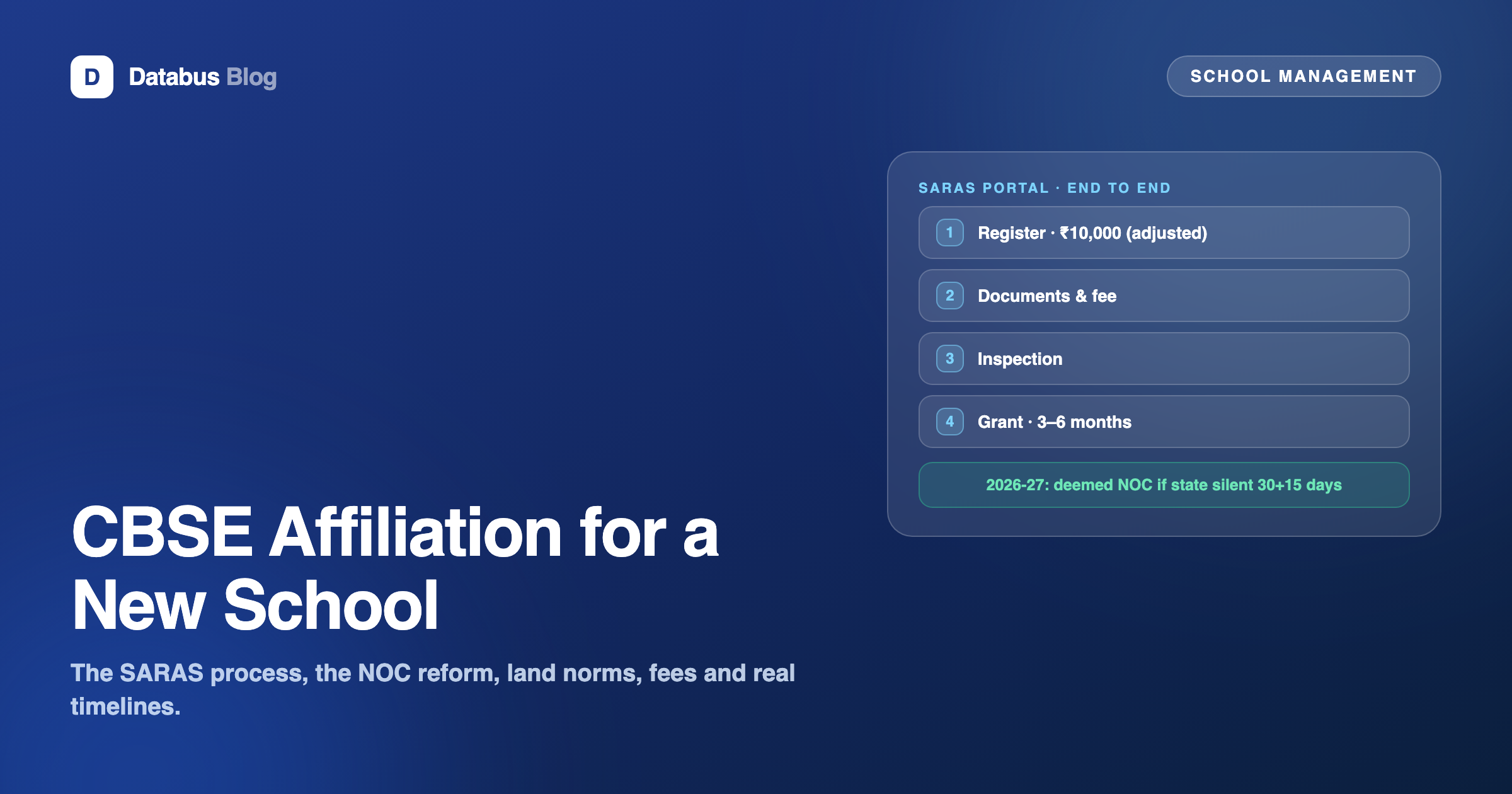
CBSE's SARAS portal (saras.cbse.gov.in) carries the entire lifecycle: fresh affiliation, upgradation (to secondary/senior secondary), extension and other applications. The flow for a fresh application:
- Register the school on SARAS with an initial payment of ₹10,000, which adjusts against the final affiliation fee.
- Fill the application — society/trust details, land documents, recognition certificate, staff, infrastructure — and upload the supporting documents.
- Pay the balance fee, which varies by application type and the number of sections applied for.
- Inspection: a CBSE-appointed committee (largely virtual/hybrid in recent practice for many categories) verifies the declarations — infrastructure, safety certificates, staff records, labs.
- Grant: affiliation is granted for a period, after which the extension cycle (also on SARAS) takes over.
The NOC reform — the big change
Historically the hardest step was the state government No Objection Certificate, which could sit unanswered indefinitely. That has changed: from session 2026-27, a school may apply with or without the state NOC — CBSE seeks the state's response, and if the state does not respond within 30 days plus a 15-day reminder window, a deemed NOC applies and the application proceeds. This removes the single largest source of multi-year delay, though state recognition of the school itself remains necessary.
Realistic timeline and the mistakes that cost months
With documents genuinely ready, the process commonly runs 3–6 months from application to grant. What actually costs applicants time: safety certificates expiring mid-process (check validity dates against the expected inspection window), mismatches between the uploaded documents and ground reality at inspection, land documentation that doesn't match the society's name, and applying for the wrong category (fresh vs upgradation). CBSE also runs application windows and revises the bye-laws and portal versions periodically — read the current-year circulars on cbse.gov.in before starting, not a consultant's summary of last year's.
After affiliation: the data obligations begin
Affiliation is where a school's compliance reporting starts, not ends: OASIS data submission, mandatory public disclosure on the school website, UDISE+ returns, and eventually board-exam LOC (list of candidates) filings — all of which draw on the same underlying records of students, staff and infrastructure. Schools that keep those records structured from day one assemble every return in hours; schools that keep them in folders rebuild the same data annually. That records layer — students, staff, fees, certificates, reports — is what SchoolDeck maintains for schools, and it is free to start for up to 100 students via the free plan, which fits a new school's first cohort exactly.
A note on accuracy: affiliation norms, fees, portal versions and the NOC framework are set by CBSE's Affiliation Bye-laws and current circulars, which change — the March 2025 SARAS circular and session-2026-27 NOC reform are recent examples. Verify against cbse.gov.in and the SARAS manual for the current cycle before applying. This is general information.
Frequently Asked Questions
How does a new school apply for CBSE affiliation?
Entirely online through CBSE's SARAS portal: register with a ₹10,000 initial payment (adjusted against the final fee), submit the application with society/trust, land, recognition, staff and infrastructure documents, pay the balance fee, clear the inspection, and receive the grant.
Is a state NOC still mandatory for CBSE affiliation?
From session 2026-27, schools may apply with or without the state NOC. CBSE seeks the state's response; if none arrives within 30 days plus a 15-day reminder window, a deemed NOC applies. State recognition of the school itself is still required.
How long does CBSE affiliation take?
Commonly 3–6 months with documents ready. The usual delays are self-inflicted: expired safety certificates, document-vs-ground mismatches at inspection, and land papers not matching the society's name.
Who can apply for CBSE affiliation?
Schools run by a registered society, trust or Section 8 company meeting the Affiliation Bye-laws' land, infrastructure and staffing norms, with state recognition for existing classes. Individuals and for-profit entities cannot hold affiliation.
What is the CBSE affiliation fee?
A ₹10,000 registration payment at the start, adjusted against the final fee, which varies by application type and number of sections. Check the current SARAS fee schedule — amounts are revised periodically.