What is the current CBSE Class 10 grading system in 2025-26?
+
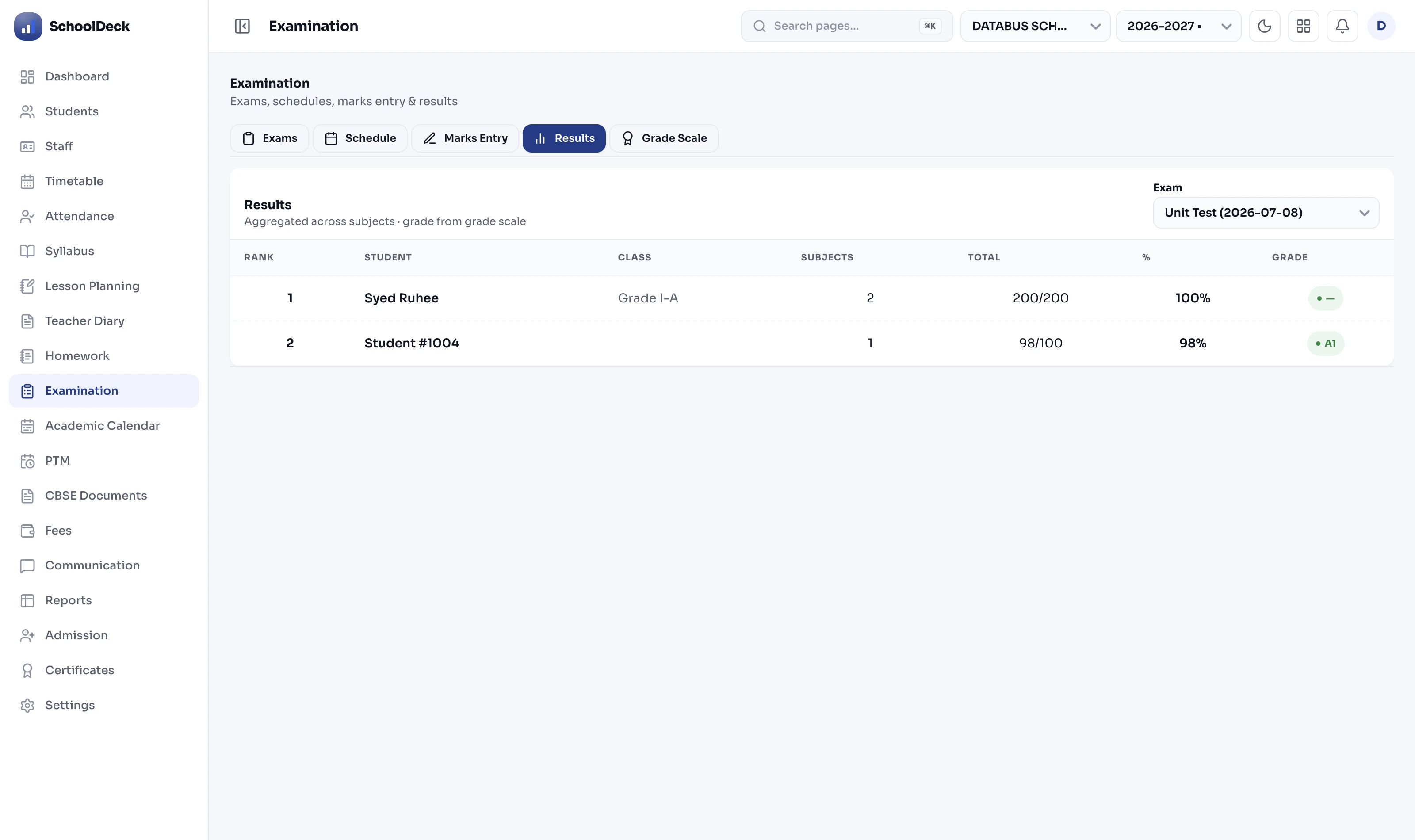
The current CBSE Class 9 & 10 system uses an 80+20 marks structure: 80 marks from the board theory exam plus 20 marks internal assessment. The 20 internal marks break down as periodic tests (10 marks, best 2 of 3), notebook submission (5 marks), and subject enrichment activities (5 marks). Final marks map to the 9-point grade scale (A1 to E2). The older FA1/FA2/FA3/FA4 + SA1/SA2 'CCE' framework has been substantially replaced by this current structure for Classes 9-10.
How is CBSE Class 10 CGPA calculated and converted to percentage?
+
CGPA uses the best 5 of 6 subjects at Class 10 (the 6th subject is excluded unless it improves the average). Step 1: add grade points for the 5 chosen subjects. Step 2: divide by 5 — this is CGPA. Step 3: multiply CGPA by 9.5 for indicative percentage. Example: grade points 10+9+8+9+8 = 44, CGPA = 8.8, percentage = 83.6%. The 9.5 multiplier comes from CBSE's analysis: A1-band students average ~95 marks ÷ A1 grade point 10 = 9.5. SchoolDeck applies this automatically.
How does the ICSE 80/20 grading split actually work?
+
CISCE applies different splits per subject group. Group I & II (English, Languages, History/Civics/Geography, Maths, Science) use 80/20 — 80% external board plus 20% internal. Group III (Comp. Applications, Economic Applications, EVS, Yoga, Performing Arts) uses 50/50. ISC Class 11-12 uses 70/30 — theory plus practical/project. CISCE moderates internal marks centrally and audits inflated scores. SchoolDeck applies the right split per subject automatically — applying the wrong rule to a Group III subject produces an invalid marksheet.
What is the NEP 2020 HPC and how does it differ from a marksheet?
+
The Holistic Progress Card replaces marks-only report cards. It assesses students across five domains — cognitive (academic), social-emotional, physical, creative, values — visualised as a radar chart. Inputs come from teacher observation, peer-assessment, and student self-assessment alongside formal marks. CBSE has issued HPC formats for Foundational (Classes 1-2), Preparatory (Classes 3-5), and Middle (Classes 6-8) stages. SchoolDeck generates HPCs from data teachers enter through the year — so it's not a separate term-end project. NEP 2020 compliance details →
Which Indian State Board report card formats does SchoolDeck support?
+
12 State Boards: Maharashtra (SSC and HSC), Tamil Nadu (SSLC with Samacheer Kalvi CCE), Karnataka (KSEAB), Rajasthan (RBSE Class 8/10/12), Uttar Pradesh (UPMSP), Madhya Pradesh (MPBSE), Gujarat (GSEB), Andhra Pradesh (BSEAP), Telangana (BSETS), West Bengal (WBBSE), Bihar (BSEB), and Kerala (DHSE/SSLC). Each template uses the correct grading pattern, subject list, regional language support, and section format mandated by the board. Templates update when boards revise their formats — typically pushed within 30 days.
Can different classes in the same school use different grading systems?
+
Yes. Common CBSE configuration: NEP HPC for Classes 1-2 (Foundational) and 3-5 (Preparatory), the current 80+20 system for Classes 6-10, theory + practical for 11-12. Each grade band picks up the right rubric automatically. For schools running multiple boards (e.g., CBSE up to Class 10 and ISC for 11-12, or different branches under a trust), the system handles all combinations from one student database.
How does Maker-Checker work for marks verification?
+
Three roles: Subject teacher (Maker) enters marks. Academic coordinator (Checker) reviews and approves. Principal locks the dataset before report cards generate. Any post-lock correction needs explicit principal approval and is logged with user ID and timestamp in the audit trail. Errors caught before reaching parents — which is the only kind of error catch that actually matters.
Does this page or another handle exam logistics like seating & hall tickets?
+
Both — at different depths. This page covers board-specific grading mechanics. Exam management automation tells the coordinator's-fortnight story (seating per CBSE 24-students-per-room norm, hall ticket generation, invigilation rosters). The examinations features page is the deep tool spec. All three share the same underlying module — three views for three buyers.