


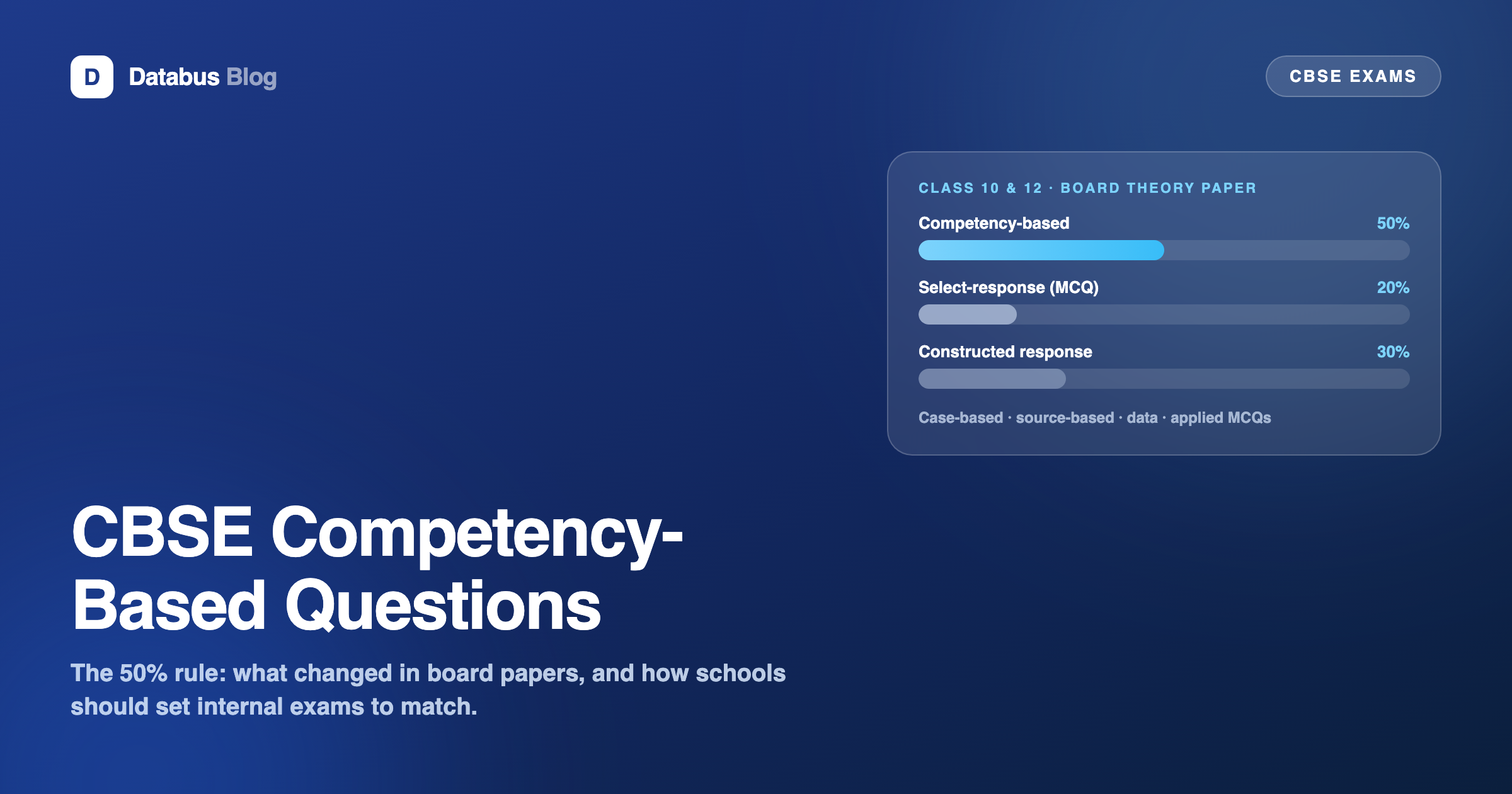
Since the 2024-25 board exams, 50% of the theory marks in CBSE Class 10 and Class 12 papers come from competency-based questions — items that test whether a student can apply, analyse and evaluate, not whether they memorised the textbook. The shift is permanent under NEP 2020, and it continues through the 2026 and 2027 boards. For schools, that one number changes how every internal paper should be set: a pre-board built on old recall-heavy patterns no longer rehearses the exam students will actually sit.
What the board paper blueprint looks like now
Across the major subjects, the theory paper splits roughly three ways:
- ~50% competency-based questions — case-based, source-based, data-driven and applied items, in both objective and descriptive formats.
- ~20% select-response questions — straightforward MCQs.
- ~30% constructed-response questions — the familiar short-answer and long-answer descriptive items.
The exact split and question counts vary by subject, and CBSE publishes the authoritative version for each year as subject-wise sample papers and marking schemes on cbse.gov.in — always set internal blueprints from those, not from memory of last year's paper.
What actually counts as a competency-based question
"Competency-based" describes what the item measures, not its format. The common forms:
- Case- or scenario-based questions — a real-world situation (an experiment, a business case, a news extract) followed by questions that require applying concepts to it.
- Source-based questions — a passage, map, cartoon or document to interpret, common in social science and languages.
- Data interpretation — tables, graphs and figures the student must read and reason from.
- Assertion–reason items — two statements whose logical relationship the student must judge.
- Applied MCQs — objective questions where the right option follows from working a concept, not recognising a definition.
The test for a genuine CBQ: could a student answer it by quoting the textbook? If yes, it is recall dressed in a scenario costume. If the scenario is doing real work — forcing the student to select the concept, apply it and defend the result — it is competency-based.
Why CBSE made the shift
NEP 2020 committed India's boards to moving assessment away from rote memorisation toward real-world application, in line with international assessments of the PISA type. CBSE phased the change in over several sessions — raising the competency share year by year until it reached half the paper — precisely so schools could adapt teaching and internal assessment gradually. The direction of travel is one-way: the competency share is not going back down.
What it means for your internal exams
The board sets the destination; the school's exam cell controls the rehearsal. Three practical moves:
- Mirror the blueprint from Class 9 up. If board papers are 50% competency-based, unit tests, half-yearlies and pre-boards in Classes 9–12 should match that ratio. Students meeting case-based items for the first time in the board hall is a preventable failure.
- Build item banks by cognitive level, not just by chapter. A chapter-wise question bank full of recall items cannot produce a 50% CBQ paper. Tag questions by Bloom's level — remember, understand, apply, analyse, evaluate — so a paper can be assembled to a cognitive blueprint, not just a syllabus-coverage one.
- Use CBSE's own practice material as the reference. CBSE publishes subject-wise competency-focused practice questions and annual sample papers. They are the calibration standard for what a CBQ looks like in each subject — set your paper-setters' expectations from those documents.
The operational problem: setting papers to a cognitive blueprint is slow
Writing one good case-based question takes far longer than writing a recall question, and a school runs dozens of exams a year across classes and subjects. This is where the workload argument for tooling is honest: SchoolDeck's AI question paper generation builds papers to a blueprint — Bloom's-taxonomy levels and difficulty balancing included — so an exam cell can produce a 50/20/30-pattern paper with answer keys in minutes and spend its human time reviewing items instead of drafting them. It sits inside the wider exams and assessments workflow — schedules, marks entry and report cards on the same platform — and you can try the paper-building flow in the live demo tool.
A note on accuracy: exam patterns, splits and question typologies are set by CBSE circulars and sample papers for each academic session, and details vary by subject. Always confirm the current year's pattern from cbse.gov.in or your school's board communications before finalising internal blueprints. Databus is not affiliated with CBSE.
Frequently Asked Questions
What percentage of CBSE board papers are competency-based questions?
Since the 2024-25 session, around 50% of the theory marks in CBSE Class 10 and Class 12 board papers come from competency-based questions, with roughly 20% select-response MCQs and 30% constructed-response descriptive questions. The exact split varies by subject — CBSE's sample papers for the current year are the authoritative reference.
What types of questions count as competency-based?
Case- and scenario-based questions, source-based questions, data interpretation, assertion–reason items, and applied MCQs. The defining feature is that the student must apply, analyse or evaluate — not recall — regardless of whether the format is objective or descriptive.
Are competency-based questions the same as MCQs?
No. Some CBQs are MCQs and many MCQs are pure recall. "Competency-based" refers to the cognitive skill an item tests, not its format — a descriptive case-study question is competency-based, while a definition-recognition MCQ is not.
Should Class 9 and 11 exams follow the same 50% pattern?
It is strongly advisable. Internal exams are the rehearsal for board papers, so mirroring the competency ratio from Class 9 onward means students meet case-based, source-based and data items long before the board hall. CBSE's competency-focused practice questions help paper-setters calibrate.
Where do official competency-based practice questions come from?
CBSE publishes subject-wise competency-focused practice questions and annual sample papers with marking schemes on cbse.gov.in. Those documents are the calibration standard for internal papers — use them rather than third-party guesses at the pattern.