


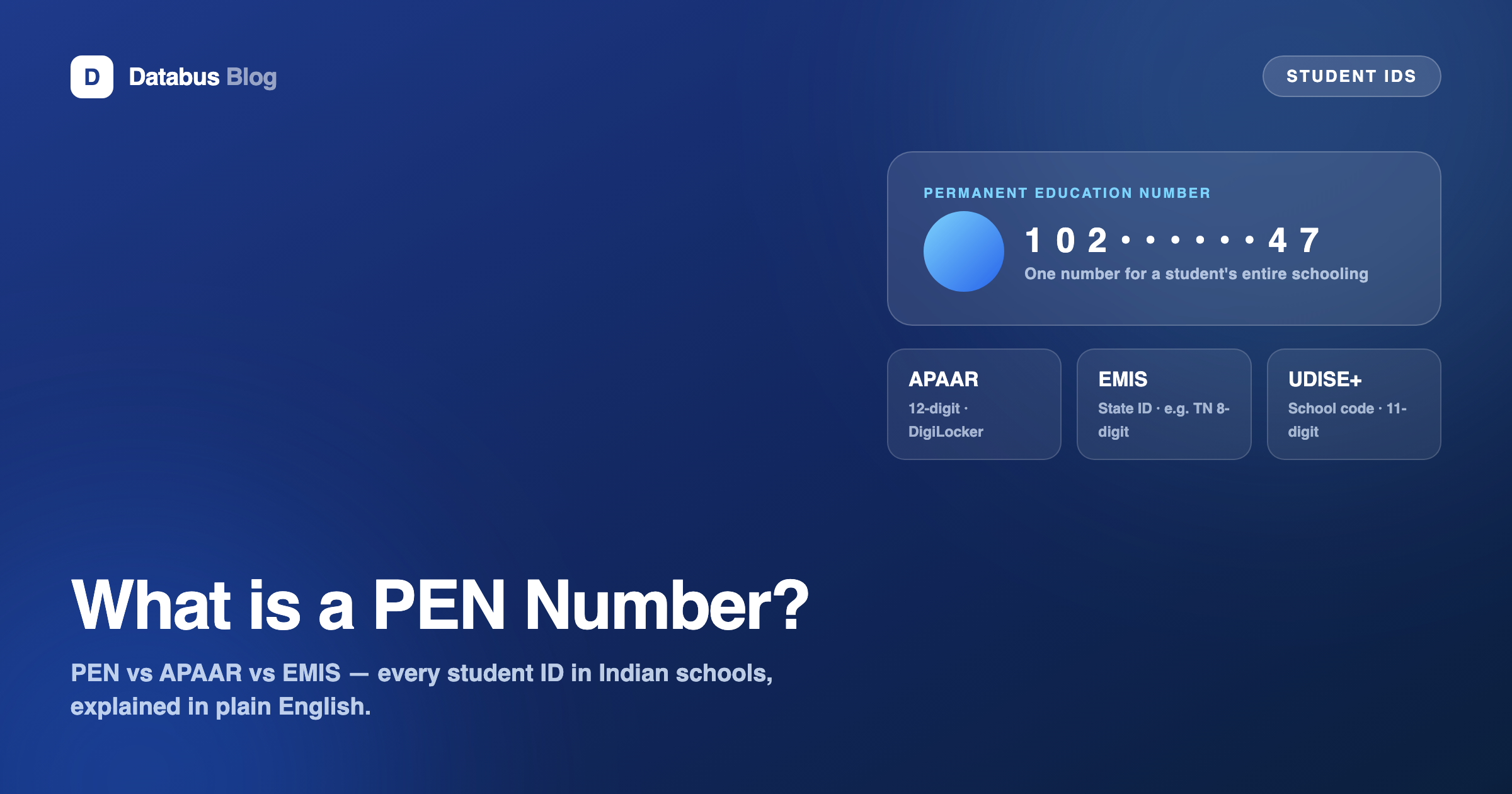
The Permanent Education Number, where it comes from, and how it fits with APAAR, EMIS and UDISE+ — in plain English.
If your school circular or your child's report card mentions a PEN number, here is what it means: the Permanent Education Number is a unique student identifier generated through UDISE+, the Ministry of Education's national school-data system. It is designed to stay with a student for their entire schooling — across classes, schools and even states — so records don't restart from zero every time a student moves.
India's school system now has several student identifiers running side by side, and they are easy to confuse. This guide explains what the PEN is, how it relates to APAAR and state EMIS numbers, and how to find a student's PEN.
What is a PEN number?
When a school enters a student into UDISE+ (the national Unified District Information System for Education), the system assigns that student a PEN — a permanent, unique number. Unlike a roll number or admission number, which changes with every class or school, the PEN is meant to be issued once and reused for life-of-schooling. When a student transfers, the receiving school imports the student against the same PEN instead of creating a duplicate record.
PEN vs APAAR vs EMIS — what's the difference?
PEN (Permanent Education Number) — generated by UDISE+ at the national level. Primarily an administrative identifier that schools use in UDISE+ records, transfers and official returns.
APAAR ID — the "One Nation, One Student ID" under NEP 2020. It is a 12-digit ID created via DigiLocker with parental consent, linked to the Academic Bank of Credits so certificates and credits follow the student. APAAR is built on top of the student's UDISE+ record — in practice, a student needs to exist in UDISE+ (with a PEN) before an APAAR ID is generated. We cover it in detail in our APAAR ID guide.
EMIS numbers — state-level identifiers issued by state education departments through their own portals. Tamil Nadu's 8-digit EMIS number is the best-known example — see what an EMIS number is. A student in a state with its own EMIS may have both a state EMIS number and a national PEN.
UDISE code — often mentioned in the same breath, but it identifies the school, not the student. Every recognised school has an 11-digit UDISE code; every student inside it has a PEN.
How to find a student's PEN
- Ask the school office. The PEN lives in the school's UDISE+ student module; the admin or UDISE+ in-charge can look it up in minutes. This is the reliable route — there is no public self-service PEN lookup for parents.
- Check school documents. Many schools now print the PEN on report cards, ID cards or transfer certificates.
- Via APAAR. If the student's APAAR ID has been generated, the school's APAAR module shows the linked UDISE+/PEN record.
Why the PEN matters for schools
Transfers without duplicate records, cleaner UDISE+ annual returns, dropout tracking, and scholarship or board-exam processes that key off the student's identity all depend on the PEN being right. The practical pain is data hygiene: if a school's own records — spellings, dates of birth, parent names — don't match what UDISE+ holds, every portal task becomes a correction exercise. Schools running structured student records in software like SchoolDeck keep a single clean master record, so UDISE+ entries, PEN lookups and transfer paperwork start from data that already matches. Our UDISE+ and EMIS guide covers the school-side workflow in depth.
A note on accuracy: identifier schemes and portal behaviour change as the Ministry updates UDISE+ and APAAR. Always confirm current procedure from official Ministry of Education / UDISE+ communications or your BEO — including before acting on this page. Databus is not affiliated with UDISE+, APAAR, DigiLocker or any education department.
Frequently Asked Questions
What is the full form of PEN in education?
PEN stands for Permanent Education Number — a unique student identifier generated through UDISE+, the national school-data system. It is designed to stay with a student across classes, school transfers and states for their entire schooling.
Is the PEN the same as the APAAR ID?
No. The PEN is an administrative identifier generated by UDISE+, while APAAR is the 12-digit "One Nation, One Student ID" created via DigiLocker with parental consent and linked to the Academic Bank of Credits. APAAR is built on the student's UDISE+ record, so the two are linked but not the same number.
How can a parent find their child's PEN number?
Ask the school office — the PEN is stored in the school's UDISE+ student module and there is no public self-service lookup for parents. Many schools also print the PEN on report cards, ID cards or transfer certificates.
Does a student get a new PEN when changing schools?
No — that is the point of the "permanent" in the name. The receiving school imports the student's existing UDISE+ record against the same PEN, so the number follows the student rather than restarting with each admission.
What is the difference between a PEN and a UDISE code?
The PEN identifies a student; the UDISE code identifies a school. Every recognised school has an 11-digit UDISE code, and every student within it has their own PEN.