


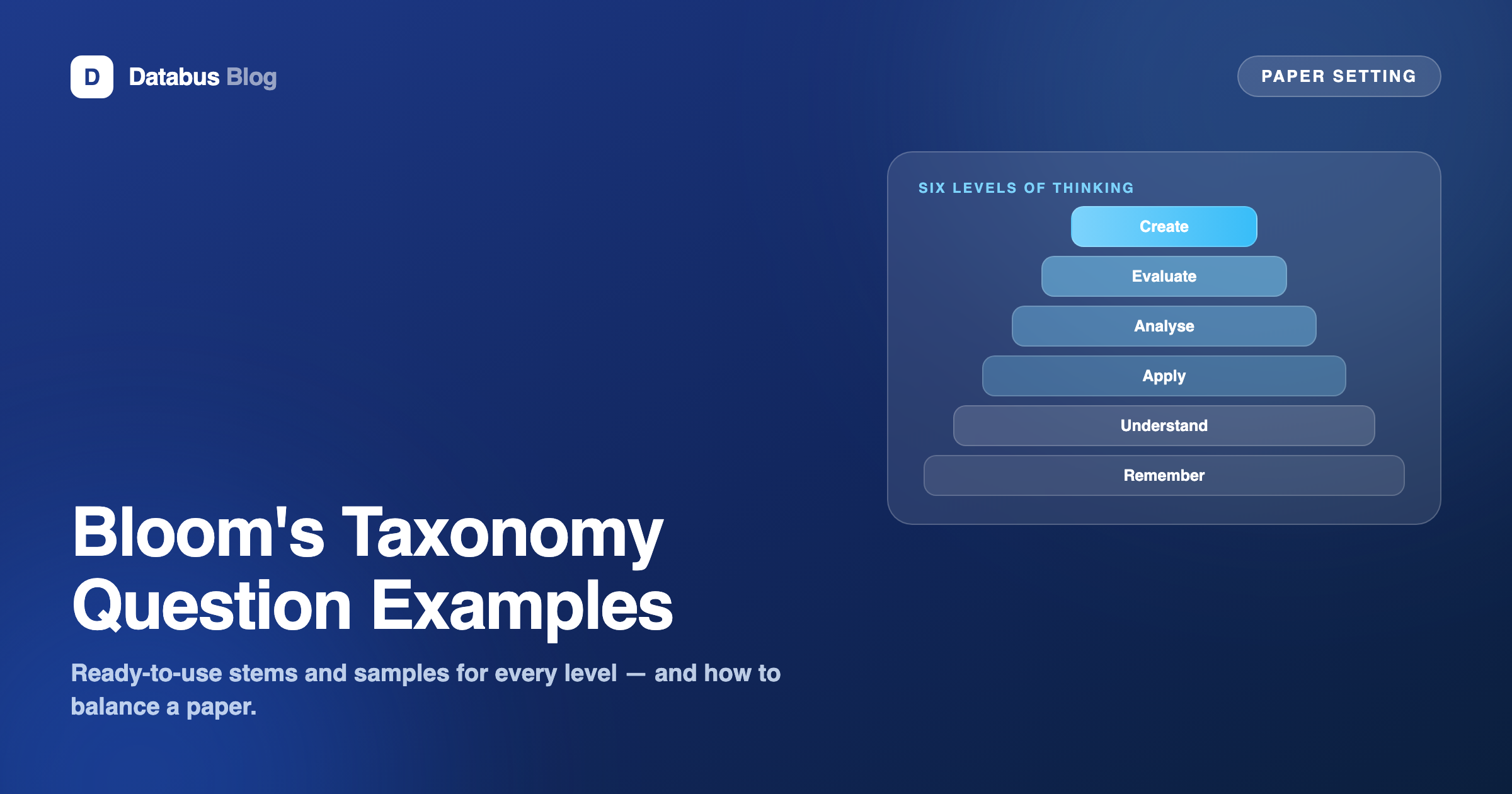
Bloom's taxonomy is the working vocabulary of good paper-setting: six levels of thinking, from recalling a fact to creating something new. The theory is famous; what teachers actually need on a Sunday night before an exam is stems and examples per level. Here they are.
1. Remember — retrieve the fact
Stems: define…, list…, state…, name…, when did…
Example (science): "State the SI unit of force."
Fast to write, fast to answer, and fine in moderation — the problem is papers made of nothing else.
2. Understand — explain it in your own words
Stems: explain…, summarise…, classify…, give an example of…, what does the graph show…
Example (economics): "Explain the difference between fixed and variable costs with one example of each."
3. Apply — use it in a new situation
Stems: calculate…, solve…, demonstrate…, what would happen if…, use the rule to…
Example (maths): "A shopkeeper buys 40 pens at ₹12 and sells them at ₹15. Calculate profit percentage."
This is where competency begins: the student must select the method, not just remember it.
4. Analyse — break it apart
Stems: compare…, differentiate…, what is the relationship between…, which factor mattered most and why…
Example (history): "Compare the causes of the revolts of 1857 and 1942. Which two differences are most significant?"
5. Evaluate — judge with criteria
Stems: justify…, critique…, which solution is better and why…, do you agree with the statement…
Example (biology): "A farmer must choose between chemical pesticides and biological pest control. Evaluate both options and recommend one, giving two criteria for your judgement."
6. Create — produce something new
Stems: design…, propose…, compose…, plan an experiment to…
Example (physics): "Design an experiment to determine which of two materials is the better thermal insulator, listing apparatus, method and how you would judge the result."
Balancing a paper across levels
A well-set paper is a deliberate mix — heavier on remember/understand in lower classes, shifting weight to apply/analyse/evaluate as students mature. Boards are pushing the same direction: CBSE's pattern now puts 50% of board-paper marks on competency-based questions, which live at the apply-and-above levels. Two practical rules: decide the level mix before writing questions (a blueprint), and tag every bank question by level so the mix is checkable rather than aspirational.
The honest cost — and the shortcut
Writing one genuine analyse-level question takes several times longer than a recall item, and a tutor or teacher sets dozens of papers a year. That is the workload PaperDeck is built for: its question paper generator assembles papers to a Bloom's-level blueprint with answer keys, so your time goes into reviewing items instead of drafting all of them from a blank page.
Frequently Asked Questions
What are the six levels of Bloom's taxonomy?
Remember, understand, apply, analyse, evaluate and create — ordered from retrieving facts to producing original work. The revised (2001) taxonomy uses these verb forms.
What is a good Bloom's level mix for an exam paper?
There is no single ratio — lower classes lean toward remember/understand while senior papers weight apply/analyse/evaluate. The method that matters: fix the mix in a blueprint before writing questions, and tag questions by level so the balance is verifiable.
Are competency-based questions the same as higher Bloom's levels?
Largely, yes. Competency-based questions ask students to apply, analyse or evaluate in context — the apply-and-above bands of Bloom's. Pure recall items sit below the competency bar regardless of format.
What are examples of "evaluate" question stems?
Justify your answer…, critique the method…, which option is better and why…, do you agree with the statement — give two reasons. The defining feature is judgement against criteria, not opinion alone.
How do I quickly raise the cognitive level of a recall question?
Wrap it in a decision. "State the unit of force" becomes "A label lists force in kg — identify the error and state the correct unit." Adding a scenario, a choice, or an error to find moves the item up the taxonomy.