


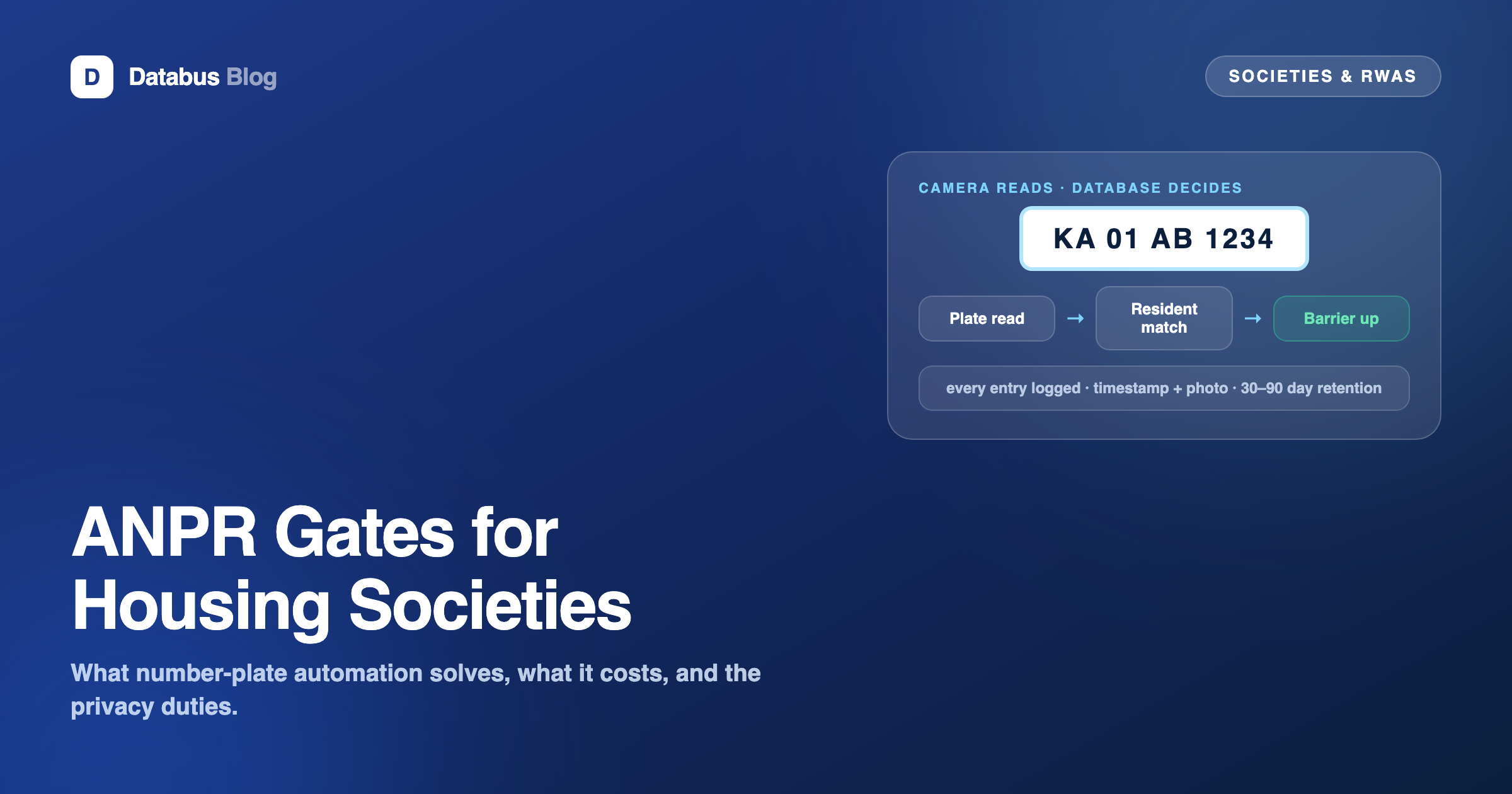
The gate is every housing society's busiest process and its most manual one: a guard squinting at a windshield, a register nobody can read later, a boom barrier operated on recognition and goodwill. ANPR — Automatic Number Plate Recognition — replaces that squint with a camera that reads plates and decides in under a second. Societies are adopting it fast, sometimes for the right reasons and sometimes because a vendor demo looked slick. Here is what ANPR genuinely solves, what it costs, and the questions committees should ask before signing.
How it works at a society gate
- A camera positioned at the approach lane captures the vehicle's plate; recognition software extracts the registration number.
- The number is checked against the society's database — resident vehicles, registered tenant vehicles, approved regular visitors (school vans, staff), and flagged entries.
- Match → the boom barrier lifts automatically. No match → the vehicle is held for the standard visitor flow (intercom/app approval), and the plate is logged either way with timestamp and photo.
The practical wins are concrete: no tailgating past a distracted guard, an accurate machine-written vehicle log (who entered, when, gone is the illegible register), faster resident entry at peak hours, and clean answers to the questions that follow any incident — "which vehicles entered between 10 and 11 that night?" takes seconds, not an evening with a register.
What it does not solve
Honesty first: ANPR reads plates, not intentions. It will not catch a visitor in a resident's car, a plate deliberately obscured or cloned, or two-wheelers and pedestrians (which need their own flow). Indian conditions add real error sources — non-standard fonts and decorative plates, dust, headlight glare, monsoon rain — so real-world accuracy is high but never 100%; the design assumption should be "guard workload drops sharply", not "guard disappears". HSRP (high-security registration plates) standardisation has improved read rates meaningfully, but the exception lane still needs a human.
What it costs — the honest ranges
For a typical single-gate setup: an ANPR-capable camera, recognition software (edge or cloud), boom-barrier integration and installation generally lands in the low lakhs — roughly ₹1.5–4 lakh per lane depending on camera grade, barrier quality and integration depth, plus AMC and any software subscription. Multi-gate societies scale roughly per lane. Two cost questions matter more than the sticker: what is the recurring fee (cloud recognition and app integrations are often subscription-priced), and who owns the data if you change vendors — insist on exportable logs. Fund it the right way too: gate automation is a capital improvement, which belongs to a general-body resolution and the appropriate fund, not quietly to the monthly budget — the same discipline as any reserve spending.
The privacy duties committees now carry
An ANPR system is a continuous record of residents' movements — genuinely useful, genuinely sensitive. With the DPDP Act era arriving for exactly this kind of data, a committee running ANPR should be able to answer four questions:
- Purpose: security and access — and the data is used for nothing else (not shared with marketers, not browsed casually).
- Access: who can view logs — named roles (security supervisor, committee designate), not every guard and not every member on demand.
- Retention: a stated period (30–90 days is common practice) after which logs auto-delete, unless preserved for a specific incident.
- Transparency: residents told, in writing, that ANPR operates and what is stored — ideally via a general-body resolution adopting the policy.
Making the data useful beyond the gate
The gate log is most valuable when it connects to the society's actual records: which flat a vehicle belongs to, whether the tenant registered it at move-in, which entries map to move-outs and handovers. That resident-and-vehicle master data is the society's system of record — the layer EstateDeck maintains for societies and RWAs: flats, residents, tenants, vehicles and dues in one ledger that gate systems can check against, instead of a second database that drifts out of date. If your society is formalising operations more broadly, start with the RWA registration and first-90-days guide.
A note on accuracy: price ranges are indicative market figures that vary by city, vendor and specification; data-protection obligations under the DPDP framework are still being operationalised through rules. Get current quotes in writing and take advice on your privacy policy. This is general information.
Frequently Asked Questions
What is ANPR in a housing society?
Automatic Number Plate Recognition — cameras at the gate read vehicle plates and check them against the society's database of resident and approved vehicles, lifting the boom barrier automatically on a match and logging every entry with timestamp and photo.
How much does ANPR gate automation cost for a society?
Roughly ₹1.5–4 lakh per lane for camera, recognition software, boom-barrier integration and installation, plus AMC and any cloud subscription. Ask specifically about recurring fees and whether logs are exportable if you change vendors.
Does ANPR replace security guards?
No — it removes the plate-checking and register-writing workload and closes tailgating gaps, but visitors, two-wheelers, unreadable plates and exceptions still need a human flow. Plan for reduced guard workload, not zero guards.
Is ANPR legal for housing societies — what about privacy?
Societies can operate gate ANPR for security, but movement logs are personal data: adopt a written policy covering purpose, named access roles, a retention period (30–90 days is common) and resident notification — ideally through a general-body resolution.
How accurate is ANPR in Indian conditions?
Good and improving — HSRP plates have standardised fonts and placement — but decorative plates, dust, glare and rain cause misreads. Treat the system as high-accuracy with an exception lane, not infallible.