


In January 2024, the Ministry of Education issued the Guidelines for Regulation of Coaching Centres — the first national framework for a sector that had grown for decades with almost none. States and union territories implement them through registration regimes, and several have moved to enforce. If you run an institute, these are the rules your registration, your marketing and your fee book are now judged against.
The rules that change operations
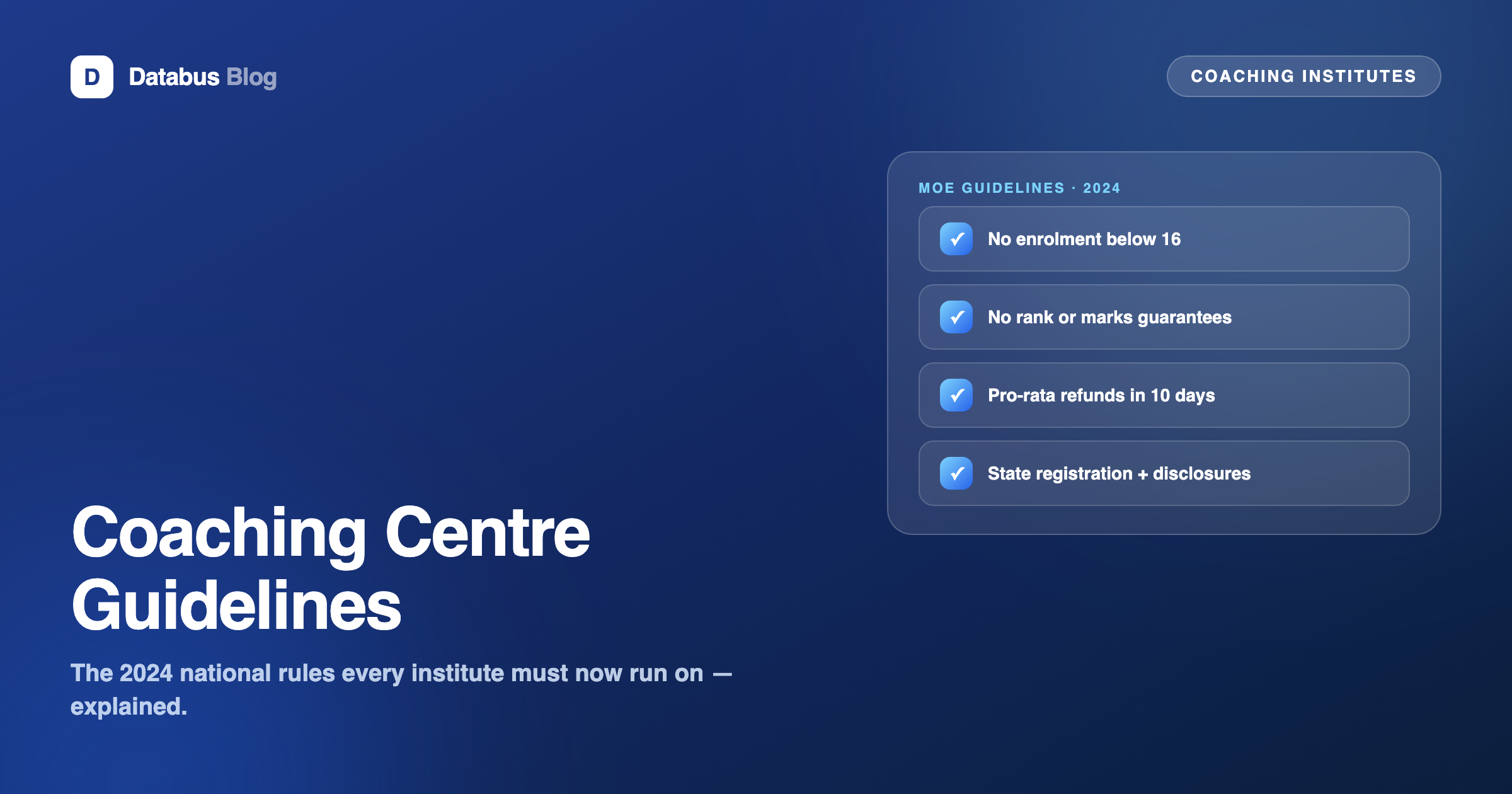
- No enrolment below 16. Coaching centres cannot enrol students younger than 16 — in practice, admission after Class 10. Batch composition and admission forms need to prove it.
- No rank or marks guarantees. "Guaranteed IIT seat", "100% selection" and misleading success claims are barred. Advertising and counselling scripts both count.
- Pro-rata fee refunds within 10 days. A student leaving mid-course must be refunded for the remaining period on a pro-rata basis — including hostel and mess fees where applicable — within 10 days. This single rule makes clean, dated fee records an operational necessity rather than good practice.
- Mandatory public disclosures. A website listing tutor qualifications, courses and curriculum, duration, fees, the exit and refund policy, hostel facilities, and honest numbers on students coached and selected.
- Registration with the state. The guidelines operate through state/UT registration of coaching centres — conditions cover infrastructure, safety and the conduct rules above.
The refund rule deserves its own paragraph
Most disputes between institutes and parents are fee disputes, and the refund rule turns each one into arithmetic: course fee, period covered, date of exit, amount refundable. An institute that collects fees in instalments with proper receipts can compute a pro-rata refund in one minute and pay it inside the 10-day window. An institute with cash entries in a register cannot prove what was collected for which period — and in a dispute, the burden of that ambiguity now falls on the institute.
What compliance looks like operationally
- Ages verifiable at admission — date of birth captured against documents, enforced at enrolment.
- Fee records that can face an inspector — receipts per instalment, per student, with refunds traceable to the original collection.
- Claims audit — every banner, pamphlet and landing page checked against the no-guarantee rule.
- Disclosure page kept current — batch fees and tutor lists go stale fast; assign ownership.
This is the record-keeping layer institute software exists for: TutorDesk keeps admissions (with student details), fee instalments, receipts and refunds in one ledger, so pro-rata refunds and registration paperwork are reports rather than reconstructions. If you are setting up a new centre, start with our cost and checklist guide and the startup cost calculator — build the compliance spine before the first batch, not after the first dispute.
A note on accuracy: the national guidelines are implemented state by state, and state rules add their own registration conditions and penalties. Verify your state's current requirements with its education department before acting. Databus is not a legal advisor and is not affiliated with the Ministry of Education.
Frequently Asked Questions
Can coaching centres enrol students below 16 years?
No. The Ministry of Education's guidelines bar enrolment of students below 16 — effectively admission after Class 10. States implement and enforce this through their registration regimes.
What does the fee refund rule require?
If a student leaves mid-course, the institute must refund the fees for the remaining period on a pro-rata basis within 10 days — including hostel and mess fees where the student used institute accommodation.
Are "guaranteed rank" claims illegal for coaching institutes?
The guidelines prohibit misleading promises and guarantees of ranks or marks. Advertising, brochures and counselling claims all fall within the rule.
Do coaching centres need to register with the government?
Yes — the framework operates through state/UT registration of coaching centres, with conditions covering infrastructure, safety, conduct, fees and disclosures. Requirements vary by state.
What must a coaching centre publish on its website?
Tutor qualifications, courses and curriculum, course duration, fees, the exit and refund policy, hostel details where applicable, and honest figures on students coached and selections achieved.