


Gratuity is the lump sum an employer pays for long service under the Payment of Gratuity Act, 1972 — and it is governed by one compact formula that most people meet only on their last working day. Better to understand it years earlier, because service length and salary structure both change what it pays.
The formula
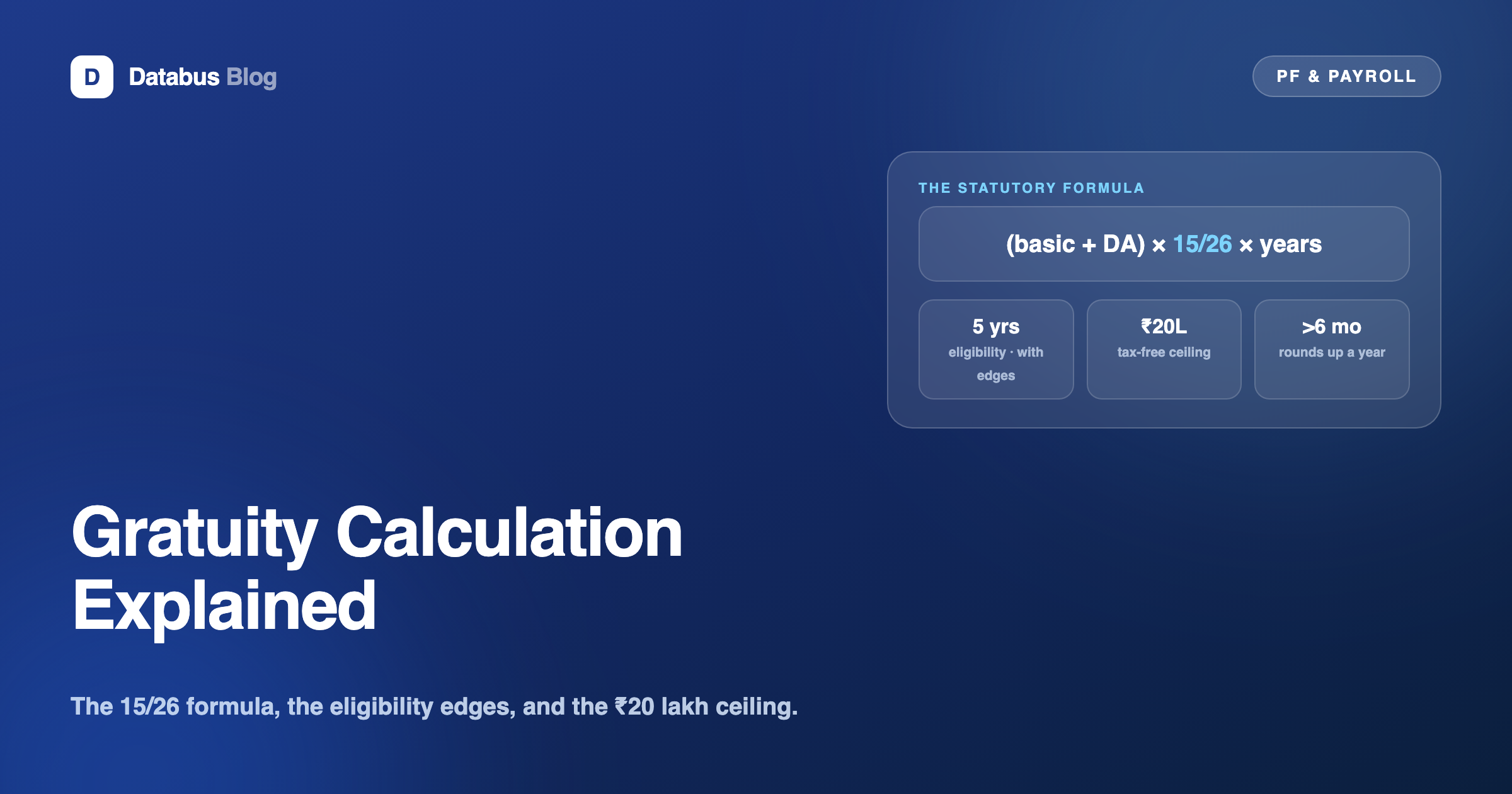
Gratuity = (last drawn basic + DA) × 15/26 × completed years of service
The 15/26 is not mysterious: 15 days' pay for every year of service, with a month counted as 26 working days (excluding Sundays). So each year of service earns you roughly 57.7% of a month's basic+DA.
Worked example: last drawn basic+DA of ₹40,000 and 12 years of service → 40,000 × 15/26 × 12 = ₹2,76,923.
Two rounding rules that surprise people:
- More than 6 months rounds up: 11 years 7 months counts as 12 years; 11 years 5 months counts as 11.
- The base is basic+DA, not gross: allowances outside basic and DA do not enter the formula — which is why salary structure quietly decides gratuity size.
Eligibility: the 5-year rule and its real edges
- The baseline is 5 years of continuous service with the employer.
- 4 years + 240 days: courts have read Section 2A so that completing 240 working days in the fifth year satisfies the requirement — the practical bar is lower than a calendar five years.
- Death or permanent disablement waives the 5-year rule entirely — gratuity is payable to the employee or nominee regardless of tenure.
- Fixed-term employees: under the Code on Social Security, 2020 (notified November 2025), fixed-term employees become eligible on a pro-rata basis after just one year — a significant change from the old regime.
The ₹20 lakh ceiling
For private-sector employees covered by the Act, gratuity enjoys a lifetime tax exemption of up to ₹20 lakh under Section 10(10). Amounts an employer chooses to pay beyond the statutory computation can exceed it, but the excess is taxable. The ceiling is a lifetime aggregate across employers, not per job.
The payroll side: gratuity is a liability that accrues monthly
For employers, gratuity is not a surprise at exit — it is a liability growing with every year each employee serves, computed from the same basic+DA that drives the payslip. Full-and-final settlements are where messy records hurt: date of joining disputes, basic+DA history, and unpaid-leave gaps all change the number. HR systems like PeopleDeck keep the service dates, salary history and settlement computation in one place, so the figure at exit is arithmetic rather than argument.
A note on accuracy: ceilings and rules change with notifications, and the labour codes' rollout continues state by state. Verify current figures with a professional before acting on a settlement. This is general information, not legal or tax advice.
Frequently Asked Questions
How is gratuity calculated?
(Last drawn basic + DA) × 15/26 × completed years of service. Fifteen days' pay per year of service, with a month counted as 26 working days. Service beyond 6 months in the final year rounds up to a full year.
Am I eligible for gratuity at 4 years and 8 months?
Very likely yes — courts have held that 4 years plus 240 working days in the fifth year satisfies the continuous-service requirement. Death or permanent disablement waives the 5-year rule entirely.
Is gratuity tax-free?
Up to ₹20 lakh as a lifetime aggregate under Section 10(10) for covered private-sector employees. Amounts beyond the exemption are taxable as salary.
Does gratuity count my full salary or only basic?
Only last drawn basic + dearness allowance. Other allowances are outside the statutory formula, which is why two people with the same gross can retire with very different gratuity.
Do fixed-term employees get gratuity?
Under the Code on Social Security, 2020 (notified November 2025), fixed-term employees are eligible on a pro-rata basis after one year of service — a major relaxation from the old 5-year norm.