


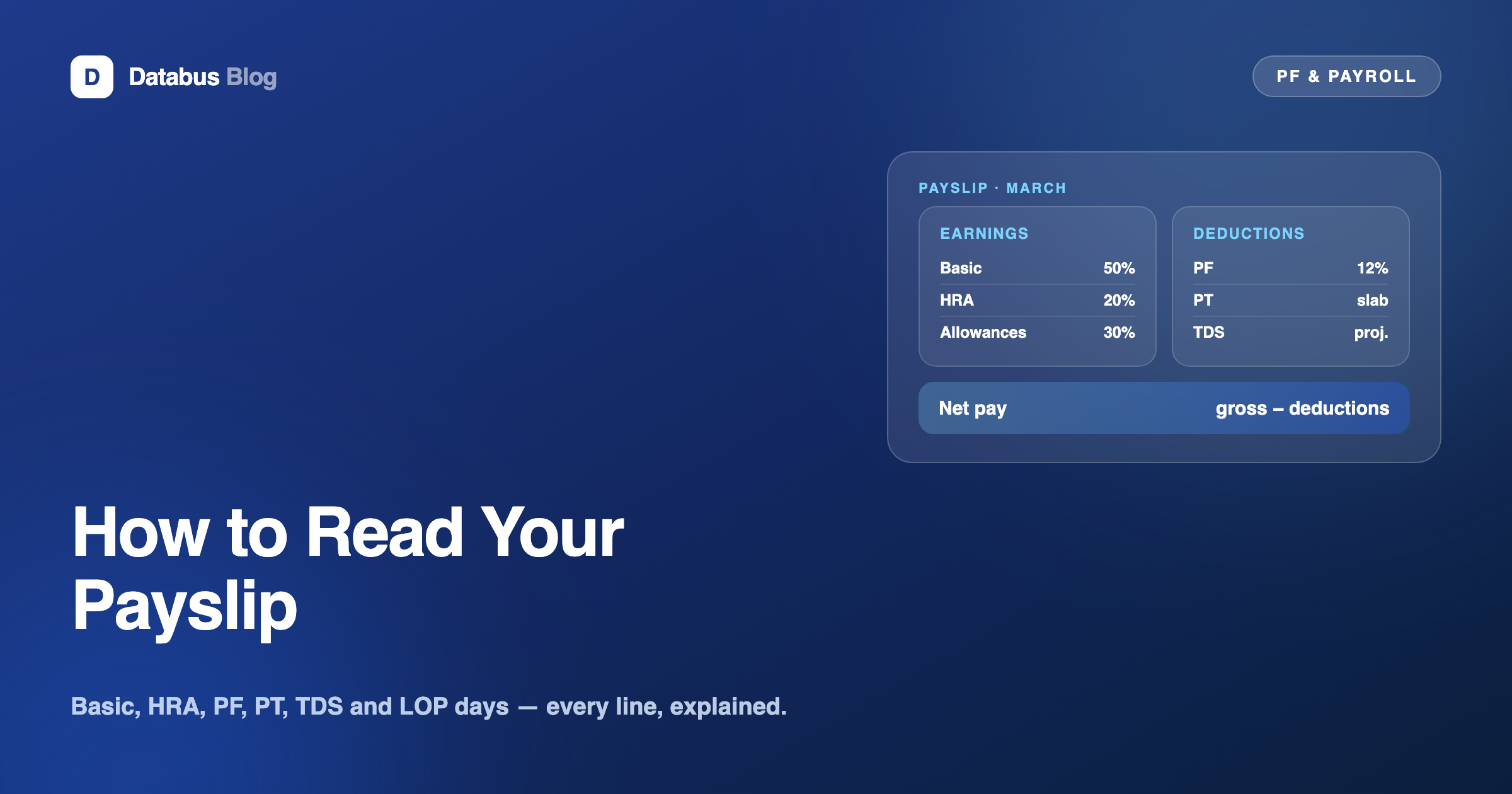
A payslip is a two-column story: what you earned, and what left before it reached you. Most confusion — "why is my in-hand less than my CTC?", "what is this LOP?" — dissolves once you can read the lines. Here is the standard Indian payslip, decoded.
The earnings column
- Basic salary — the anchor. Several other numbers are percentages of it (PF, gratuity, often HRA), which is why employers structure it carefully.
- HRA (House Rent Allowance) — typically a percentage of basic; partially tax-exempt if you pay rent and claim it.
- Special/other allowances — the flexible balancing figure that makes the package add up to the offered gross.
- Reimbursements and variable pay — appear in the months they are actually paid, which is one reason two months' payslips rarely match.
The deductions column
- Provident Fund (PF) — the employee's 12% of basic goes to your EPF account under your UAN. Your employer contributes a matching share separately (part of it to pension), which you see in your PF passbook, not your payslip's deduction column.
- ESI — health insurance contribution, applicable when monthly gross is within the ESI wage ceiling (₹21,000). Above it, the line disappears.
- Professional tax (PT) — a small state-levied tax; the amount and slab depend on your state, and some states levy none.
- TDS (income tax) — tax deducted at source based on your projected annual income and declared investments; it settles against your actual liability when you file returns.
- Other deductions — loan EMIs recovered through salary, canteen/transport recoveries, and similar employer-specific lines.
LOP / offset days — the line that shrinks a month
Loss of Pay (LOP), sometimes shown as offset or LWP days, is the number of unpaid days in the month — leave taken beyond your balance, or unapproved absence. The month's salary is computed on paid days: with 2 LOP days in a 30-day month, each salary component is scaled by 28/30. If a payslip suddenly looks light, the LOP count is the first thing to check. The reverse entry also exists: arrears, where a previous month's shortfall or revision is paid now.
CTC vs gross vs net — the three numbers people mix up
- CTC — everything the company spends on you, including its own PF/gratuity contributions and benefits you never see as cash.
- Gross — your earnings column total for the month, before deductions.
- Net (in-hand) — gross minus deductions. This is the credit in your bank account.
CTC is always the largest and net the smallest; neither is "wrong" — they answer different questions.
Why payslips go wrong — and what clean ones look like
Most payslip disputes trace to manual assembly: attendance kept in one sheet, leave in another, statutory rates updated by memory. Payroll software like PeopleDeck computes the slip from attendance and leave records with PF, ESI and PT applied by rule — so the LOP count, the deductions and the net figure reconcile by construction, and employees get self-service payslips instead of email requests to HR.
A note on accuracy: statutory rates, ceilings and tax rules change with government notifications and budgets. Confirm current figures with your payroll team or a professional before acting on any single number here.
Frequently Asked Questions
Why is my in-hand salary less than my CTC?
CTC counts everything the employer spends — including its own PF and gratuity contributions and non-cash benefits. Your in-hand is the monthly earnings column minus deductions like your PF share, professional tax and TDS. The gap is definitional, not an error.
What are LOP or offset days on a payslip?
Loss of Pay days — unpaid days in the month from leave beyond balance or unapproved absence. Salary is scaled to paid days: 2 LOP days in a 30-day month means each component is paid at 28/30.
What is the PF deduction on my payslip?
Your 12% of basic salary, deposited into your EPF account under your UAN. The employer's matching contribution is paid separately and appears in your PF passbook rather than as a payslip deduction.
Why did the ESI line disappear from my payslip?
ESI applies while monthly gross is within the wage ceiling of ₹21,000. Once a revision takes your gross above the ceiling (subject to contribution-period rules), the deduction stops.
Why do professional tax amounts differ between my colleagues in other cities?
Professional tax is a state levy with state-specific slabs — some states charge nothing, others up to ₹200 per month in the top slab. Different work states mean different PT lines.