


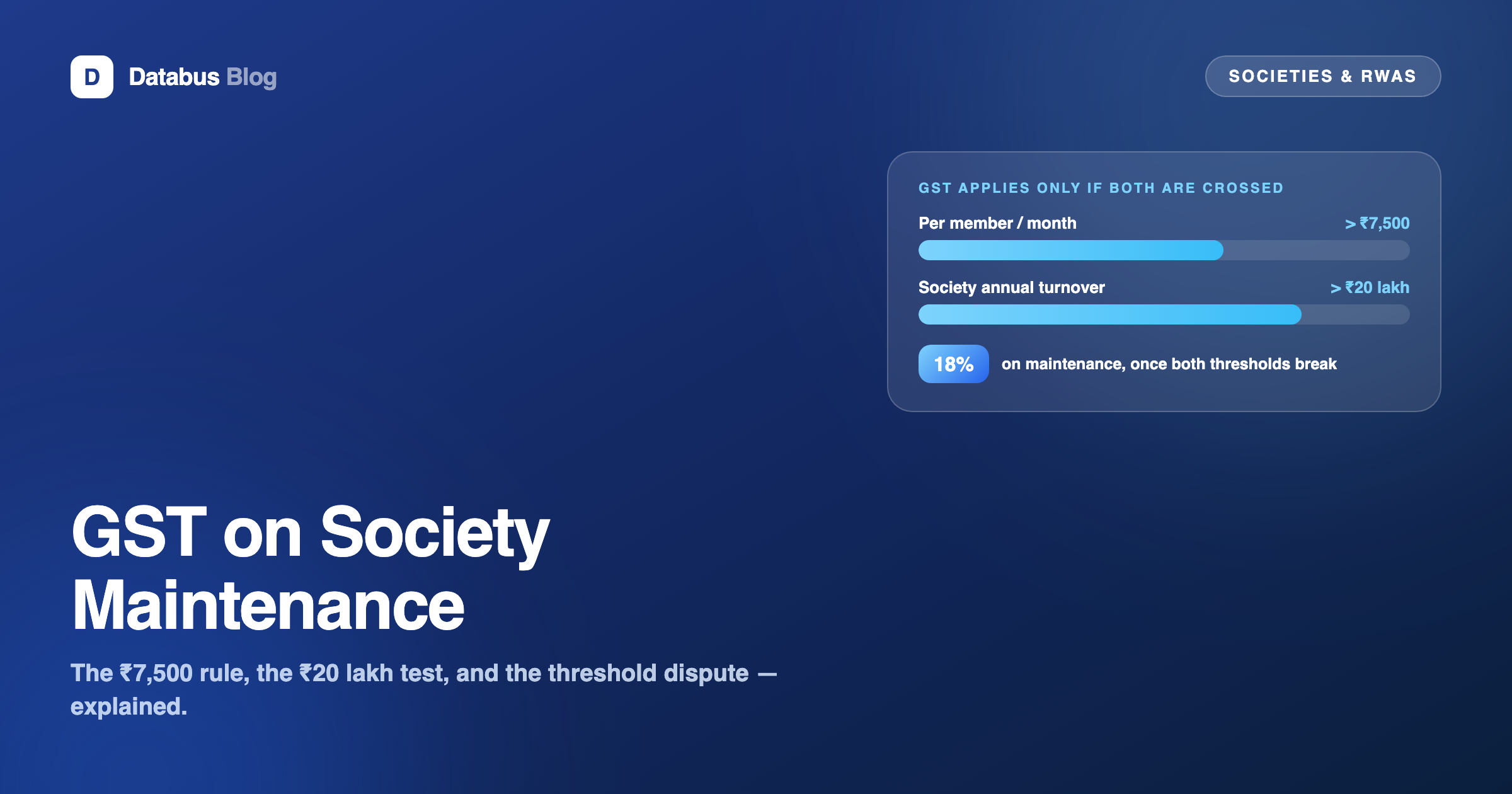
Whether a housing society must charge GST on maintenance comes down to two numbers, and a society is liable only when it crosses both:
- ₹7,500 per member per month — the exemption limit for maintenance charges collected by an RWA or cooperative housing society from its members, and
- ₹20 lakh aggregate annual turnover — the general GST registration threshold for the society itself.
A society collecting ₹9,000 per flat but with total annual collections under ₹20 lakh: no GST. A large society with ₹2 crore turnover but charging ₹4,000 per flat: no GST. Cross both lines, and maintenance attracts GST at 18%.
The dispute everyone should know about: threshold or exemption?
Say maintenance is ₹9,000 per month. Is GST charged on the whole ₹9,000, or only on the ₹1,500 above the limit? This is genuinely contested:
- The CBIC circular's position: ₹7,500 is a threshold — once crossed, the entire amount is taxable. GST on the full ₹9,000.
- The Madras High Court's position: "up to ₹7,500" is an exemption — only the excess is taxable. GST on ₹1,500.
The High Court ruling binds in Tamil Nadu; elsewhere, departments generally follow the circular. A society near the line should price this risk with its CA rather than pick the friendlier reading unilaterally.
Details that decide real cases
- The limit is per member, per flat. A member owning two flats gets the ₹7,500 exemption evaluated separately for each.
- What counts toward ₹7,500: the society's charges for common services — upkeep, security, common-area electricity and the like. Statutory pass-throughs such as property tax collected on behalf of the municipality are generally outside; the classification of individual heads is exactly the sort of thing to confirm with a CA, because billing structure changes the answer.
- Registered societies get input tax credit: a society charging GST can claim ITC on its own inputs — lifts AMC, security contracts, repairs — which softens the net burden.
- Once registered, compliance is monthly: invoices/receipts with GST, returns, and reconciliations become part of the society's routine.
What this means for the society's billing
The ₹7,500 test is applied per member per month, which means clean member-wise billing records are the difference between a five-minute answer and an audit problem. Societies that bill from a proper ledger — each flat's monthly charge, each head itemised, each receipt tracked — can show exactly who crossed the line and when. That's the billing layer EstateDeck runs for societies and RWAs, and our free society maintenance GST calculator does the two-threshold arithmetic for your numbers. For the governance side of maintenance decisions, see our guide to RWA rules and powers.
A note on accuracy: this is general information, not tax advice. GST rates, exemption limits and circulars change, and individual heads of charges are classified case by case — confirm your society's position with a chartered accountant before billing or registering. Databus is not a tax advisor.
Frequently Asked Questions
When does a housing society have to charge GST on maintenance?
Only when both conditions are met: the maintenance charge exceeds ₹7,500 per member per month, and the society's aggregate annual turnover exceeds ₹20 lakh. Cross both and the rate is 18%.
If maintenance is ₹9,000, is GST on the full amount or only above ₹7,500?
It is disputed. The CBIC circular says the full ₹9,000 becomes taxable once the limit is crossed; the Madras High Court held only the excess ₹1,500 is taxable, a ruling binding in Tamil Nadu. Elsewhere the circular view generally prevails — take a CA's advice.
Does the ₹7,500 limit apply per person or per flat?
Per member, per flat. A member owning two flats in the society gets the exemption evaluated separately for each flat.
Can a society claim input tax credit if it charges GST?
Yes. A GST-registered society can claim ITC on inputs like security contracts, lift maintenance and repairs, which reduces the net cost of charging GST.
Do small societies below ₹20 lakh turnover ever need GST registration?
If aggregate turnover stays under ₹20 lakh, the society is outside GST registration requirements even if some members pay more than ₹7,500 — both thresholds must be crossed for liability. Confirm edge cases (commercial income, other receipts) with a CA.