


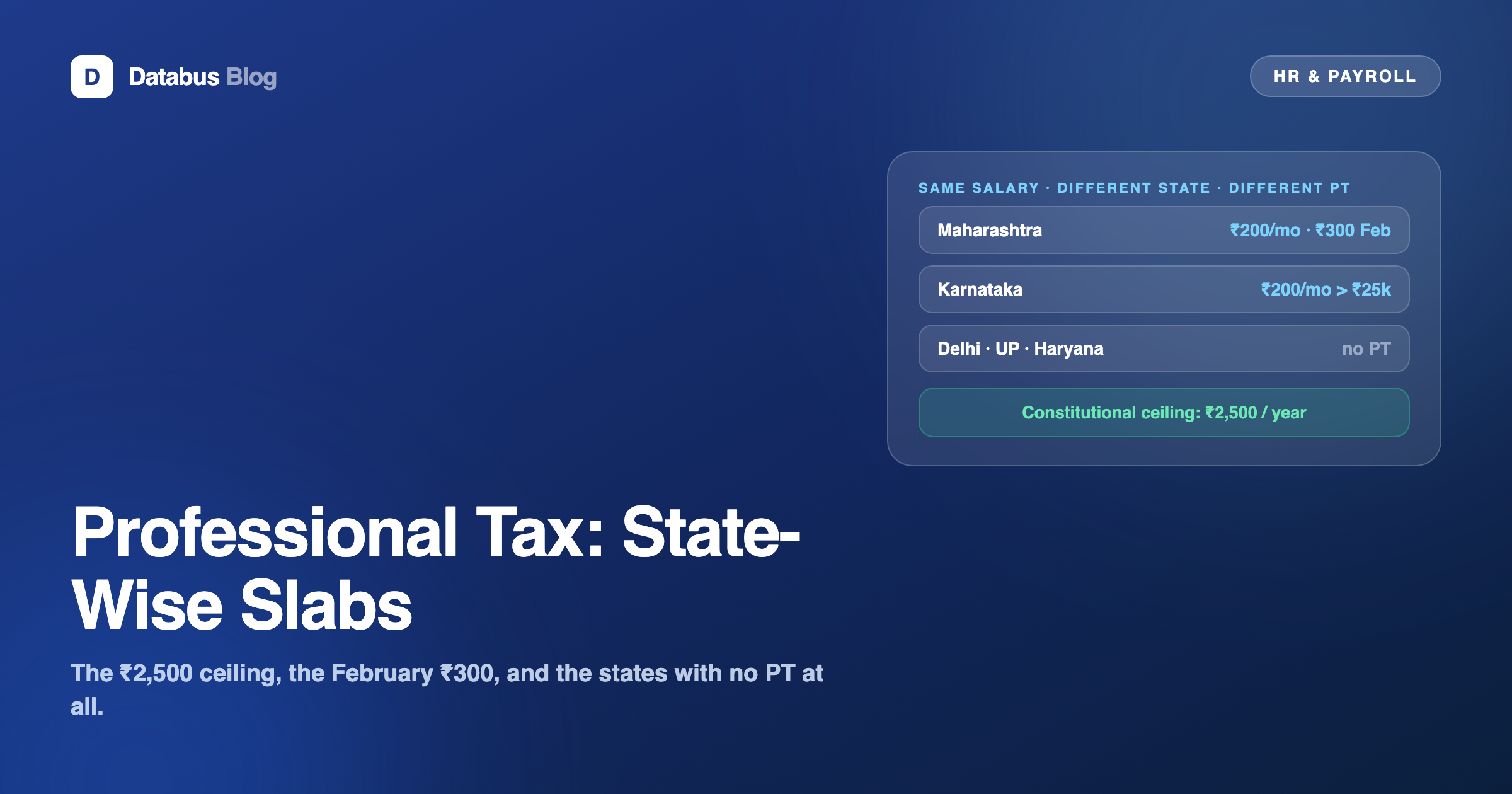
Professional tax (PT) is the small deduction on the payslip that generates outsized payroll confusion — because it is the one salary statute where the rules genuinely change every time your company crosses a state border. One employer running teams in Mumbai, Bengaluru and Gurugram deals with three different PT regimes — including one that doesn't exist. Here is how professional tax actually works, state by state.
What professional tax is
PT is a tax on professions, trades and employment levied by state governments (often administered through municipal bodies), authorised by Article 276 of the Constitution — which also sets its famous ceiling: no person can be charged more than ₹2,500 per year. That cap has stood since 1988, which is why PT amounts look quaint next to income tax. For salaried employees, the employer must deduct PT from salary and deposit it with the state; the self-employed pay directly against an enrolment certificate.
The two certificates employers need
- PTRC (Registration Certificate): registers you as an employer who deducts and deposits PT for employees.
- PTEC (Enrolment Certificate): covers the entity's (and directors'/partners') own liability as a person carrying on business.
Most PT states require both, per state where you have employees — a point multi-state employers routinely miss until a notice arrives.
Which states levy it — and which don't
PT is levied by most large states, including Maharashtra, Karnataka, West Bengal, Tamil Nadu, Telangana, Andhra Pradesh, Gujarat, Madhya Pradesh, Kerala, Odisha, Bihar, Jharkhand, Assam and several north-eastern states. Notably, there is no professional tax in Delhi, Uttar Pradesh, Haryana, Rajasthan, Punjab, Uttarakhand and a few others — an NCR employee pays zero PT while a colleague in Mumbai pays ₹2,500 a year on the same CTC.
Sample slabs — the flavour of the differences
- Maharashtra: salary above the threshold pays ₹200/month, but ₹300 in February — eleven ₹200s plus one ₹300 lands exactly on the ₹2,500 annual cap. Women earning up to ₹25,000/month are exempt.
- Karnataka: a deliberately simple structure — ₹200/month above a ₹25,000/month threshold (threshold raised effective April 2025), nothing below it.
- West Bengal, Telangana, AP, Gujarat, MP: multi-slab monthly structures with their own thresholds and amounts; Tamil Nadu levies half-yearly through urban local bodies, with slabs varying by municipality.
The pattern to internalise: the destination is fixed (max ₹2,500/year), but every state's road there differs — monthly vs half-yearly, thresholds, exemptions (women, senior citizens, persons with disabilities, in some states parents of children with disabilities), and February true-ups.
What this means for payroll
- PT follows the work location, not the head office. An employee working from Bengaluru is under Karnataka's slabs even if the company is registered in Delhi. Remote and hybrid teams have quietly turned this into a real compliance question.
- Slabs are checked against monthly gross (in most states) — so a variable-pay month can move an employee across a slab boundary.
- Deadlines and returns are state-specific — monthly, quarterly or annual filings depending on state and employee count, with interest and penalties for delay.
- PT paid is deductible from salary income under Section 16(iii) of the Income-tax Act — it reduces taxable income, which is why it appears in the tax computation on Form 16.
In practice, PT is exactly the kind of rule that should never live in a spreadsheet formula someone updates by memory: state-wise slab tables, exemption flags, February adjustments and location changes are configuration, and payroll software should apply them automatically. That is how PeopleDeck treats it — PT computed per employee from their work state's current table, deducted on the payslip, with the challan trail ready for filings.
A note on accuracy: slabs, thresholds and exemptions above are indicative and change through state budgets and notifications — Karnataka's 2025 threshold revision is a case in point. Verify your state's current schedule (state commercial-tax department or municipal body) before configuring payroll. This is general information, not tax advice.
Frequently Asked Questions
What is the maximum professional tax that can be charged in India?
₹2,500 per person per year — a ceiling set by Article 276 of the Constitution. States design their slabs to land at or under this cap; Maharashtra's ₹200 × 11 months + ₹300 in February pattern hits it exactly.
Which states have no professional tax?
Delhi, Uttar Pradesh, Haryana, Rajasthan, Punjab and Uttarakhand are the prominent ones. Most large states — Maharashtra, Karnataka, West Bengal, Tamil Nadu, Telangana, AP, Gujarat, MP, Kerala — do levy it.
Why is professional tax ₹300 in February?
In states like Maharashtra, ₹200 for eleven months totals ₹2,200; February's ₹300 tops the year up to exactly the ₹2,500 constitutional cap.
Is professional tax deducted on work location or company location?
Work location — the state where the employee actually works levies PT under its slabs, regardless of where the company is registered. Multi-state and remote teams need per-state PT registrations and tables.
Is professional tax deductible from income tax?
Yes — PT actually paid is allowed as a deduction from salary income under Section 16(iii), so it reduces taxable income in the year of payment.