


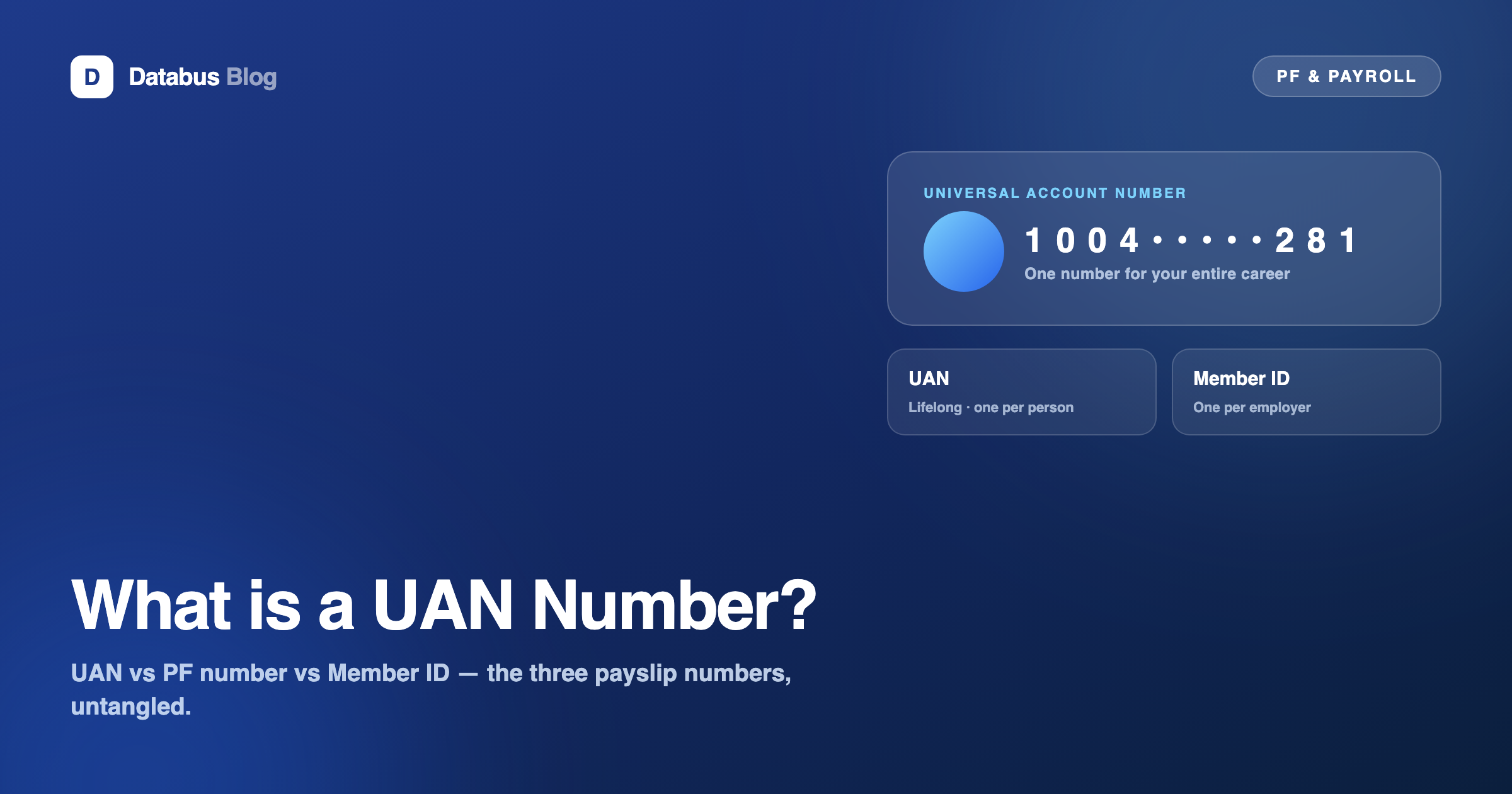
The Universal Account Number (UAN) is a 12-digit number issued by the Employees' Provident Fund Organisation (EPFO) to every employee who contributes to Provident Fund. It is allotted once and stays with you for your entire working life — across every job, employer and city. If you have ever contributed to PF, you have a UAN, even if you have never looked at it.
UAN vs PF number vs Member ID — the difference in one line
The confusion exists because three numbers travel together on your payslip:
- UAN — your identity with EPFO. One per person, for life.
- Member ID (often called the PF number) — your PF account with one employer. It encodes the EPFO office, your employer's establishment code and your member serial. Every time you join a new company, a new Member ID is created.
- The link between them — all your Member IDs sit under your single UAN, the way multiple bank accounts can sit under one customer ID.
So no — the UAN and the PF number are not the same thing. The PF number changes with every job; the UAN never does.
Where to find your UAN
- Your payslip. Most employers print the UAN (and the Member ID) on the monthly payslip.
- Your HR or payroll team. Employers capture the UAN at joining; payroll can look it up in a minute.
- The EPFO member portal. The unified member portal has a "Know your UAN" facility using your Aadhaar-linked mobile number.
What happens when you change jobs
Your new employer does not create a new UAN — they create a new Member ID under your existing UAN. You share your UAN at joining, the new PF account links to it, and you can then transfer the old account's balance to the new one online. Two UANs for one person is an error state (it usually happens when a joiner doesn't share their existing UAN and the employer generates a fresh one); EPFO has a merge process, but the cleaner path is simply telling every new employer your existing UAN on day one.
Why the UAN matters more every year
Almost everything EPFO offers is keyed to an activated UAN: viewing your PF passbook, checking whether your employer actually deposited contributions, online withdrawal and transfer claims, and updating KYC. Our companion guide walks through activating your UAN and using the EPFO member portal step by step.
The employer's side of the same number
For payroll teams, UANs are a monthly operational reality: capturing the UAN correctly at onboarding, generating Member IDs for joiners, keeping name/Aadhaar/date-of-birth KYC consistent so employees' claims don't bounce, and filing the monthly ECR against the right accounts. Payroll software like PeopleDeck keeps employee PF identities, contributions and statutory files in one system, so the numbers on the payslip and the numbers with EPFO stay in agreement.
A note on accuracy: EPFO processes and portal behaviour change over time. Confirm current procedure on the official EPFO portals or with your payroll team before acting. Databus is not affiliated with EPFO.
Frequently Asked Questions
Is the UAN the same as the PF number?
No. The UAN is your single, lifelong 12-digit identity with EPFO. The PF number (Member ID) identifies one PF account with one employer and changes every time you switch jobs. All your Member IDs link under the same UAN.
How do I find my UAN?
Check your payslip, ask your HR or payroll team, or use the "Know your UAN" facility on the EPFO unified member portal with your Aadhaar-linked mobile number.
Do I get a new UAN when I change jobs?
No. Your new employer creates a new Member ID under your existing UAN. Share your UAN at joining so a duplicate is not generated by mistake.
I have two UANs. What should I do?
This usually happens when a previous UAN was not shared with a new employer. EPFO provides a merge/deactivation process — typically by raising a request through the member portal or your employer — after which the old account's balance is transferred to the active UAN.
Is a UAN mandatory to withdraw or transfer PF?
In practice, yes. Online claims, transfers and the PF passbook all operate through an activated UAN with completed KYC. Paper-era processes without UAN are effectively obsolete.