


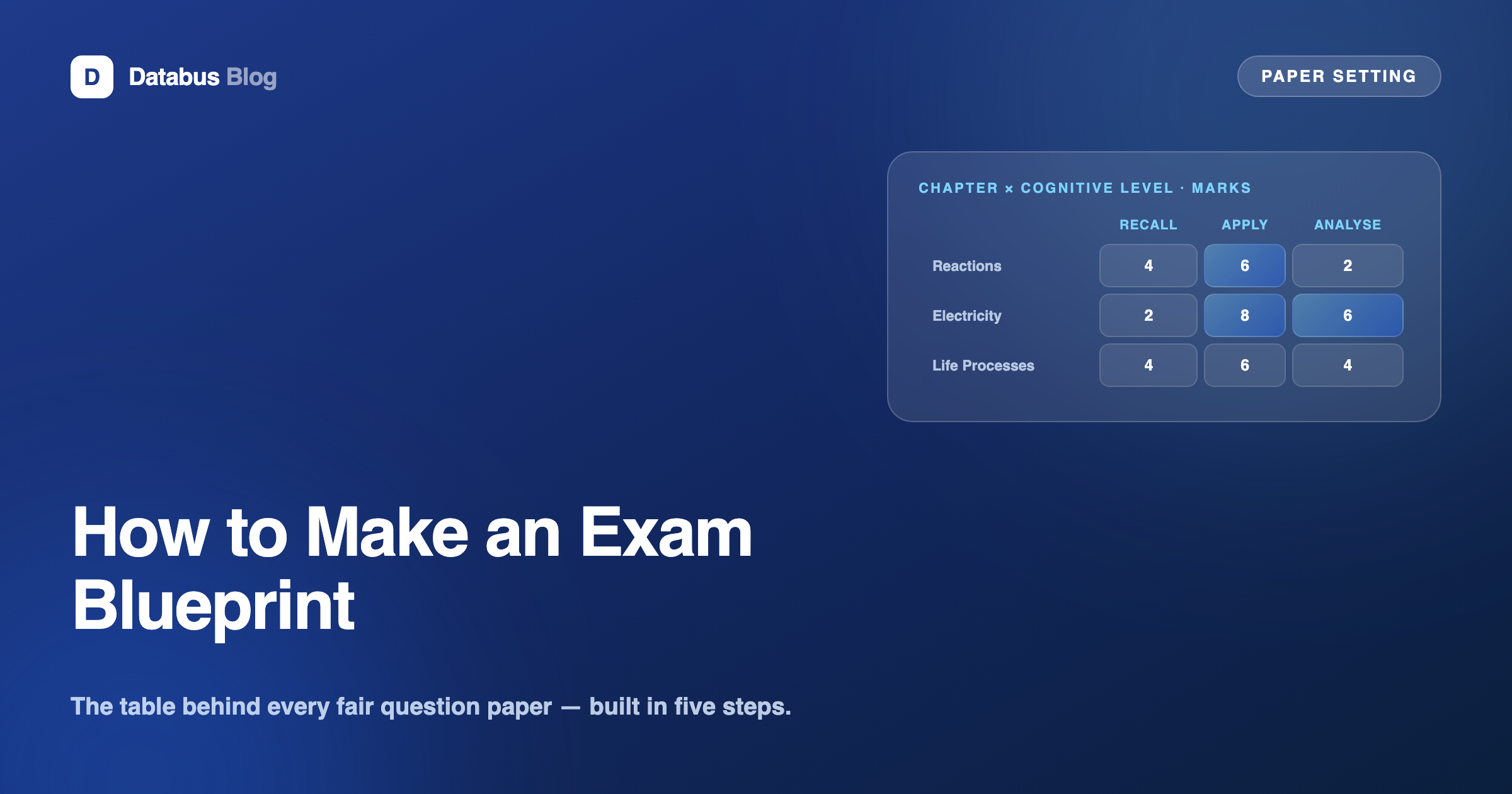
The difference between a fair exam paper and a lopsided one is usually decided before a single question is written. A blueprint — the table that fixes how marks distribute across chapters, cognitive levels and question types — is what boards use to keep papers consistent year after year, and what individual teachers skip when Sunday night runs short. Here is how to build one in five steps.
Step 1 — Fix the paper's frame
Total marks, duration, sections, and question types with their mark values (MCQ ×1, short answer ×2/×3, long answer ×5, case-based ×4). This frame is arithmetic: if the paper is 80 marks, the blueprint's cells must total exactly 80.
Step 2 — Weight the chapters
Distribute marks across syllabus units in proportion to teaching hours and importance — the weightage boards publish for exactly this reason. A unit that took 20% of the term should carry roughly 20% of the marks. Deviations should be decisions, not accidents.
Step 3 — Weight the cognitive levels
Decide the split across Bloom's levels — say 30% remember/understand, 40% apply, 30% analyse-and-above for a senior secondary paper. This is the step that stops a paper from silently collapsing into recall. If you set papers for CBSE classes, the board has already made this decision for you: 50% of board-paper marks are competency-based, and internal papers should rehearse that ratio.
Step 4 — Cross the two: the blueprint grid
The blueprint is a chapter × cognitive-level grid, each cell holding marks and question counts. A fragment of one for an 80-mark science paper:
- Chemical Reactions — 12 marks: 2 MCQ (recall), 1 short (apply), 1 long (analyse)
- Electricity — 16 marks: 2 MCQ (apply), 1 case-based (analyse), 1 long (evaluate)
- Life Processes — 14 marks: 1 MCQ (recall), 2 short (understand/apply), 1 long (analyse)
When the grid totals the paper's marks and both margins match your step-2 and step-3 weightings, the design is done — and anyone on the department can now write or review questions against it.
Step 5 — Write to cells, then audit against the grid
Questions are written to fill specific cells, not free-form. The audit is mechanical: does each question sit at its intended level (a "case-based" question that is really recall in costume fails the cell), and do difficulty and time-to-answer feel right per section? A colleague can audit a blueprinted paper in twenty minutes; an unblueprinted one can't be audited at all, only re-argued.
Why teachers skip blueprints — and the way out
Honest answer: time. Building the grid and then hand-writing thirty questions to fit it takes an evening per paper, and a tutor or school teacher sets dozens a year. This is precisely the workload PaperDeck automates — its question paper generator takes the blueprint (chapters, marks, Bloom's mix, question types) and assembles the paper with an answer key, so the teacher's evening goes into reviewing against the grid instead of drafting from a blank page.
Frequently Asked Questions
What is an exam blueprint?
A pre-writing design table that fixes how a paper's marks distribute across syllabus chapters, cognitive levels and question types. Boards use blueprints to keep papers consistent; the same tool works for any class test.
What should chapter weightage be based on?
Teaching time and syllabus importance — a unit that consumed 20% of the term should carry roughly 20% of the marks. Boards publish official weightages for board classes; follow them for pre-boards.
How do I decide the cognitive-level split?
By class maturity and board pattern. Junior papers lean toward remember/understand; senior papers shift weight to apply and above. CBSE's 50% competency-based requirement effectively fixes the senior split for you.
How detailed should the blueprint grid be?
One cell per chapter × cognitive level, holding marks and question count (and question type). Detailed enough that a colleague could write the paper from the grid alone — that is the test.
Can a blueprint be reused across years?
The grid can persist as long as syllabus and pattern stay stable — that is how boards achieve year-to-year consistency. Refresh the questions, keep the design, and revise the grid when weightages or patterns change.