


Multiple-choice questions look like the easiest item type to write and are actually the hardest to write well. A subjective question can survive a vague phrasing — the examiner's judgement absorbs it. An MCQ has no examiner at grading time; every weakness is baked in permanently, and students are superb at exploiting them. Here is the craft, distilled: stems, distractors, option hygiene, and the checklist to run before any question reaches a paper.
Start with the stem, and make it self-sufficient
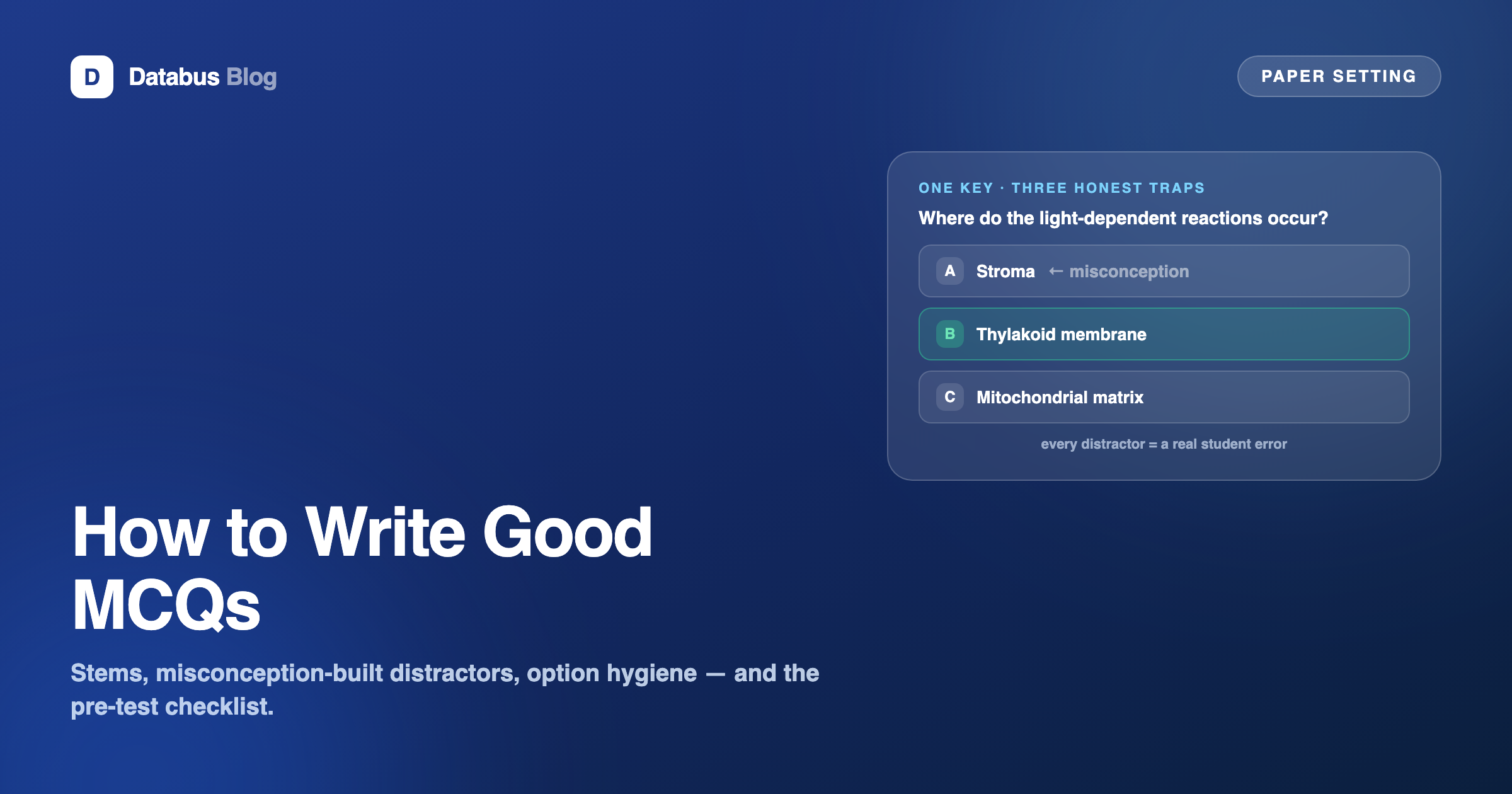
The stem should pose a complete problem before the options are read. The test: cover the options — can a student who knows the material answer from the stem alone? "Which of the following is true about photosynthesis?" fails the test; it is four true/false questions in a trench coat. "In which organelle do the light-dependent reactions of photosynthesis occur?" passes. Practical stem rules:
- Ask one thing. Compound stems ("define and identify…") belong in subjective sections.
- Prefer positive phrasing. If you must use NOT/EXCEPT, capitalise it — students under time pressure read past lowercase negatives, and then the item measures reading care, not the concept.
- Put shared words in the stem, not the options. If every option starts with "It increases the…", move that phrase up.
- No unintended cues. Grammar that agrees with only one option ("an ___" followed by one vowel-initial option) hands over the answer.
Distractors: the real work
The key is easy — you know the right answer. The question's quality lives in the wrong options. A distractor earns its place only if a student with a specific, real misunderstanding would choose it. The best sources:
- Known misconceptions. Every teacher knows them: mass vs weight confusions, sign errors in electrochemistry, "current gets used up" in circuits. Each misconception is a ready-made distractor — and choosing it tells you exactly what to reteach.
- Right method, wrong step. For numericals, work the problem with the classic error — forgot to square, used diameter for radius, unit slip — and use that result. A random wrong number distracts nobody; the botched-step number catches exactly the students who half-know.
- True statement, wrong question. A fact that is correct in itself but doesn't answer this stem — catches keyword-matchers who never processed the question.
And the hygiene rules that keep distractors honest: all options parallel in grammar and, roughly, in length (the longest option is the answer often enough that students bet on it); no "all of the above" (two recognised truths give it away without knowledge of the third) and "none of the above" only when defensible; one — exactly one — defensibly correct key, which is where most disputed answer keys are born.
Aim questions at the right cognitive level
MCQs are not condemned to recall. A stem that presents a novel scenario and asks students to apply a principle tests application; one that presents data and asks what conclusion follows tests analysis. The board shift toward competency-based questions is exactly this move. The discipline is to decide the level before writing — a blueprint that allocates items across Bloom's levels — and then write to the slot, rather than discovering afterwards that the whole paper is remembering-level.
The pre-test checklist
Run every item past these before it ships:
- Stem answerable with options covered?
- Exactly one defensible key — would a subject expert dispute it?
- Every distractor tied to a real error a student actually makes?
- Options parallel, similar length, no grammatical cues, no overlap?
- Negatives capitalised; no double negatives anywhere?
- Numerical options sorted, plausible, and not eliminable by estimation alone?
- Language at or below the students' reading level — testing the concept, not vocabulary?
Then the step almost nobody does solo: have a colleague attempt the item cold. If a knowledgeable colleague hesitates between two options, students will split on them — fix the key or the distractor before the exam does it for you.
The practical bottleneck
None of this is conceptually hard; it is time-expensive. A well-built MCQ with misconception-based distractors takes several minutes of focused work, and a 40-question paper of them is an evening gone. This is the specific drudgery AI generation compresses well — producing structured first drafts with plausible distractors at chosen difficulty levels for a teacher to curate — and it is what PaperDeck is built for: generate against your syllabus and blueprint, then apply exactly the checklist above to the draft, keeping the judgement human. The free teacher tools cover the adjacent jobs — blueprints, answer sheets — if you want to see the workflow.
Frequently Asked Questions
What makes a good MCQ distractor?
A wrong option that a student with a specific, real misunderstanding would actually choose — a known misconception, the result of a classic wrong step in a calculation, or a true statement that doesn't answer this stem. Random wrong answers distract nobody.
Should I use "all of the above" in MCQs?
Avoid it. A student who recognises any two options as true gets the item right without knowing the third, and a student who spots one false option eliminates it instantly — either way it measures test-taking, not knowledge.
How many options should an MCQ have?
Four is the practical standard (boards and national exams use it). Research shows three well-built options often work as well as four weak ones — the real constraint is how many genuinely plausible distractors exist, not the count.
Can MCQs test higher-order thinking?
Yes — stems that pose novel scenarios, present data to interpret, or require choosing the right principle to apply test application and analysis. The item's cognitive level is a design decision made before writing, ideally fixed by the paper's blueprint.
How do I check an MCQ before putting it in a paper?
Cover the options and confirm the stem stands alone; verify exactly one defensible key; tie each distractor to a real error; check options are parallel with no grammar cues; and have a colleague attempt it cold — hesitation between two options predicts a disputed key.