


An unregistered residents' group can talk to the builder; a registered RWA or housing society can open a bank account, sign contracts, sue and be sued, and collect maintenance with legal standing. Registration is what turns a WhatsApp group of owners into a body the law recognises. Here is how it works — and what to set up the day after the certificate arrives.
The three legal routes
Which law you register under depends on your state and the shape of your community:
- Societies Registration Act (1860, with state amendments) — the classic RWA route: a minimum group of residents forms an association with a memorandum and rules, registered with the state's Registrar of Societies.
- State Cooperative Societies Acts — the cooperative housing society route, common in states like Maharashtra where flat-purchaser bodies conventionally register as cooperative housing societies under the state act, with model bye-laws.
- Apartment Ownership Acts — many states provide for associations of apartment owners under their apartment ownership legislation, typically tied to the builder executing a deed of declaration.
The right route is state-specific — the same community would register differently in Delhi, Mumbai and Bengaluru. Confirm with the local registrar's office or a lawyer before filing.
The documents registrars actually ask for
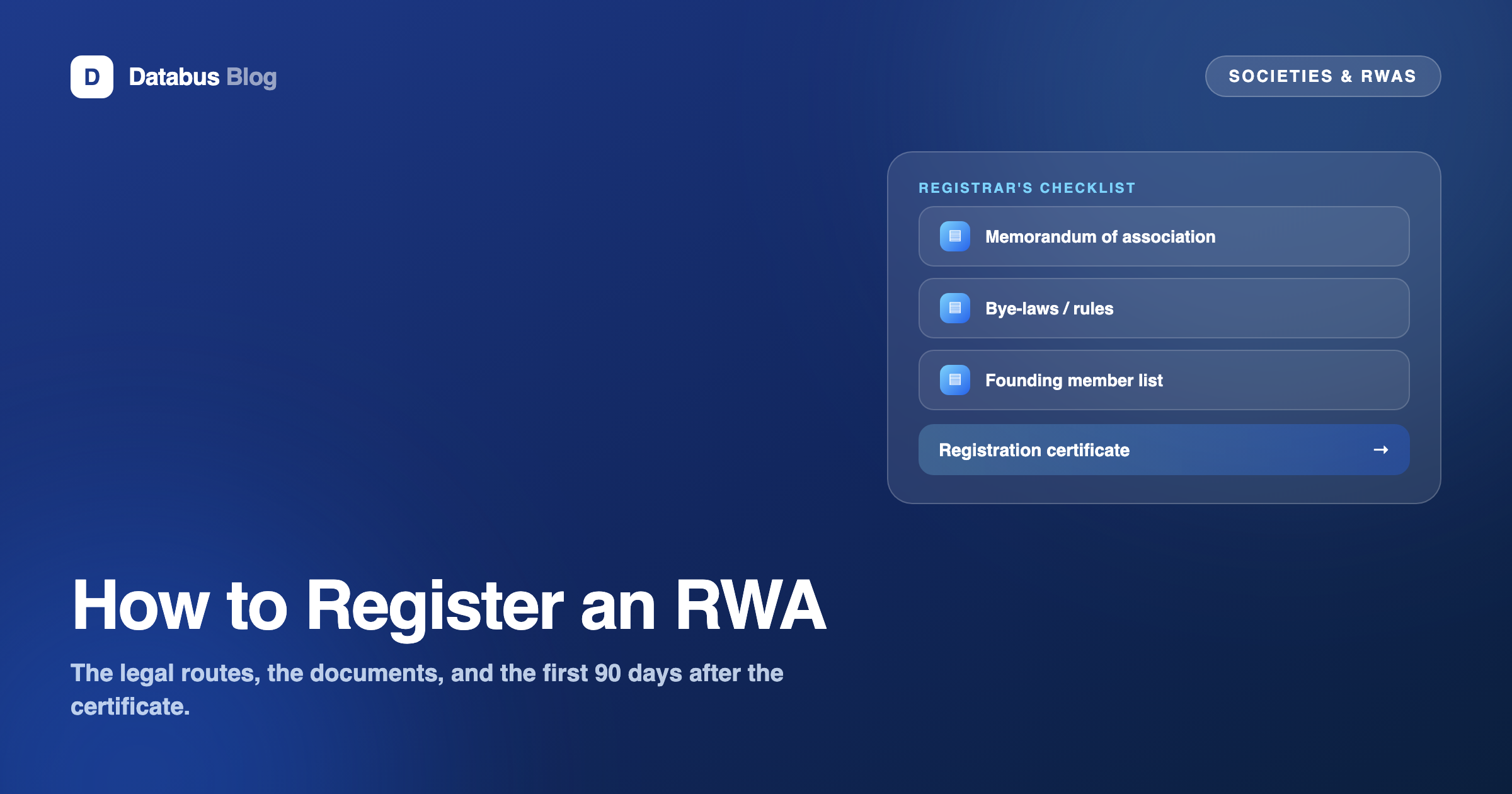
- Memorandum of association — name, registered address, aims and objects, and the founding members' details.
- Rules and regulations / bye-laws — how the body is governed: membership, general-body meetings, committee elections, accounts and audit. Cooperative routes usually adopt the state's model bye-laws.
- Member list with signatures — the founding members (minimum counts vary by route and state), with addresses and consent.
- Proof of address for the registered office, identity proofs of office bearers, and the prescribed fee.
- Resolution of the formation meeting authorising the application.
After scrutiny, the registrar issues the registration certificate — the document banks, vendors and courts will ask for.
The first 90 days after registration
Registration creates the body; these steps make it function:
- Open the bank account in the association's name, operated per the bye-laws (typically president + treasurer jointly).
- Apply for PAN, and evaluate GST exposure — maintenance above ₹7,500 per member per month with turnover above ₹20 lakh brings the society into GST.
- Adopt a maintenance structure — per-flat or per-sqft, due dates, late-fee policy — by general-body resolution, so collection has authority behind it.
- Start the books on day one — member ledger, receipts for every collection, expense records against bills. The first audit and the first AGM both depend on them.
- Minute everything — committee and general-body minutes are the association's legal memory.
Most new committees discover that the hard part is not registering but running: billing every flat correctly each month, chasing dues fairly, and producing accounts members trust. That operating layer is what EstateDeck gives a new association from day one — member-wise billing, receipts, dues and expense ledgers in one system. For what the governing committee can and cannot do once registered, see our guide to RWA rules, responsibilities and powers.
A note on accuracy: registration routes, member minimums, fees and formats differ by state and change with amendments. Confirm current requirements with your state's Registrar of Societies / cooperative department or a local lawyer before filing. This is general information, not legal advice.
Frequently Asked Questions
Which law is an RWA registered under?
Depending on the state and the community's structure: the Societies Registration Act (with state amendments) for classic RWAs, the state Cooperative Societies Act for cooperative housing societies, or the state's Apartment Ownership Act for associations of apartment owners. The right route is state-specific.
What documents are needed to register a housing society or RWA?
A memorandum of association, rules/bye-laws, the founding members' list with signatures and consent, address proof for the registered office, office bearers' ID proofs, the formation-meeting resolution and the prescribed fee. Exact formats vary by state.
Can an unregistered RWA collect maintenance?
It can ask, but it lacks legal standing — no bank account in its own name, no enforceable contracts, weak footing in disputes. Registration is what gives maintenance collection and vendor contracts legal authority.
What should a newly registered society do first?
Open the association's bank account, obtain PAN, assess GST exposure, adopt a maintenance structure by general-body resolution, and start proper books — member ledger, receipts and expense records — from the first collection.
How long does RWA registration take?
It varies by state and registrar workload — typically weeks from filing a complete application, longer if the memorandum or bye-laws need corrections. Filing complete, correctly formatted documents is the main thing applicants control.