


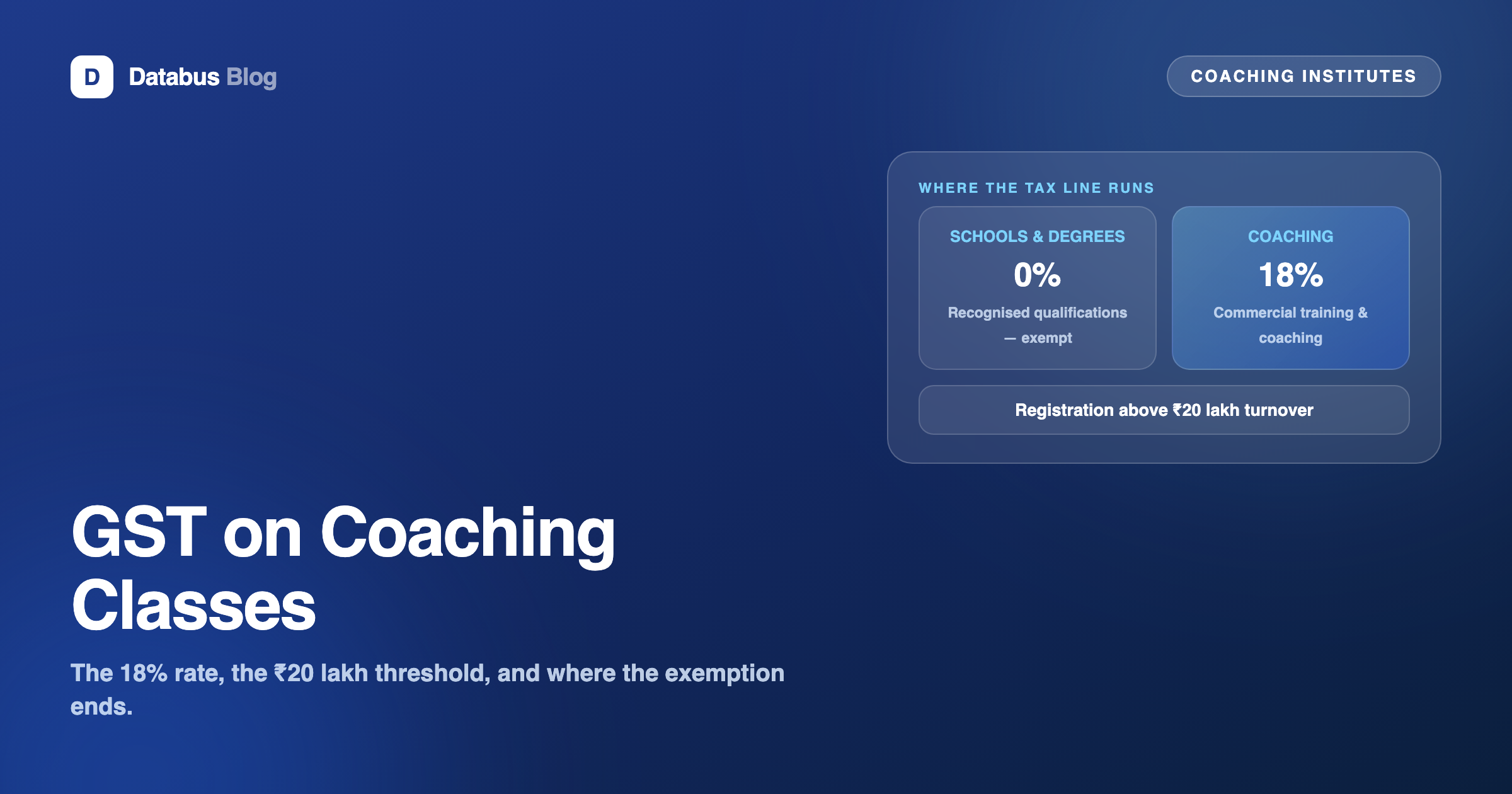
Indian tax law draws a sharp line through education: formal education is exempt from GST; commercial coaching is taxed at 18%. A school teaching Class 11 physics charges no GST; a coaching centre teaching the same physics to the same student charges 18%. Understanding where that line runs — and when it starts applying to you — is basic hygiene for anyone running an institute.
The exemption line
- Exempt: pre-schools, schools up to higher secondary, and institutions whose courses lead to a qualification recognised by law (degrees, diplomas from recognised boards/universities).
- Taxed at 18%: competitive-exam coaching (JEE, NEET, UPSC, banking), tuition centres, skill and hobby classes, and commercial online courses. The service is classified under commercial training and coaching.
The test is not the subject taught — it is whether the provider's course leads to a legally recognised qualification. Coaching supplements formal education; it does not award it. That is exactly why it is taxed. The GST 2.0 rate restructuring (September 2025) left this architecture unchanged: recognised institutions stay exempt, commercial coaching stays at 18%.
The ₹20 lakh registration threshold
GST registration becomes mandatory when aggregate annual turnover crosses ₹20 lakh (₹10 lakh in special-category states). Below it:
- a home tutor or small centre need not register and cannot charge GST;
- crossing the threshold mid-year triggers registration obligations from that point;
- "aggregate turnover" counts all taxable income of the entity, not just tuition fees — materials sold, hostel income and the rest count toward the line.
What registration changes operationally
- Fees are quoted GST-inclusive or plus-18% — and which one you choose changes your effective price against unregistered competitors.
- Every receipt becomes a tax invoice with GSTIN, SAC classification and tax shown separately.
- Returns are periodic, and input tax credit opens up — GST paid on rent, software, advertising and equipment offsets output tax.
- Refunds interact with the fee rules: the Ministry's coaching guidelines require pro-rata refunds within 10 days; refunding a GST-invoiced fee means issuing credit notes that keep the tax trail clean.
The record-keeping this demands
An institute near the threshold needs to know its aggregate turnover continuously — and a registered one needs every collection invoiced, every refund credit-noted, every return reconciled. That is ledger discipline, not tax expertise, and it is what institute software exists for: TutorDesk keeps fee collections, receipts and refunds student-wise and date-wise, so your CA gets clean numbers instead of a shoebox. Planning a new centre? Price the GST question into your fees from day one — our starting-a-centre guide and startup cost calculator cover the rest of the arithmetic.
A note on accuracy: rates, thresholds and classifications change with GST Council decisions, and individual cases turn on facts. Confirm your institute's position with a chartered accountant. This is general information, not tax advice.
Frequently Asked Questions
What is the GST rate on coaching classes?
18%, under commercial training and coaching services. The GST 2.0 restructuring of September 2025 kept coaching at 18% while formal education remains exempt.
Why are schools exempt from GST but coaching centres not?
The exemption attaches to institutions whose courses lead to legally recognised qualifications — schools, boards, universities. Coaching supplements formal education without awarding recognised qualifications, so it is treated as a commercial service.
Does a home tutor need to charge GST?
Only after crossing the registration threshold of ₹20 lakh aggregate annual turnover (₹10 lakh in special-category states). Below it, registration is not required and GST cannot be charged.
Can a coaching institute claim input tax credit?
Yes — once registered, GST paid on rent, advertising, software, equipment and other business inputs can offset the 18% output tax, reducing the net burden.
Is online coaching also taxed at 18%?
Yes. Commercial online courses and e-learning from a GST-registered provider attract 18% just like classroom coaching; the exemption follows recognised qualifications, not the mode of delivery.