


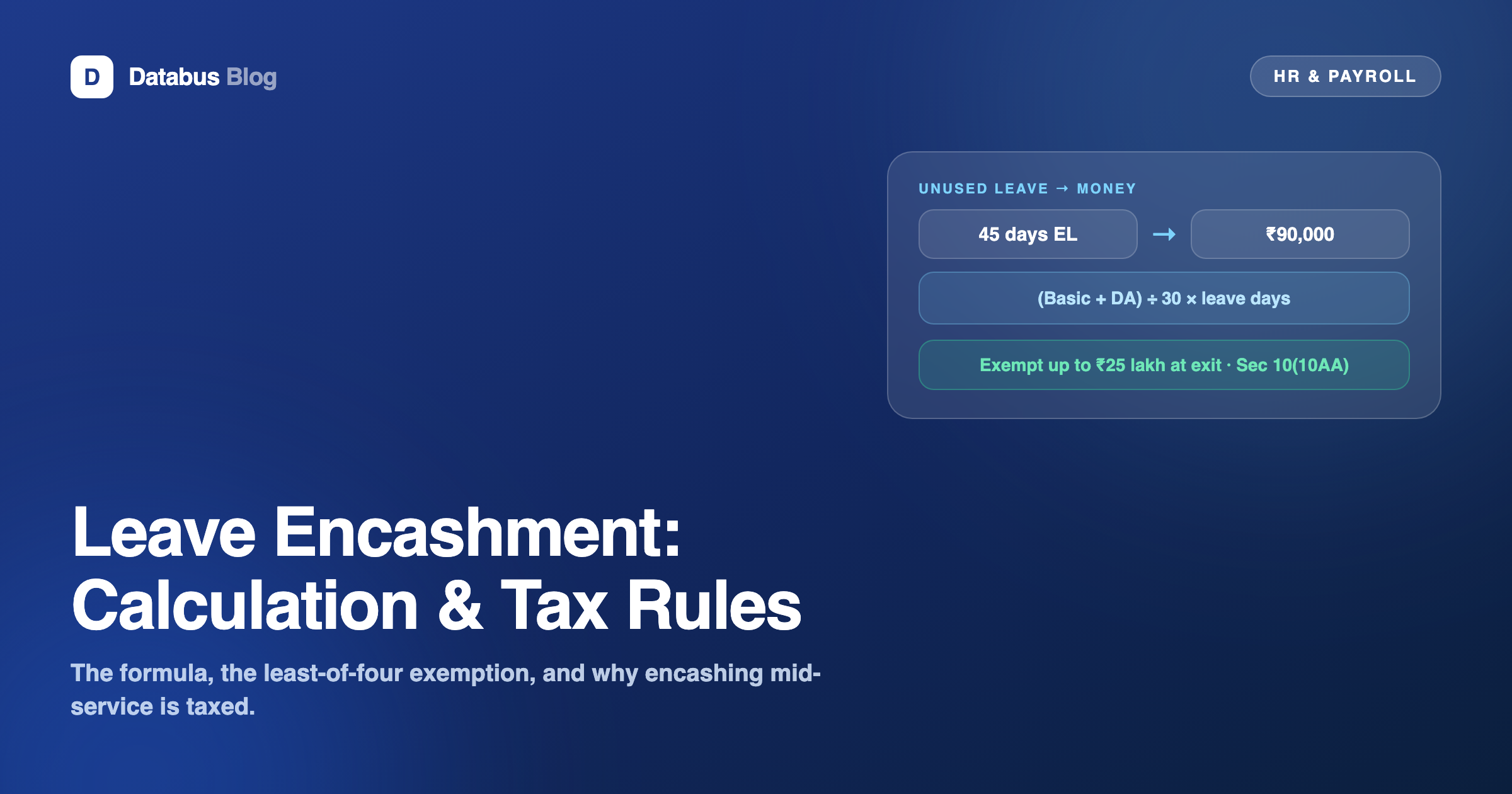
Unused earned leave is money — most organisations let employees convert accumulated leave into cash, either while working or when they finally leave. The catch is that the two moments are taxed completely differently, and the calculation itself trips up both payroll teams and employees. Here is how leave encashment actually works: the formula, the Section 10(10AA) exemption, and the ₹25 lakh limit that changed the game for private-sector employees.
What gets encashed
Only leave that survives the year gets encashed — typically earned leave (EL) / privilege leave, which most leave policies allow to carry forward and accumulate up to a cap. Casual leave and sick leave usually lapse and are not encashable (policy-dependent). The employer's leave policy decides three things: which leave types accumulate, the accumulation ceiling, and whether encashment is allowed during service or only at exit.
The standard calculation
Most policies pay leave at basic salary (often basic + dearness allowance), per day, using a 30-day month:
Encashment = (Basic + DA) ÷ 30 × number of unused leave days
An employee with basic + DA of ₹60,000/month and 45 days of unused EL receives ₹60,000 ÷ 30 × 45 = ₹90,000. Some employers use gross salary or a 26-day divisor — the policy document governs, so payroll and the employee should be reading the same clause.
The tax rules — where it gets interesting
Taxation under Section 10(10AA) of the Income-tax Act splits on two axes: when you encash, and who you work for.
1. Encashment during service: fully taxable
Encash leave while still employed — as many companies allow annually — and the entire amount is taxable as salary income for everyone, government or private. No exemption applies. It simply lands in the payslip and gets taxed at slab.
2. At retirement or resignation — government employees
Central and State government employees get a full exemption: leave encashment received at retirement (including on resignation) is entirely tax-free, with no upper limit.
3. At retirement or resignation — everyone else
Private-sector and other non-government employees get an exemption equal to the least of four amounts:
- Leave encashment actually received;
- 10 months' average salary (average of basic + DA for the 10 months before exit);
- Cash equivalent of unused leave, counting leave entitlement at a maximum of 30 days per completed year of service;
- ₹25 lakh — the ceiling raised from ₹3 lakh, effective 1 April 2023.
Anything above the least-of-four is taxable as salary. Two fine-print points that matter in practice: the ₹25 lakh is a lifetime aggregate — exemptions claimed at earlier exits eat into it — and if you receive encashment from more than one employer in the same year, the combined exemption still cannot cross ₹25 lakh.
Worked example
An employee resigns after 14 years. Basic + DA averaged ₹80,000/month over the last 10 months; 320 days of EL stand unused; the employer's policy pays all of it: ₹80,000 ÷ 30 × 320 = ₹8,53,333 received. The four candidates: received ₹8,53,333; 10 months' salary ₹8,00,000; 30 days × 14 years = 420 days minus leave already availed — at the statutory 30-day rate the cash equivalent here works out above the received amount; and ₹25,00,000. The least is ₹8,00,000 exempt; the remaining ₹53,333 is taxed as salary. Note the second limb — 10 months' salary — is the one that usually bites long-tenure employees, not the ₹25 lakh cap.
What payroll teams get wrong
- Treating exit encashment as fully exempt by default. The least-of-four computation is mandatory for non-government employees, and TDS must be deducted on the taxable slice in the full-and-final settlement.
- Using the wrong salary base. The exemption formula uses basic + DA (plus commission as a fixed percentage of turnover, where applicable) — not gross.
- Ignoring the 30-days-per-year statutory cap. A policy may credit 40 days of EL a year, but the exemption calculation recognises at most 30 days per completed year of service.
- Missing the aggregation rules. Prior-year exemptions and multiple employers in one year both count against the same ₹25 lakh.
Leave encashment sits at the junction of the leave ledger and payroll — the balance must be right before the money can be. That is why leave accounting and payroll belong in one system: PeopleDeck tracks accruals, carry-forward and encashment against policy, and carries the result straight into the payslip and full-and-final settlement, alongside gratuity and Form 16.
A note on accuracy: figures reflect Section 10(10AA) as amended effective 1 April 2023 (₹25 lakh limit notified May 2023). Tax outcomes depend on individual facts and the applicable regime — confirm with a tax professional before acting. This is general information, not tax advice.
Frequently Asked Questions
Is leave encashment taxable?
During service, yes — fully taxable as salary for everyone. At retirement or resignation, government employees are fully exempt; non-government employees get an exemption equal to the least of the amount received, 10 months' average salary, leave valued at up to 30 days per year of service, and ₹25 lakh.
What is the leave encashment exemption limit for private employees?
₹25 lakh, effective 1 April 2023 (raised from ₹3 lakh). It is a lifetime aggregate across all employers and exits, and the actual exemption is often lower because the least-of-four formula applies.
How is leave encashment calculated?
Most policies pay (basic + DA) ÷ 30 × unused leave days. The employer's leave policy decides which leave types are encashable, the accumulation cap, and the salary base — check the policy clause.
Is leave encashment on resignation exempt, or only on retirement?
The Section 10(10AA) exemption applies to encashment received on leaving the job, which courts and practice have extended to resignation — not just superannuation. The same least-of-four computation applies for non-government employees.
Does leave encashment exemption apply under the new tax regime?
Yes — the Section 10(10AA) exemption for encashment at retirement or resignation is available under both the old and new regimes. Encashment during service remains fully taxable under both.