


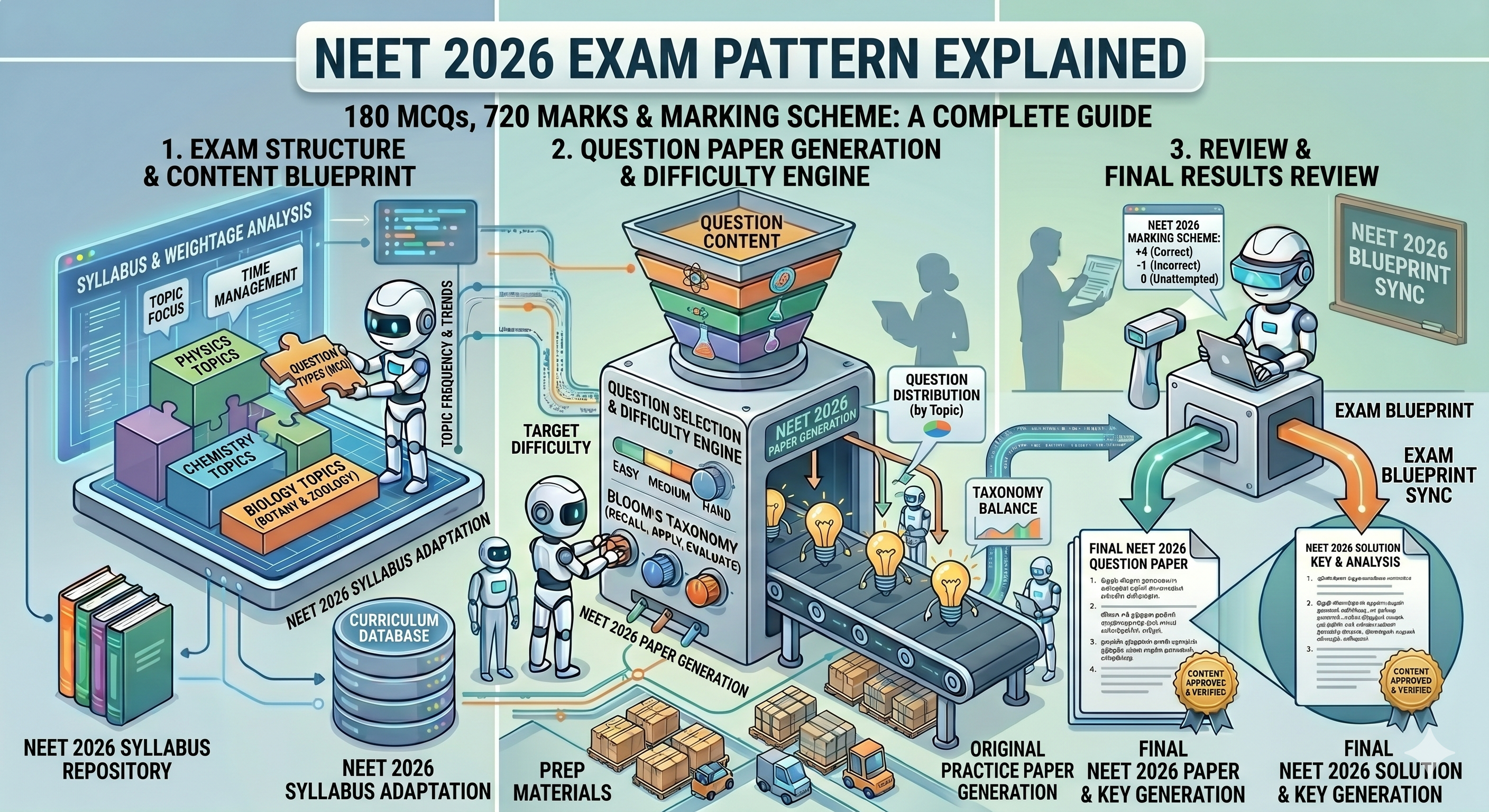
The NEET UG pattern in plain English — how the paper is structured, how marking works, and how to build mock tests that mirror it.
NEET UG is a single 180-question, multiple-choice paper worth 720 marks, sat offline in 3 hours, covering Physics, Chemistry and Biology. Each correct answer earns +4, each wrong answer loses 1, and unanswered questions score zero. Since 2025 the old optional "Section B" was removed, so all 180 questions are now compulsory. Here's the full breakdown — and how to turn it into realistic practice papers.
NEET UG pattern at a glance
| Element | Detail |
|---|---|
| Mode | Offline (OMR / pen-paper) |
| Duration | 3 hours (180 minutes) |
| Total questions | 180 (all compulsory) |
| Total marks | 720 |
| Question type | Single-best-answer MCQs (4 options) |
| Correct answer | +4 |
| Wrong answer | −1 |
| Unanswered | 0 |
NTA can revise the pattern; confirm the current year's details at neet.nta.nic.in before relying on them.
Subject-wise split
The 180 questions are divided across three subjects, with Biology carrying the heaviest weight because it combines Botany and Zoology:
- Physics — 45 questions · 180 marks
- Chemistry — 45 questions · 180 marks
- Biology (Botany + Zoology) — 90 questions · 360 marks
That 50% Biology weighting is the single most important planning fact: half your marks live in one subject, so mock tests should reflect that ratio rather than splitting questions evenly.
How the marking scheme shapes strategy
The +4/−1 scheme rewards accuracy and punishes guessing. Two practical consequences:
- Blind guessing is negative-expectation. A random 4-option guess averages out to a loss over many questions, so a well-built mock should train students to skip rather than guess when they have no elimination.
- Partial elimination changes the maths. Once two options are ruled out, attempting becomes worthwhile — so practice papers are most useful when they include plausible distractors, not obviously wrong options.
Building NEET mock tests that match the pattern
A practice paper only helps if it mirrors the real thing — same 45/45/90 split, same +4/−1 weighting, same NCERT-anchored difficulty. Done by hand, assembling a balanced 180-question paper with a clean answer key takes hours. This is exactly what an AI NEET question paper generator is for: it builds full 180-question papers across Physics, Chemistry and Biology, NCERT-mapped, with chapter-tagged answer keys and HD biology diagrams — so coaching staff produce exam-faithful mocks in minutes instead of an evening.
For institutes running NEET batches alongside JEE, the same engine also produces JEE Mains and Advanced pattern papers, and sits inside the wider AI question paper generator for board and other exam formats.
Generate exam-faithful NEET mock tests in minutes
Build full 180-question NEET papers with the correct 45/45/90 split, +4/−1 marking, NCERT-mapped questions and chapter-tagged answer keys.
Book a DemoFrequently Asked Questions
How many questions are in NEET UG and what are the total marks?
NEET UG has 180 compulsory multiple-choice questions worth 720 marks in total. Each question carries 4 marks, sat over 3 hours in offline mode.
What is the NEET marking scheme?
Each correct answer earns +4 marks, each incorrect answer loses 1 mark, and unanswered questions score zero. Marking more than one option also results in a deduction.
What is the subject-wise split in NEET?
Physics has 45 questions (180 marks), Chemistry has 45 questions (180 marks), and Biology has 90 questions (360 marks) combining Botany and Zoology — so Biology alone is half the paper.
Did the NEET pattern change recently?
Yes. The optional Section B was removed from NEET UG 2025, so all 180 questions are now compulsory and the duration is 3 hours. Confirm the current year's pattern at neet.nta.nic.in.
How can coaching institutes create realistic NEET mock tests?
The most reliable way is to mirror the real pattern — 45/45/90 subject split, +4/−1 marking and NCERT-anchored difficulty. An AI NEET question paper generator builds full papers to this pattern with answer keys, saving hours of manual assembly.