


A century of memory research keeps converging on two findings, and most students use neither. Active recall: retrieving an answer from memory strengthens it far more than re-reading it. Spaced repetition: reviews spread over growing intervals beat the same total time spent in one sitting. Together they are the highest-yield change a student can make — and they cost nothing but honesty.
Why rereading feels good and works badly
Rereading a chapter produces fluency — the material looks familiar, so the brain files it as known. But familiarity is not retrievability: recognising a formula on the page and producing it in an exam hall are different skills, and only one of them is tested. This is the "fluency illusion", and it is why students who "studied for hours" blank in the exam. Highlighting has the same trap: it marks text as seen, not as retrievable.
Active recall: study by asking, not looking
The fix is to make retrieval the default act of studying:
- Close the book and write what you remember of the topic, then check what you missed — the misses are the study list.
- Turn headings into questions ("Ohm's law" → "State Ohm's law and its limits") and answer before reading.
- Solve problems without the worked example open; struggle first, then compare.
- Practice tests and previous-year questions are recall machines — which is why mock tests analysed properly teach more than another content pass.
The discomfort of retrieval — reaching for something and only half-finding it — is not a sign of failure. The effort is the mechanism; retrieval difficulty is what triggers the strengthening.
Spaced repetition: schedule the forgetting
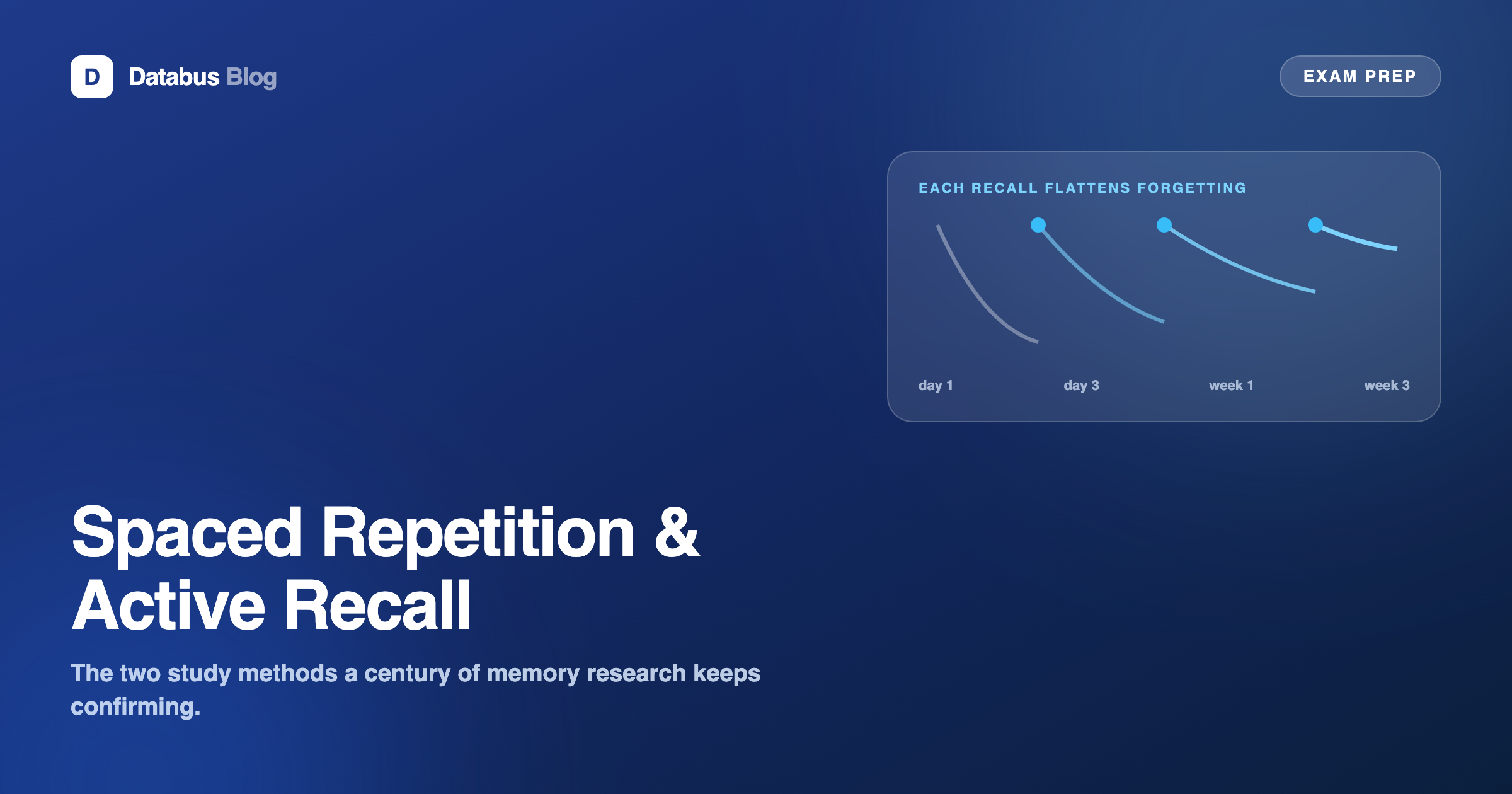
Memory fades on a curve, and each successful recall flattens it. The practical consequence: review a topic just as it starts slipping — typically at expanding intervals such as 1 day → 3 days → 1 week → 2 weeks → a month. Ten reviews of one hour spread over a month beat a ten-hour weekend by a wide margin, because each spaced retrieval happens at the point of maximum strengthening. Cramming works for tomorrow's test and evaporates by next month — measured, its retention collapses within weeks.
A weekly system that combines both
- Day of learning: study the topic, then immediately self-test — write the summary from memory.
- Day 2: 10-minute recall pass (questions, not rereading). Mark what failed.
- Day 4–5: second recall pass, failures first.
- Weekend: mixed practice set across the week's topics — interleaving topics in one session is itself a proven multiplier.
- Monthly: a full mock, then error analysis: every miss becomes a scheduled review item.
The bookkeeping — which topic is due when, which errors repeat — is exactly what software should carry so the student's effort goes into retrieval itself. That is the design premise of PrepWise: an AI study coach that schedules reviews from your actual attempt data and turns every mock's errors into the next week's recall list.
Frequently Asked Questions
What is active recall?
Studying by retrieving information from memory — self-testing, closed-book writing, question-first reading — instead of re-exposing yourself to it by rereading. Retrieval is the act that strengthens memory.
What is spaced repetition?
Reviewing material at expanding intervals (roughly 1 day, 3 days, a week, two weeks, a month) timed to catch memories as they start to fade. The same hours spread out produce far stronger retention than one massed session.
Why does rereading feel effective if it isn't?
Rereading creates fluency — the material becomes familiar and easy to process, which the brain mistakes for knowing it. Exams test retrieval, not recognition, and fluency does not transfer.
How many times should I revise a topic before an exam?
Successful spaced recalls matter more than a count — most topics stabilise after several spaced retrievals (typically 4–6), with failures resetting to shorter intervals. Schedule by performance, not by a fixed number.
Do these methods work for numerical subjects like physics and maths?
Yes — recall there means solving problems without the solution open, not memorising them. Spacing problem practice across weeks and interleaving topic types is measurably better than blocking one chapter at a time.