


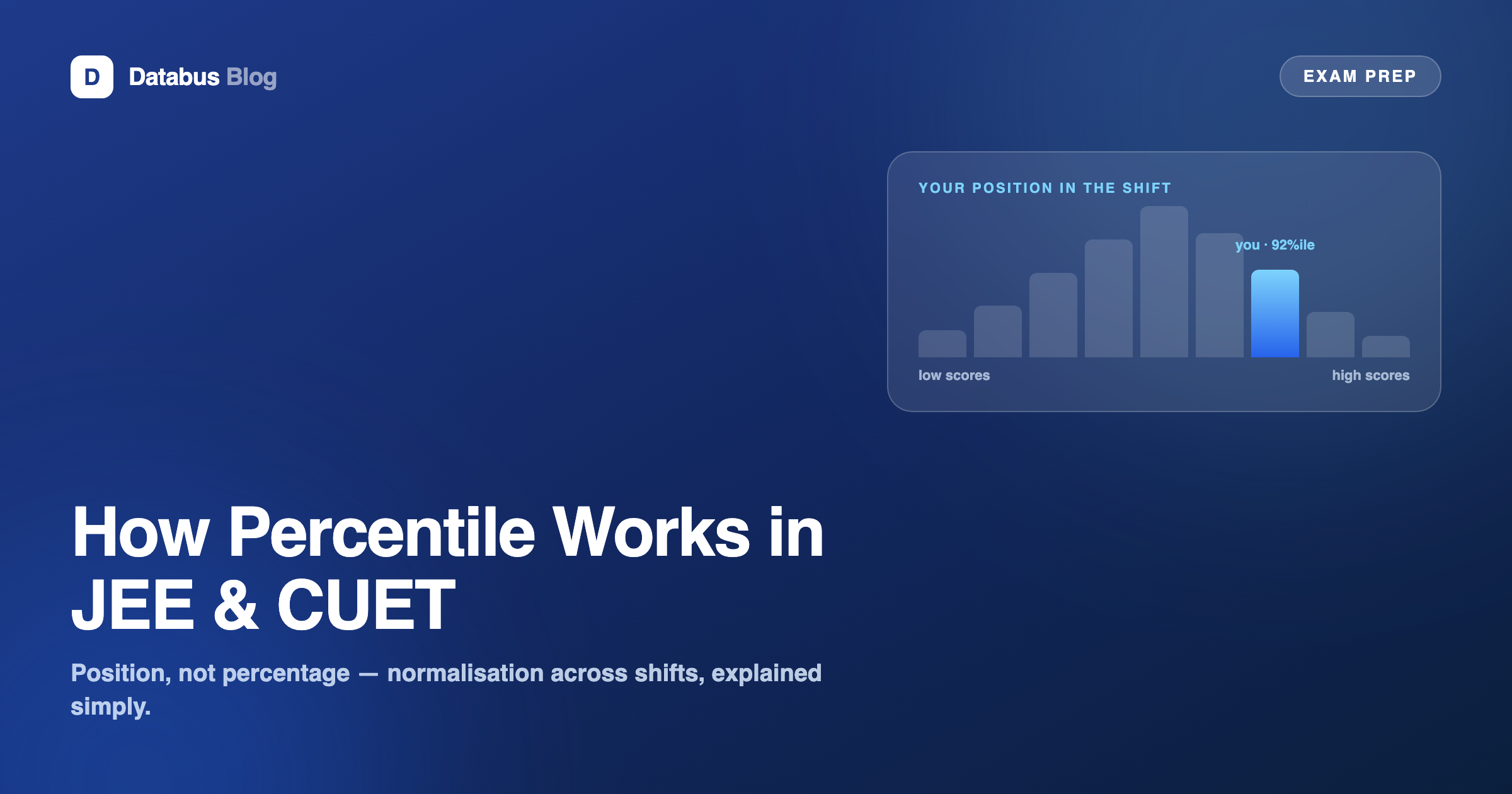
Every JEE and CUET season produces the same confusion: a student scores 120 marks out of 300 and receives a 92 percentile; another compares "percentage" with "percentile" and panics. The two numbers answer different questions. Percentage measures your marks. Percentile measures your position.
What a percentile actually says
A percentile score tells you what fraction of candidates you performed better than or equal to. The working definition NTA uses:
Percentile = 100 × (number of candidates in your session with a score ≤ yours) ÷ (total candidates in your session)
So a 92 percentile means you did at least as well as 92% of the candidates in your shift. It says nothing directly about your marks — in an easy shift, 92 percentile might take 150 marks; in a brutal one, 95 might do it.
Why normalisation exists at all
Exams like JEE Main and CUET run in multiple shifts over multiple days, each with a different question paper. Papers cannot be made exactly equally difficult, so comparing raw marks across shifts would be unfair — the students who drew the harder paper would be punished for scheduling luck. Percentile-based normalisation solves this by ranking each candidate within their own shift first: your percentile compares you against people who faced the same paper. The final merit list is then built from these session percentiles (with fixed rules for ties and decimal precision).
The consequences students should actually internalise
- The topper of every shift lands at or near 100 percentile — there is a "100" in each session, which is why multiple candidates share it.
- Raw-marks comparisons across shifts are meaningless. Your friend's 140 in another shift and your 128 are not directly comparable; your percentiles are.
- Percentile ≠ percentage of syllabus mastered. It moves with the strength of the cohort, not just your preparation.
- Cutoffs are quoted in percentiles for exactly this reason — they define a position in the field, robust to paper difficulty.
Where mock tests fit
Because percentile is positional, the useful question after every mock is not "how many marks?" but "where does this put me, and which topics moved me?" A mock analysed topic-wise — accuracy, time per question, silly-error rate — tells you which 20 marks are cheapest to gain next. That analysis loop is what PrepWise automates: an AI study coach that reads your attempt data and tells you what to fix, instead of leaving you staring at a scorecard. For the exam structures themselves, see our guides to the JEE Main vs Advanced pattern and the NEET pattern.
A note on accuracy: the precise normalisation formulae, tie-break rules and decimal conventions are published by NTA in each exam's information bulletin and can change between cycles. Treat the bulletin for your exam year as the authority. Databus is not affiliated with the NTA.
Frequently Asked Questions
What is the difference between percentile and percentage?
Percentage is your marks as a fraction of the maximum. Percentile is your position — the share of candidates in your session who scored less than or equal to you. A 92 percentile means you matched or beat 92% of your shift, whatever the raw marks.
Why do exams like JEE Main use normalisation?
Because the exam runs in multiple shifts with different papers of unavoidably different difficulty. Ranking candidates within their own shift by percentile removes the luck of which paper you drew.
Can two candidates have the same percentile?
Yes — ties happen within a session, and every session produces candidates at or near the 100 percentile. NTA's published tie-break rules order the merit list beyond the percentile score.
Does a 99 percentile mean 99% marks?
No. It means you performed at least as well as 99% of candidates in your session. Depending on the paper, a 99 percentile can correspond to very different raw marks.
How should I use percentile in mock test analysis?
Track position, not just marks: which topics cost you rank, where accuracy or speed lags, and which errors repeat. Marks fluctuate with paper difficulty; positional and topic-level trends are what preparation can act on.