


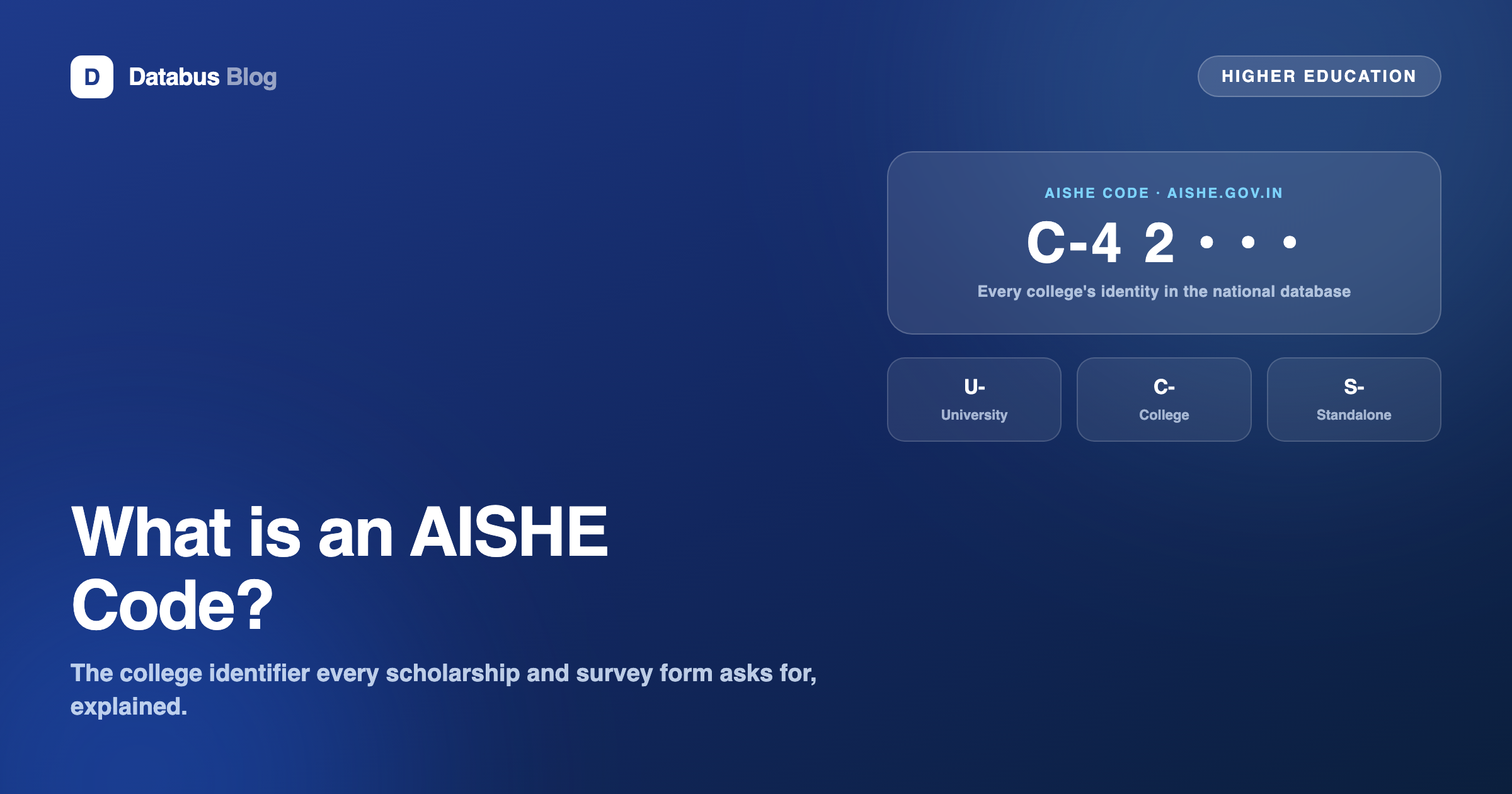
The AISHE code is the unique identifier the Ministry of Education assigns to every higher-education institution in India — universities, colleges and standalone institutions alike — through the All India Survey on Higher Education portal (aishe.gov.in). If schools have the 11-digit UDISE code, colleges have the AISHE code: it is the number that says an institution officially exists in the national higher-education database.
What AISHE actually is
AISHE is the Ministry's annual, web-based census of higher education, running since 2010-11. Every registered institution reports its data each year — enrolment, programmes, teachers, examination results, infrastructure and finances — and that data feeds national statistics, policy and scheme eligibility. Registration on the portal, and therefore the AISHE code, is mandatory for HEIs, and the survey cycles for 2025-26 and 2026-27 are open.
Why forms keep asking for it
The AISHE code shows up far beyond the survey itself: scholarship applications, UGC and AICTE processes, NIRF participation, and a growing set of government schemes ask for the institution's AISHE code as the standard way to identify a college. For students filling scholarship forms, the code identifies your institution, not you — it is not a student ID.
How to find a college's AISHE code
- The AISHE portal. aishe.gov.in has an institution search — look up by name, state and district, and the listing shows the code (formats like "C-XXXXX" for colleges, "U-XXXX" for universities, "S-XXXX" for standalone institutions).
- The college's own website or office. Many institutions publish the AISHE code on their website's mandatory-disclosure or accreditation pages; the administrative office will have it on file.
- Existing documents. NIRF, NAAC and UGC filings by the institution quote the AISHE code.
How a new institution gets one
By registering on the AISHE portal — the institution nominates a nodal officer, submits its details through the portal's registration flow, and the code is issued after verification. It is an institutional process through the Ministry's system, not something done through an agent.
The institution's side: the annual data burden
For the college administration, AISHE is one of several annual reporting obligations — alongside NIRF, NAAC/accreditation cycles and university returns — that all ask overlapping questions about enrolment, faculty, results and infrastructure. The institutions that find survey season painless are the ones whose student, staff and exam records live in one system all year, so returns are exports rather than reconstruction projects. That operational layer is what CampusAlly provides for colleges — with accreditation and reporting workflows built on the same records. Related reading: how NAAC grades work and what the ABC ID is.
A note on accuracy: portal processes and survey timelines are set by the Ministry of Education and change between cycles. Confirm current procedure on aishe.gov.in before acting. Databus is not affiliated with AISHE or the Ministry of Education.
Frequently Asked Questions
What is the full form of AISHE?
All India Survey on Higher Education — the Ministry of Education's annual census of every university, college and standalone higher-education institution in India, running since 2010-11.
What is an AISHE code used for?
It uniquely identifies a higher-education institution in the national database. Scholarship forms, UGC/AICTE processes, NIRF participation and many government schemes use it as the standard institutional identifier.
How do I find my college's AISHE code?
Search the institution directory on aishe.gov.in by name, state and district, check the college website's mandatory-disclosure pages, or ask the administrative office. Codes look like C-XXXXX for colleges and U-XXXX for universities.
Is the AISHE code a student ID?
No. It identifies the institution. Student-level identifiers in higher education are the APAAR/ABC ID; the AISHE code appears on your forms only to say which college you attend.
Is AISHE registration mandatory for colleges?
Yes — all higher-education institutions are required to register on the AISHE portal, obtain a code, and participate in the annual survey.