


The key is born with the paper
An answer key written after the paper is a second job and a second source of errors. PaperDeck generates the key and marking scheme with the paper, so the two can never disagree.
What does the answer key generator do?
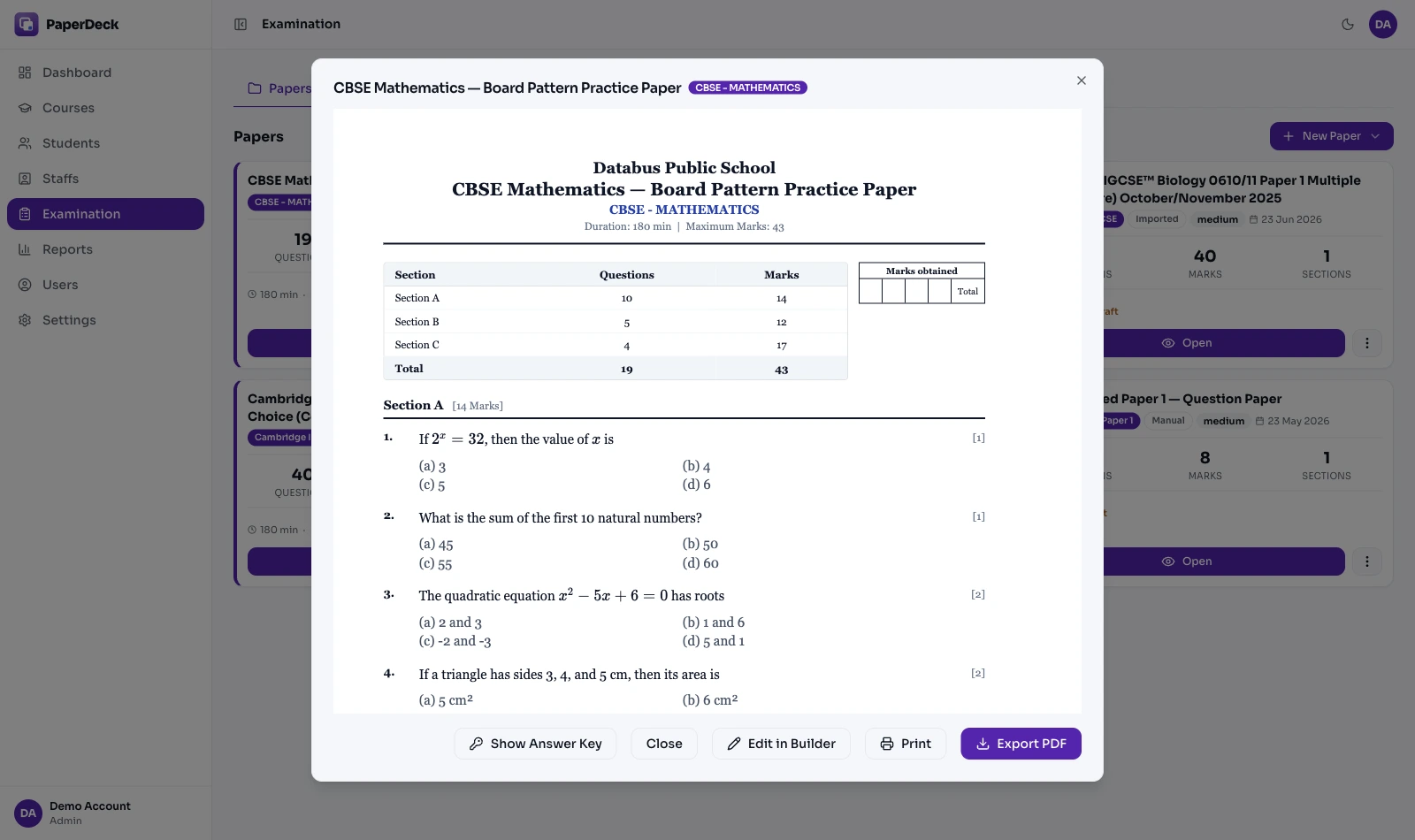
For every paper PaperDeck drafts, it also drafts the evaluation apparatus: correct options for MCQs, expected answers for short questions, and stepwise marking schemes for long answers that say what each stage of working earns. Because key and paper generate together from the same questions, a swapped or edited question updates its key entry automatically. The output prints separately from the paper, ready for evaluation day or for handing to students after the test as a model-answer sheet.
Marking schemes are where evaluation becomes fair. Two teachers marking the same long answer converge only when the scheme says the method carries two marks, the substitution one and the final value one; without that, marks depend on the evaluator's mood at question 43. The generator writes schemes in that stepwise style by default, and the same discipline turns post-test review into teaching: a student who sees where the marks lived learns more from a lost mark than from a lost paper.
There is also a workload equity angle inside departments. Evaluation load is the least visible teacher burden, and vague keys multiply it: every ambiguous answer becomes a judgment call, and forty judgment calls a night is how evaluators burn out. Step-marked schemes shrink each script to comparisons a tired mind can still make correctly at 11pm. That is why departments that adopt scheme-first evaluation report faster marking and fewer re-evaluation requests in the same term.
How keys and schemes work
-
1
Generated together
The key drafts alongside the paper, question by question. There is no separate key-writing session and no version mismatch between what was asked and what is marked.
-
2
Stepwise where it matters
MCQs get the option; numericals and long answers get staged schemes with marks per step, so partial credit is a rule rather than a negotiation.
-
3
Edited in sync
Change a question and its key entry flags for review; replace a question and the key replaces with it. The pair stays consistent through every edit.
-
4
Printed for two audiences
An evaluator's version with the scheme, and an optional student version as model answers for post-test review.
A worked example
After Tuesday's 80-mark chemistry paper, the evaluator's copy shows question 27's scheme: balanced equation 1 mark, correct mole ratio 1 mark, substitution 1 mark, final answer with units 1 mark. Forty answer books later, every partially-correct attempt has been marked the same way. On Friday the teacher hands out the student version, and the boy who lost the units mark finds it himself in the scheme, which is a lesson no red circle ever taught.
Where this fits, and where it doesn't
Built for you if
- ✓ Evaluation eats more time than paper-setting
- ✓ Multiple evaluators mark the same paper and must converge
- ✓ You return papers with model answers as a teaching step
- ✓ Partial credit should follow a rule, not a mood
Not the fit if
- ✕ You expect the key to be infallible; review before evaluation is part of the design
- ✕ You need automated on-screen evaluation of scanned scripts; that is exam-system machinery
Institution-scale evaluation, with script scanning, moderation and result processing, lives in SchoolDeck’s exam module. PaperDeck keeps the paper-and-key pair perfect for the teacher who marks by hand.
The habit that compounds most is returning the scheme with the paper. Students who see where marks actually lived write differently within weeks: steps appear because steps visibly earn, units appear because a lost unit mark stings once, and presentation stops being nagging and becomes strategy. The scheme costs nothing extra to print, and it converts every returned test from a verdict into a lesson, which is the cheapest teaching upgrade a paper can carry.
Frequently asked questions
Are the answers always correct?
They are strong and occasionally fallible, like any drafted content. That is why the key is editable and the read-through is part of the flow. What the generator guarantees is consistency: the key always matches the paper's current questions.
Do long answers really get step marks?
Yes, schemes break long and numerical answers into stages with marks per stage. You can adjust the split before printing if your marking convention differs.
Can I share model answers with students?
A student-facing version prints without the mark allocations or with them, your choice. Many teachers hand it out with returned papers as the review lesson.
What happens to the key when I edit the paper?
Edited questions flag their key entries for review; replaced questions bring fresh entries. The two documents cannot drift apart.
Does the key work for State Board patterns?
Keys and schemes follow the paper, and the paper follows the board pattern you chose, so State Board papers get State Board style schemes.
Do schemes follow board-style marking conventions?
They follow the stepwise convention board evaluators use: method, substitution, result, each carrying declared marks. You can rebalance the split per question before printing if your school's convention differs.
Can I mark digitally against the key?
The key prints or displays alongside however you evaluate; PaperDeck does not capture marks itself. Result records belong to your school system or gradebook, and SchoolDeck handles them where the full ERP is in place.
Keep exploring
Mark by scheme, not by mood.
Keys and marking schemes with every paper, consistent through every edit.
Book a demo