


Every format the boards actually use
Modern board papers mix objective, descriptive and competency formats in one paper. PaperDeck generates all of them and lets your blueprint decide the mix.
Which question types can PaperDeck generate?
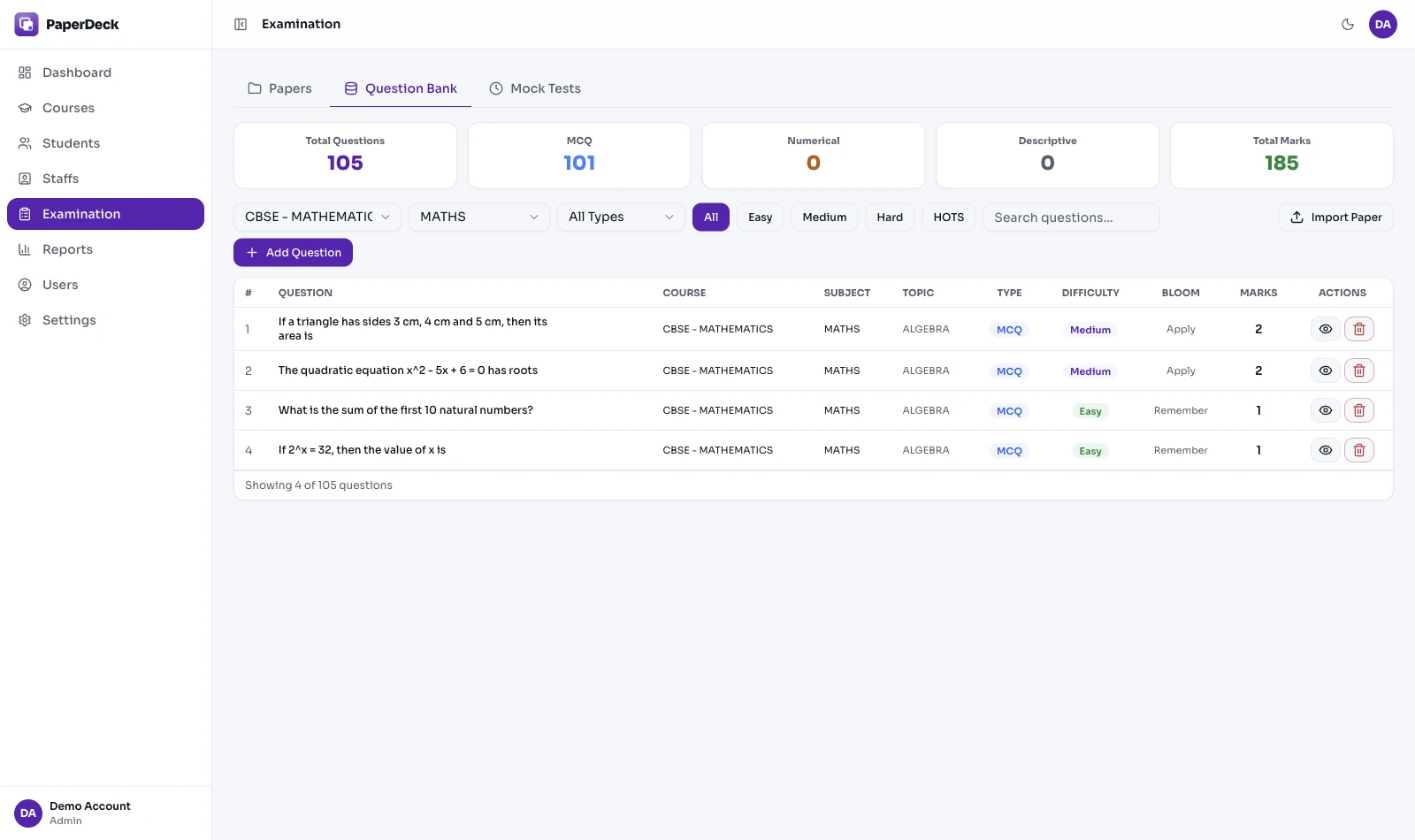
The full range Indian board and school papers draw on: multiple-choice questions with plausible distractors, assertion-reason pairs, fill-in-the-blanks and true-false for rapid recall, very short and short answer questions, long answers with staged marks, and the case-based and competency-focused formats that newer patterns emphasise, where a passage, data table or scenario carries a set of linked questions. Your blueprint sets how many of each; the generator holds the mix and tags every question with its type, chapter and difficulty.
Formats are not interchangeable and good papers use the difference by design. MCQs sample breadth cheaply; long answers probe depth expensively; case-based items test whether knowledge survives contact with an unfamiliar scenario, which is precisely what competency-based patterns are reaching for. A teacher who controls the mix controls what the test measures. That is why the blueprint treats type counts as first-class settings rather than an afterthought, and why the generator refuses to let a paper drift into one comfortable format.
Format control also changes how teachers diagnose. A student strong in MCQs but weak in long answers has a writing problem, not a knowledge problem. The reverse pattern suggests recall gaps under time pressure. Papers that by design mix formats in known proportions turn every test into that diagnostic for free, and the tagged questions make the follow-up practical: next week's paper can lean toward whichever format the class bled marks on.
How the mix is controlled
-
1
Types in the blueprint
Set counts per type per section: ten MCQs, two assertion-reason, five short, three long, one case study. The paper follows the plan.
-
2
Distractors that work
MCQ wrong options are drafted to be plausible rather than absurd, because a distractor nobody picks tests nothing. Edit any option that gives the game away.
-
3
Cases that carry weight
Case-based items generate a fresh scenario with linked sub-questions across marks, matching how boards now frame competency questions.
-
4
Tagged for balance
Every question carries its type, chapter and difficulty tag, so you can see at a glance whether the paper's spread matches your intention.
A worked example
For a Class 10 science term paper, the blueprint reads: section A, sixteen MCQs and four assertion-reason of 1 mark; section B, six short answers of 2 marks; section C, seven of 3 marks; section D, three long answers of 5 marks; section E, three case-based sets of 4 marks. The generator fills all five sections in one pass, the case studies arriving with fresh scenarios rather than the textbook's. The teacher tightens one distractor, swaps a case, and the paper mirrors the board pattern her students will meet in March.
Where this fits, and where it doesn't
Built for you if
- ✓ Your board pattern mixes objective, descriptive and case-based formats
- ✓ You want distractors that discriminate, not giveaways
- ✓ Competency-style questions take you longest to write by hand
- ✓ You care what each format is measuring
Not the fit if
- ✕ You want only one format forever; the product will oblige, but a single-format paper is rarely a good test
- ✕ You need diagram-drawing or map-work questions authored from your own images; add those by hand after generation
Students drilling specific formats on their own, MCQ speed or long-answer writing practice, do it inside PrepWise, where practice adapts to the student. PaperDeck serves the paper-setter.
When you design your next blueprint, try one deliberate experiment: shift ten percent of marks from your paper's dominant format into its weakest-represented one and watch what the results reveal. Classes drilled on one format develop format-shaped knowledge, and the gap only shows when the mix moves. Papers that rotate emphasis across the term produce students who meet the board's own mix without flinching, because no format is a stranger by March.
Frequently asked questions
Does it handle the newer competency-based patterns?
Yes, case-based and competency-focused items are first-class types: a generated scenario with linked sub-questions, weighted per your blueprint, in the style current board patterns use.
Can one paper mix many types?
That is the normal case. The blueprint sets counts per type and section, and one generation pass fills the whole structure.
How good are the MCQ distractors?
Drafted to be plausible, usually built on the classic misconceptions for the topic. Review them like everything else; a weak distractor is a one-click swap.
Can I add my own questions into a generated paper?
Yes, papers are editable documents. Drop in your own question, and the key gains an entry for you to complete.
Are diagrams and figures supported?
Questions can reference standard figures, and you can attach your own images while editing. Fully auto-drawn original diagrams are not something we claim.
Are assertion-reason questions really generated correctly?
Yes, with the standard four-option logic structure boards use, and they are worth reviewing like everything else because the reasoning link is where drafts occasionally wobble. A weak pair is a one-click regeneration.
Can I set section-wise internal choice?
Internal choice (attempt any five of seven) is part of the blueprint, matching how board papers actually offer options. The key covers every alternative so evaluation stays mechanical.
Keep exploring
Blueprint the mix. Test what matters.
Every board format, held to your plan, in one generated paper.
Book a demo