


Teach the class, not the photocopier
Paper-setting is the homework teachers assign themselves. PaperDeck gives those evenings back: syllabus-mapped papers with keys, drafted in minutes, reviewed and printed by you.
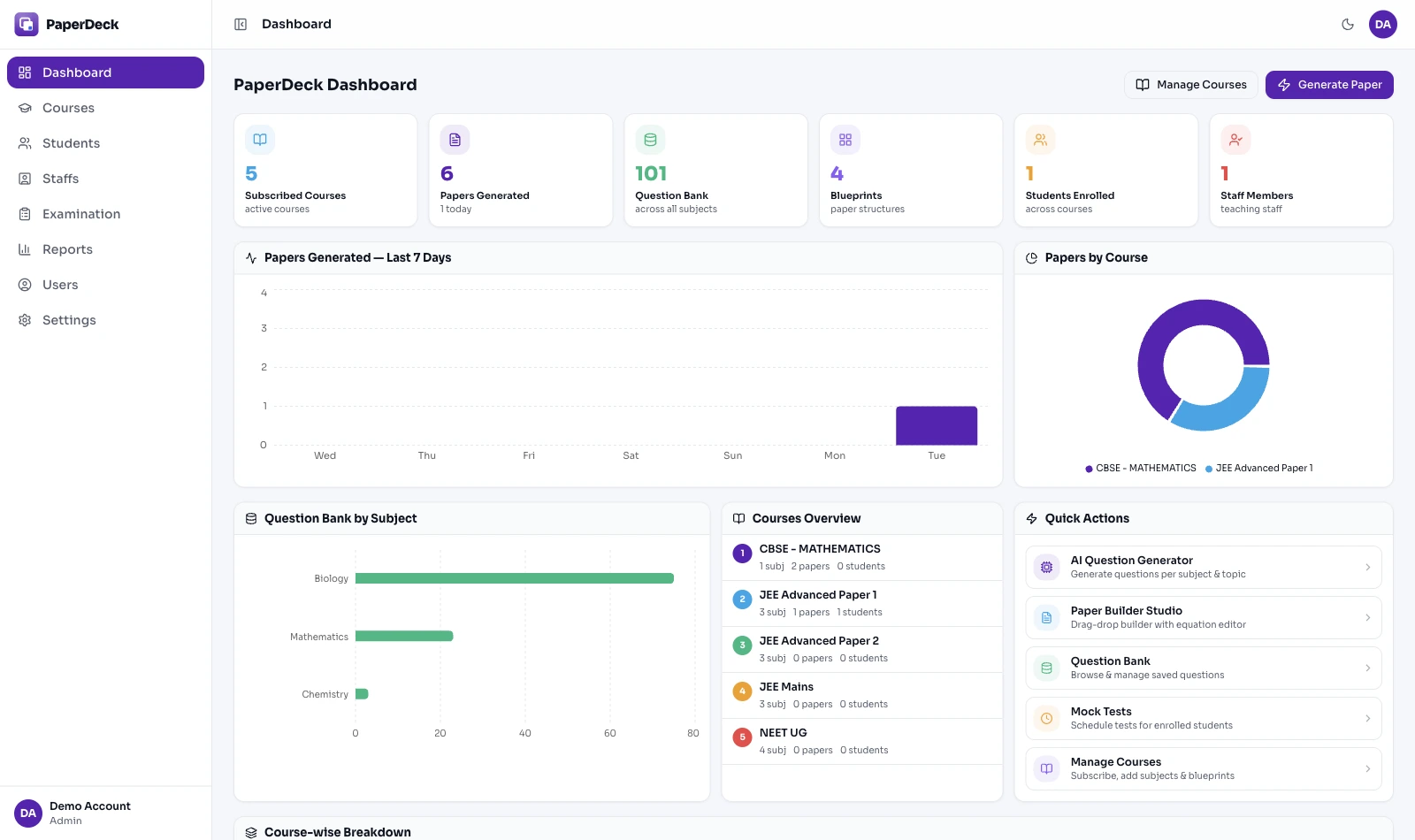
What does PaperDeck change for a teacher?
It removes the assembling. You still decide what to test, how hard, and in what format. The blueprint captures those decisions in a minute. The generator then does what used to take the evening: drafting questions across the chapters, balancing difficulty, formatting sections, writing the key and scheme. Your role shifts to review, the part that actually needs a teacher. A weekly class test becomes a fifteen-minute job including the read-through; a term paper stops being a weekend.
The quiet cost of manual paper-setting is not just time; it is repetition. Reused papers leak, question banks go stale, and the third section of every paper tends to get written at midnight standards. Generation resets that: fresh questions each run, difficulty held across the whole paper, and formats you would not hand-write at 11pm, like case-based sets, arriving as easily as MCQs. Teachers report the same second-order effect the payroll world knows: when producing a test is cheap, you test more often, and more testing with feedback is simply better teaching.
The strongest objection teachers raise is quality: will a generated paper embarrass me in front of a sharp class? The review step is the answer, but so is the arithmetic of attention. An evening spent authoring produces one read-through at midnight standards; fifteen minutes spent reviewing a draft produces the same read-through at full attention, plus the option to regenerate anything weak. The teacher's judgment is applied either way; generation just moves it from exhausted authorship to fresh editing, which is where judgment works best.
A teacher’s week with PaperDeck
-
1
Monday's test, Sunday night
Two chapters, 25 marks, the saved blueprint from last week: the draft is ready before the tea is. Review, swap one question, print with the key.
-
2
Homework that is not the textbook
A ten-question practice sheet on today's topic, generated in the staff room, handed out at the bell. The textbook exercises stay for classwork.
-
3
The retest without the leak
The Friday absentees sit a parallel paper: same blueprint, fresh questions, same key discipline. Nobody benefits from photographing Monday's paper.
-
4
Term papers as assembly, not authorship
The half-year syllabus, the board-style pattern, and a full draft to shape rather than a blank page to fill. The scheme comes along for evaluation week.
A worked example
A physics teacher with three sections of Class 9 used to write one test and pray it did not travel between sections. Now each section gets a parallel paper from the same blueprint: identical shape and difficulty, different questions. Marking stays fair because the schemes match; leakage stops mattering because there is nothing shared to leak. Her actual evening work on test weeks is forty minutes of review across all three papers, which used to be the time it took to type one.
Where this fits, and where it doesn't
Built for you if
- ✓ You set your own class tests and papers
- ✓ Evenings and weekends fund your paper-setting today
- ✓ You teach multiple sections and want parallel papers
- ✓ You want to test more often than authoring currently allows
Not the fit if
- ✕ Your school centralises all paper-setting in an exam cell; show them SchoolDeck instead
- ✕ You never review drafts; the teacher's read-through is the quality bar here
If the school itself wants this for every teacher, with exams, seating and results attached, that is SchoolDeck. PaperDeck is yours as one teacher, no ERP and no committee required.
There is also a career dimension worth naming. The teachers who set sharp, varied, fair papers become the department's quiet standard-setters, and paper quality travels: into board results, into principal reviews, into reputation among parents who compare notes. A tool that lets one teacher produce department-grade papers on a weekday evening does not just save time; it moves where that teacher's craft is visible, from the photocopier queue to the paper itself.
Frequently asked questions
Do I need my school's permission or systems?
No. PaperDeck runs standalone for an individual teacher: your account, your papers, your printer. Nothing integrates unless your school later chooses the ERP.
How long does a weekly test actually take?
Selection and blueprint take a couple of minutes, generation is fast, and the real cost is your review, typically ten to fifteen minutes for a class test. The forty-mark question is whether you would rather spend the evening.
Can I make parallel papers for multiple sections?
Yes, rerun the blueprint per section: same structure and difficulty, fresh questions each time, keys to match.
What about my own favourite questions?
Edit them in. Generated papers are documents, not sealed outputs, and many teachers blend one signature question into every paper.
Which boards does it support?
CBSE, ICSE/ISC and State Boards, with syllabus maps maintained per board. You pick once and the papers follow your board's shape.
My handwriting-based paper style has worked for years. Why change?
If the evenings are sustainable, nothing forces the change. The teachers who switch are the ones with three sections, weekly tests and a life. The product exists for the arithmetic of that week, not to correct anyone's craft.
Can the school see or control my papers?
No. An individual account is private to you; papers, blueprints and history are yours. School-level visibility only exists in the ERP context, and only if your school chooses it.
Keep exploring
Get the evenings back.
Papers drafted in minutes, reviewed by the only person who should: you.
Book a demo