


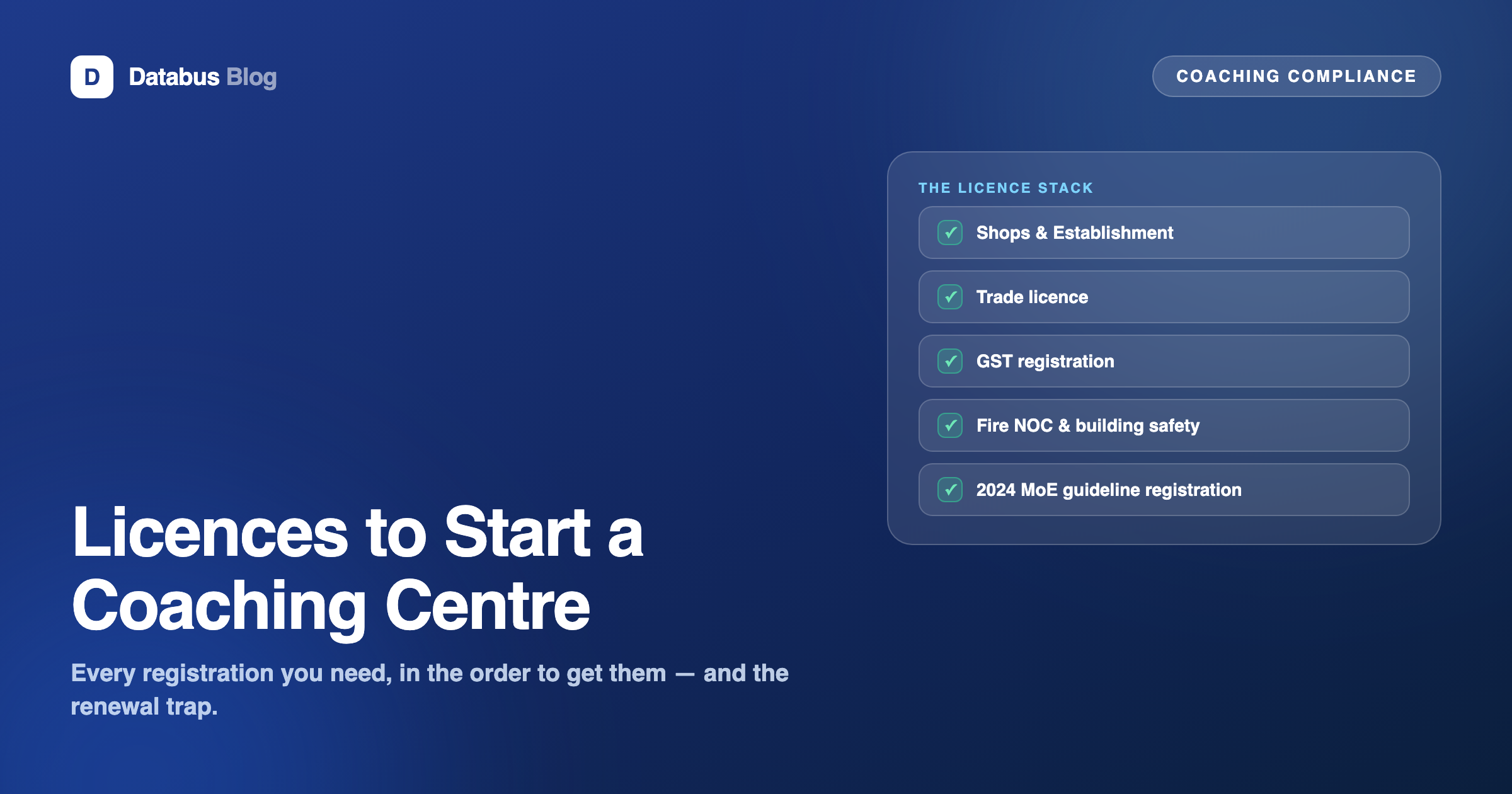
Opening a coaching centre involves more paperwork than most founders expect — not one licence but a stack of them, issued by different authorities that don't talk to each other. Skipping one rarely hurts on day one; it hurts eighteen months later, at renewal time, at a bank, or during an inspection. Here is the full checklist in the order that actually makes sense, and what each registration costs you in effort. (For what the rules say about running the centre — batch sizes, timings, advertising — see our companion piece on the 2024 coaching centre guidelines; this post is about the licences themselves.)
1. Business structure first
Everything downstream asks for your entity proof, so decide the structure before applying for anything: sole proprietorship (fastest, no separate registration — your PAN is the entity), partnership/LLP, or private limited (needed if you plan investors or franchising later). Open the current account immediately after — every other registration wants a cancelled cheque.
2. Shops & Establishment registration
The baseline registration for any commercial premises with employees, issued under your state's Shops and Establishments Act — usually online, within days, against premises proof and employee count. It is the document banks, payment gateways and many other registrations ask for first. Renewals are periodic in most states; put the date in a compliance calendar.
3. Trade licence from the local body
Municipal corporations require a trade licence to run a commercial activity from a premises. Requirements and enforcement vary by city — some treat small tuition as exempt, large centres almost never are. Apply through the municipal portal with ownership/rent proof and the S&E certificate.
4. GST registration — at the threshold, or earlier
Commercial coaching is a taxable service at 18% GST, with registration mandatory once aggregate turnover crosses the service threshold (₹20 lakh in most states; ₹10 lakh in special-category states). Register earlier if you invoice other businesses or want input credit on rent and equipment. The rate, exemption boundaries and invoicing mechanics are covered in our GST on coaching classes guide.
5. Fire NOC and building safety
The registration most often skipped, and the one with the highest stakes. Coaching centres are assembly-type occupancies in practice — dozens of minors in enclosed rooms — and the 2024 Ministry of Education guidelines make fire and building safety certificates a condition of registration, alongside adequate electrification, ventilation, CCTV and first aid. Requirements scale with built-up area and floor; basement classrooms attract particular scrutiny after well-publicised tragedies. Apply to the state fire service with the building plan; renew as your state prescribes.
6. Coaching-centre registration under the 2024 guidelines
The MoE's Guidelines for Registration and Regulation of Coaching Centres (January 2024) create a dedicated registration with the district's competent authority — conditions include no enrolment below 16 years, no misleading advertisements or rank guarantees, qualified tutors, counselling support, fee receipts with prospectus-published fees, and pro-rata refunds. Penalties escalate: ₹25,000 first violation, ₹1 lakh second, then revocation. Because they are model guidelines, states implement them at their own pace — several states also have their own coaching acts predating 2024 (Bihar, Goa, Manipur among them; others are legislating). Check your state education department's current notification; where a state scheme exists, this registration is not optional.
7. The supporting cast
- Udyam (MSME) registration: free, online, and unlocks priority-sector lending and scheme benefits.
- Professional tax: employer registration in states that levy it.
- EPF/ESI: mandatory at 20 and 10 employees respectively — growing centres cross these thresholds sooner than they expect.
- Music/content licences and signage permission: city-dependent; signage usually rides on the trade licence.
Sequencing and the renewal trap
The efficient order: entity → current account → S&E → trade licence + fire NOC (parallel) → GST → guideline registration → Udyam/PT/EPF as applicable. Then the discipline that separates centres that stay compliant from centres that scramble: every one of these has a renewal or filing cadence, and each authority's notice goes to whatever address you gave years ago. Keep a single compliance register with issue dates, renewal dates and the responsible person. Fee receipts, student records and the operational side of the guidelines — batch registers, attendance, fee ledgers with receipts — are what TutorDesk keeps in order daily, so an inspection is a printout, not a panic. Expanding later? The same stack repeats per premises — factor it into the second-branch plan.
A note on accuracy: licensing is state and city specific — thresholds, fees and whether the 2024 guidelines are notified in your state all vary, and rules change. Verify with your municipal body, state education department and a local compliance professional before relying on this checklist. This is general information, not legal advice.
Frequently Asked Questions
What licences are required to open a coaching centre in India?
Typically: business entity + current account, Shops & Establishment registration, municipal trade licence, GST registration (mandatory past the turnover threshold), fire NOC and building safety certificate, registration under the 2024 MoE coaching guidelines where your state has implemented them, plus Udyam, professional tax and EPF/ESI as you grow.
Is coaching centre registration mandatory under the 2024 guidelines?
The MoE guidelines require registration with the district competent authority, with penalties of ₹25,000 (first violation), ₹1 lakh (second) and revocation thereafter — but they are model guidelines that states implement. Check your state education department's notification; several states also have their own coaching acts.
Do small home tuitions need all these licences?
Scale matters. A single tutor teaching at home is generally outside most of the stack (and below GST threshold), while a centre with premises, staff and enrolled students needs S&E, trade licence and the rest. The 16-year age rule and safety norms under the guidelines target organised centres.
Is GST mandatory for a coaching centre?
Registration becomes mandatory once aggregate turnover crosses the threshold (₹20 lakh in most states). Commercial coaching attracts 18% GST — unlike formal schooling, it has no education exemption.
Why is a fire NOC so important for coaching centres?
Centres concentrate minors in enclosed commercial spaces, and the 2024 guidelines make fire and building safety certificates a registration condition. Enforcement has tightened sharply after coaching-centre tragedies, with basement classrooms a particular focus.