


Most aspirants treat a mock test as the workout. It isn't — it is the diagnostic scan. The workout is the ninety minutes after, when the paper gets dissected. Students who write twenty mocks and analyse none plateau at the same score; students who write ten and analyse all ten climb. Here is a complete analysis method: the error taxonomy, the time audit, the log format, and the routine that turns each mock into next week's study plan.
First: score is the least useful number
The total tells you where you are; it tells you nothing about what to do. Two students at 120/300 can have opposite problems — one is losing marks to silly errors in strong chapters, the other to entire untouched units. Same score, completely different prescriptions. The analysis exists to separate those cases, which is also why percentile obsession right after a mock is wasted emotion: the percentile ranks you; the error breakdown improves you.
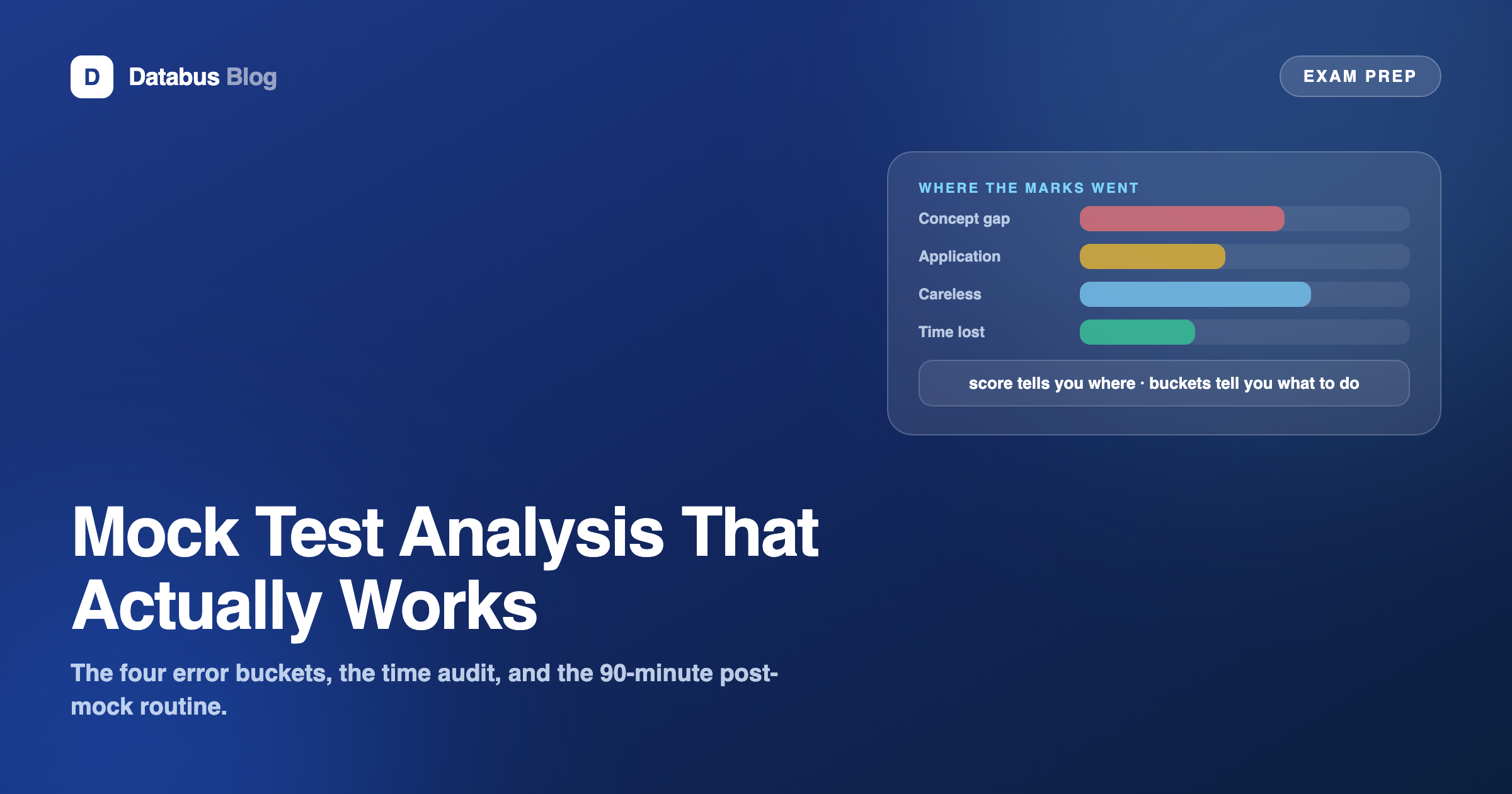
The four-bucket error taxonomy
Go question by question through everything wrong or skipped, and force each into exactly one bucket:
- Concept gap — you didn't know it. The topic needs learning, not revision. These go to your study plan as fresh material.
- Application failure — you knew the concept but couldn't wield it: wrong formula chosen, couldn't set up the problem, missed the trick. These need practice sets on that specific pattern, not rereading theory.
- Careless error — sign slips, misread questions, calculation mistakes, wrong bubble. Individually trivial, collectively lethal: for many aspirants this bucket alone is 15–25 marks. The fix is procedural (underline what's asked, reserve 30 seconds to sanity-check units and signs), not academic.
- Time casualty — questions you could have solved but never reached, or abandoned half-done. These are strategy losses; the material knowledge is already there.
The bucket totals are your prescription. Concept-heavy? Your syllabus coverage is the problem. Careless-heavy? Your exam procedure is. Time-heavy? Your question selection is. Most students discover their loss profile is nothing like what they assumed.
The time audit
Marks measure accuracy; the clock measures strategy. From the test's question-wise time data, pull three things: your expensive wrong answers (4+ minutes spent AND wrong — the double loss), your ego questions (the one you refused to abandon for 8 minutes while three easy ones went unattempted), and your section pacing against plan. The single highest-leverage habit change for most aspirants is a hard personal rule: mark-and-move at 2.5 minutes, return only if time remains. One audit usually finds 10–20 recoverable marks sitting in time misallocation alone.
The error log — the compounding asset
One row per error, kept across all mocks: date, subject/chapter, question type, bucket, the actual mistake in one honest sentence ("assumed elastic collision without reading"), and the fix action. Two rules make it work:
- Write the mistake specifically. "Silly mistake" is not an entry; "dropped negative sign while transposing" is. Patterns only emerge from specifics.
- Review the log before the next mock — ten minutes, every time. This is the compounding step: you are priming exactly your own failure patterns, which no coaching material can do for you. Repeat errors across three mocks get escalated to dedicated practice.
The 48-hour routine
Same day (90 minutes): full question-by-question pass while your reasoning is still fresh — bucket every error, log every row, run the time audit. Re-solve nothing yet; just diagnose. Within 48 hours: re-solve every concept-gap and application question without the solution, then against it; schedule the concept gaps into the coming week's plan; pick the one procedural fix (not five) to consciously run in the next mock. Then the part that requires honesty across mocks: track whether each bucket is shrinking. Careless errors flat across four mocks means your fix isn't being executed — change the fix, not the goal.
Making the loop automatic
Everything above can run on paper and a spreadsheet — the method is free. What software does is remove the friction that kills the habit: PrepWise mocks come with question-wise time and accuracy analytics built in, wrong-answer explanations to close application gaps on the spot, and rank insight to place the score honestly — and its spaced revision engine resurfaces exactly the chapters your errors cluster in. Planning the week around the findings is the timetable generator's job. But tool or no tool, the discipline is the same: no mock without its ninety minutes.
Frequently Asked Questions
How do I analyse a mock test properly?
Go question by question through everything wrong or skipped and classify each into four buckets — concept gap, application failure, careless error, time casualty. Add a time audit (expensive wrong answers, abandoned-too-late questions, section pacing), log every error specifically, and re-solve the concept/application questions within 48 hours.
How much time should mock test analysis take?
Roughly 90 minutes same-day for the full diagnostic pass, plus a re-solving session within 48 hours. As a rule of thumb, analysis time should approach the test time itself — a 3-hour mock deserves more than a 20-minute glance at the score.
What is an error log and what goes in it?
A running record across all mocks: one row per error with date, chapter, error bucket, the specific mistake in one sentence, and the fix. Review it for ten minutes before every next mock — repeat patterns across three mocks get escalated to dedicated practice.
How many mocks should I write per week?
Only as many as you fully analyse — for most aspirants one to two per week. Ten mocks with complete analysis beat twenty without; unanalysed mocks repeat the same errors at the same cost.
My mock scores aren't improving — what should I check?
Check the bucket trend, not the total. If careless errors are flat across several mocks, the procedural fix isn't being executed; if concept gaps dominate, coverage — not more mocks — is the need; if time casualties dominate, change question selection rules before anything else.