


Small cards, long memory
Every exam has a memory layer: formulas, reactions, articles, exceptions. Flashcards with spaced repetition turn that layer into minutes a day instead of a final-month emergency.
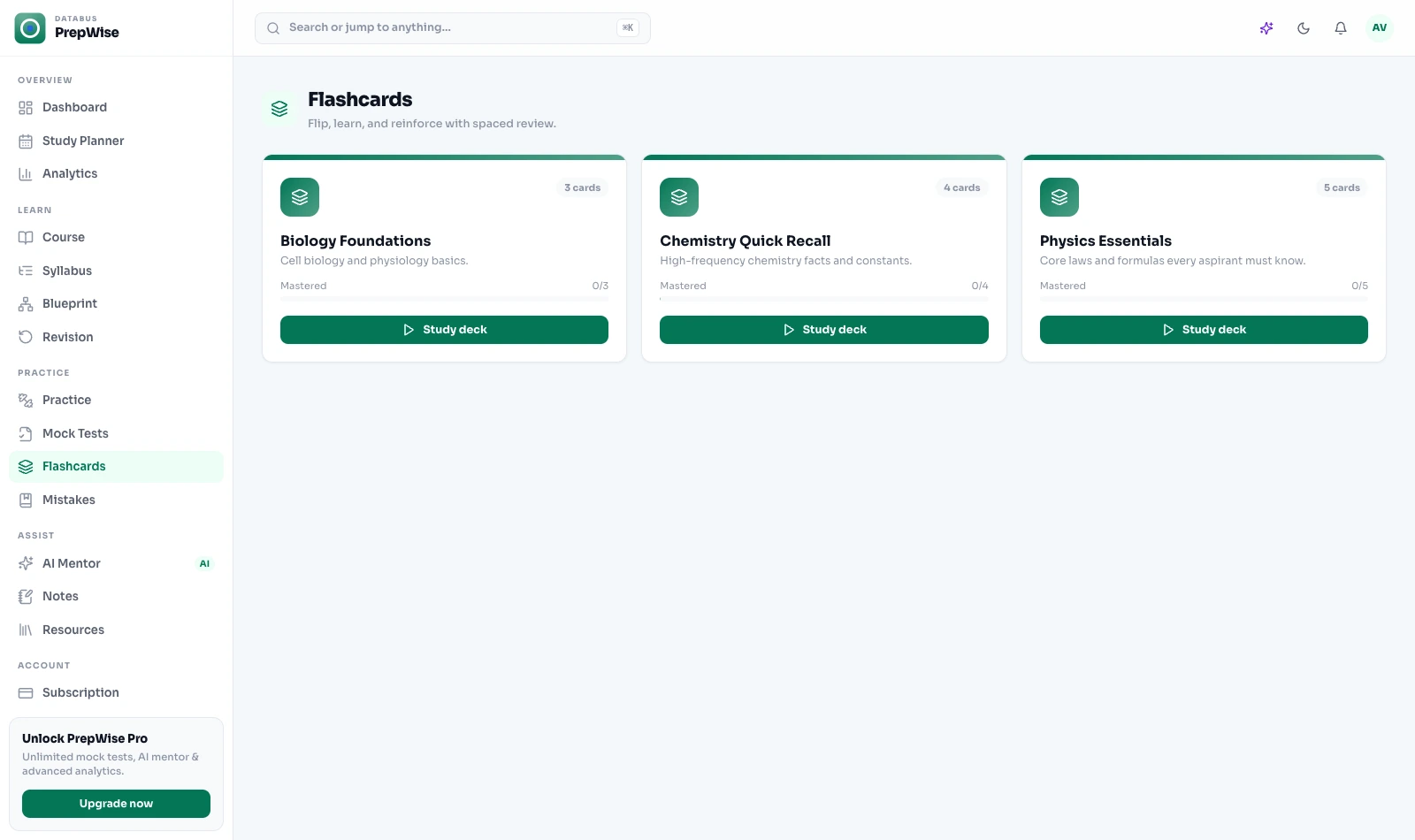
How do PrepWise flashcards work?
Each card is one retrievable fact: a formula, a reaction, a definition, a date, a map fact. When you review a card, you grade yourself honestly (knew it, hesitated, forgot), and the scheduler sets its next appearance accordingly: confident cards retreat to longer intervals, shaky ones return soon. Decks build themselves from the chapters in your plan, and you can add your own cards in seconds for the facts your particular brain keeps dropping. Ten to fifteen minutes a day keeps a thousand-card deck alive.
Spaced repetition is not a study hack; it is the memory system with decades of evidence behind it, and its whole trick is timing: a fact reviewed just before forgetting gets a stronger trace than one reviewed early or late. Doing that scheduling by hand across hundreds of facts is impossible. That is why the technique lives in software. The daily-minutes framing matters too: cards work as a background process alongside real study, filling bus rides and tea breaks, not competing with problem-solving for prime hours.
A practical note on card quality, because it decides everything: good cards ask one thing with one answer. 'Explain electrochemistry' is not a card; 'anode charge in an electrolytic cell' is. The auto-generated decks follow that discipline, and the habit is worth copying when you write your own: split anything with 'and' in the answer into two cards. Small, sharp cards feel trivial individually and compound into the exam-day experience every topper describes: facts arriving before the question finishes asking.
A deck that runs itself
-
1
Cards arrive with chapters
Finish a chapter in the plan and its core facts join your deck: the formulas, definitions and named results worth keeping retrievable.
-
2
Review in the cracks
The day's due cards fit in spare minutes. The queue is honest: it shows what is due, not everything, so the habit stays light enough to keep.
-
3
Grade yourself truthfully
Knew, hesitated, forgot. The scheduler is only as good as your honesty, and hesitation is information: those cards return sooner.
-
4
Watch intervals stretch
A card you keep knowing retreats to weeks, then months. By exam season the deck's daily load is small and the memory layer is simply there.
A worked example
A JEE aspirant's chemistry deck holds 340 cards by November: reagents, named reactions, exceptions that objective papers love. Her daily review runs about twelve minutes, mostly on the bus. In the January full mocks, the inorganic questions that once cost her guesses now cost her seconds, and her final-month revision skips the flip-through-everything panic entirely because the deck's due-queue already knows which forty facts were about to slip.
Where this fits, and where it doesn't
Built for you if
- ✓ Your exam has a heavy memory layer alongside problem-solving
- ✓ Final-month cramming keeps failing you
- ✓ You have scattered minutes that study currently wastes
- ✓ You want forgetting managed by a system, not by anxiety
Not the fit if
- ✕ You expect cards to teach concepts; cards retain what understanding built, they do not replace it
- ✕ Your exam's demands are almost purely applied problem-solving with nothing to memorise; rare, but then decks add little
Flashcards hold the facts; testing proves you can use them. The practice tests and the revision system close that loop. The three are designed as one machine.
If you adopt only one habit from this page, make it the daily queue at a fixed trigger: with morning tea, on the bus, before dinner, anywhere a consistent cue exists. Spaced repetition's power compounds through unbroken days, and the habit survives on cue-attachment, not motivation. Ten minutes attached to an existing routine outlasts forty minutes scheduled by willpower, and by exam season the deck's compounding will look, from the outside, indistinguishable from talent.
Frequently asked questions
How many cards a day will I face?
Typically ten to twenty minutes' worth once a deck matures, because well-known cards retreat to long intervals. The load peaks when a deck is young and shrinks as it stabilises.
Can I write my own cards?
Yes, and you should: the facts your brain drops are personal. A card takes seconds to add and joins the same scheduler.
What happens when I miss review days?
The queue accumulates honestly and the scheduler adapts; a missed week means a heavier catch-up, not a broken system. The design goal is graceful recovery, since missed days are certain.
Do cards work for UPSC-style breadth?
Especially there: polity articles, geography facts, economy definitions. The UPSC preparation page shows how decks carry the static portion while your reading carries the rest.
Is this the same as making paper flashcards?
The cards are; the scheduling is not. Paper cannot know that card 214 is due today and card 215 in three weeks, and that difference is most of the method's power.
Can I import decks from other flashcard apps?
Bring the facts, not the files: cards are quick to add and the scheduler starts fresh with your grading anyway. Scheduling history from other systems rarely transfers meaningfully.
Do images work on cards?
Diagram-based cards, label the structure, identify the graph, are supported and especially useful for biology and geography. Keep the question one thing with one answer, as with text.
Keep exploring
Never meet a forgotten formula again.
Minutes a day, scheduled by the science of forgetting.
Get early access