


Tests that feed the plan
A test you never analyse is a diary entry. PrepWise runs timed chapter tests and full mocks, then feeds every result back into your plan so weak areas earn more time automatically.
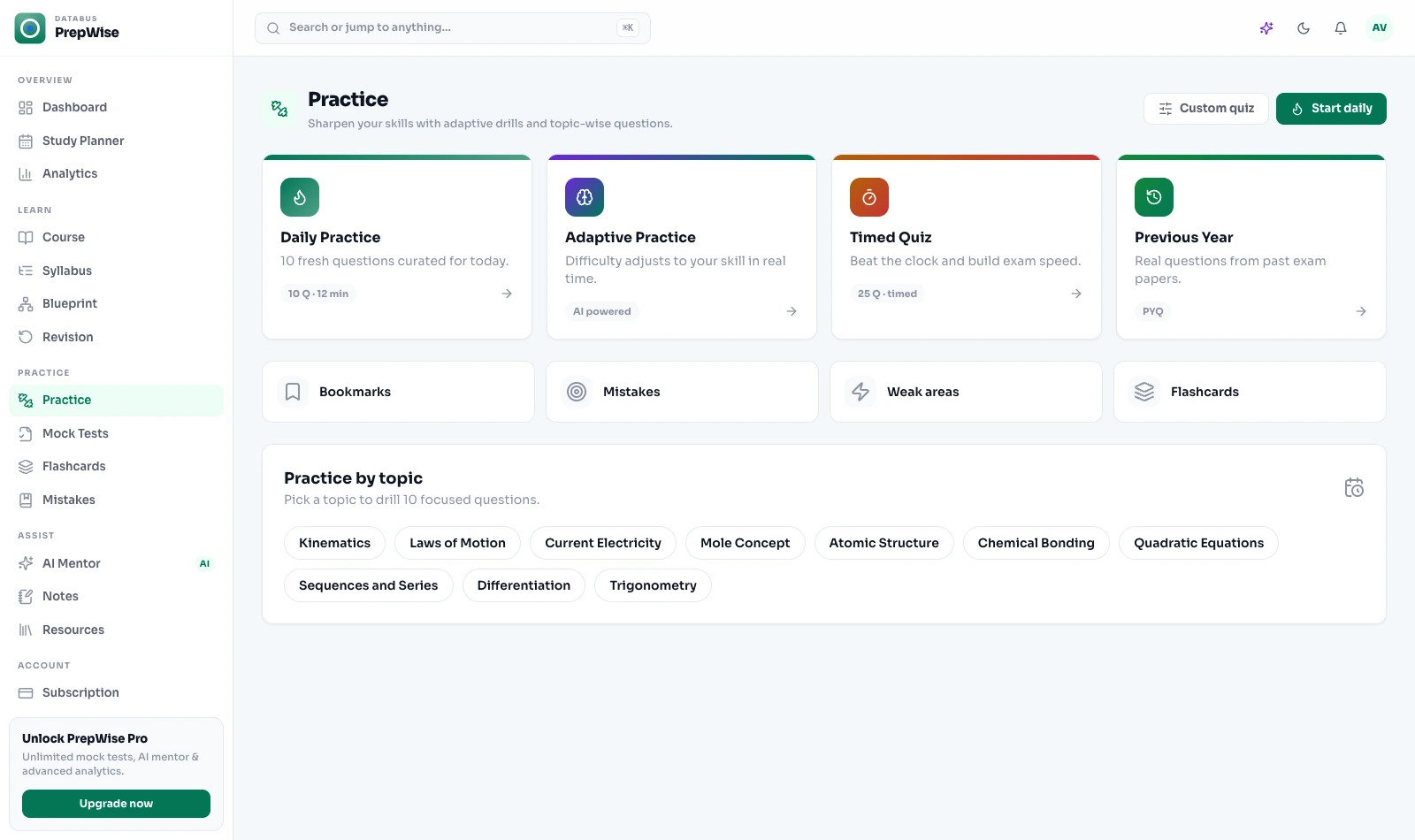
What do practice tests look like in PrepWise?
Three shapes, one loop. Chapter tests confirm a topic before the plan marks it done. Mixed drills pull questions across everything you have covered, which is where forgetting gets caught. Full mocks rehearse the actual exam: its length, its sections, and negative marking where your exam has it. Every attempt is timed, every result is broken down by chapter and question type, and the analysis is not a report to admire; it adjusts the plan, giving more revision and drill time to whatever just underperformed.
The testing effect is the best-replicated finding in learning science: retrieving under pressure strengthens memory more than re-reading ever will. But self-testing fails in practice for mundane reasons: no good questions ready, no timer discipline alone at a desk, no honest scoring, no consequence for the result. The product's job is to remove those frictions: the test is scheduled so you do not negotiate with yourself, timed so pressure is real, scored with the exam's rules, and consequential because the plan actually changes.
One testing habit deserves special mention because it separates score bands: post-test error autopsy. The analysis classifies each dropped mark as concept gap, silly slip, time pressure or attempt-choice error, and the four have different cures: revision, checking ritual, pacing drills and skip discipline respectively. Students who spend twenty minutes on the autopsy after every mock improve faster than students who sit twice as many mocks without it, because unexamined mistakes reliably repeat.
The testing loop
-
1
Scheduled, not optional
Tests appear in the plan like any other task: a chapter check after each topic, a mixed drill weekly, mocks on a rhythm that intensifies toward the exam.
-
2
Timed with the exam's rules
Duration, question counts and negative marking mirror your exam's shape, so the arithmetic of attempting versus skipping becomes instinct before it becomes expensive.
-
3
Analysed where it hurts
Results split by chapter, question type and time spent. The number that matters is rarely the total; it is the two chapters bleeding marks and the ten minutes lost to one stubborn question.
-
4
Fed back automatically
Weak chapters get more drills and earlier revision slots in the recomputed plan. Strong ones step back. The plan stays warm to your reality.
A worked example
A NEET aspirant's Sunday mock scores 512. The total is fine; the analysis is not: Human Physiology cost 28 marks, and eleven minutes vanished on two Physics numericals she should have skipped. Monday's recomputed plan moves Physiology revision up two weeks and inserts skip-discipline drills of timed 20-question sets. Three mocks later the same chapters cost 9 marks and her skips are decisive. The score moved because the plan moved, and the plan moved because the test told it where.
Where this fits, and where it doesn't
Built for you if
- ✓ You test rarely because arranging tests is friction
- ✓ Totals look fine but you cannot name your leaks
- ✓ Negative marking still costs you attempt-choice marks
- ✓ You want results to change the plan, not decorate it
Not the fit if
- ✕ You want a teacher's evaluation of written long answers; self-marked descriptive work has limits a human should fill
- ✕ You want question papers to print for a class; that is PaperDeck's job
Teachers and tutors producing printed papers for a batch should use PaperDeck, the generator built for paper-setters. PrepWise tests the student who is studying alone and answers to nobody's timetable but the exam's.
The score anxiety deserves addressing directly: early test scores are supposed to be bad, and a system that tests early surfaces that badness on purpose, while it is cheap. The aspirant who first meets their real level in a February mock has no runway left to act on the information. The one who met it in September bought five months of targeted correction with one uncomfortable evening. Test early, score badly, improve measurably; that sequence is the product working.
Frequently asked questions
Where do the questions come from?
Generated and curated against your exam's syllabus and pattern, fresh per test, so drills stay unseen. Anything that feels off can be flagged and is excluded from your future sets.
Does it handle negative marking accurately?
Where your exam deducts for wrong answers, tests score identically, and the analysis separates marks lost to wrong attempts from marks forgone by skips: two different diseases with different cures.
How long are the tests?
Chapter checks run short, drills medium, mocks at full exam length. The mix follows your plan's phase: more checks early, more mocks near the date.
Can I retake a test I did badly?
You can re-drill the same chapters with fresh questions, which is more useful than re-sitting known ones. The plan cares that the weakness closed, not that a number was replayed.
What about descriptive answers, like UPSC mains?
Objective testing is native. For written mains-style answers, PrepWise schedules the writing practice and tracks it, but a human evaluator's feedback is irreplaceable, and the UPSC page says so plainly.
How is 'time lost' actually measured?
Per-question time is tracked during the test, so the analysis can show exactly where minutes pooled. The two-minute question that took nine is usually the biggest single finding in a student's first mock.
Can I practise only my weak chapters?
Yes, targeted drills pull from any chapter set, and the plan generates them automatically for whatever the last analysis flagged. Strength maintenance still gets scheduled so strong areas do not quietly decay.
Keep exploring
Test. Analyse. Recompute. Repeat.
Timed tests that change tomorrow's plan, not just today's mood.
Get early access