


A plan that knows what today is for
Preparation fails in the gap between the syllabus and the calendar. PrepWise closes it: exam date and weekly hours in, a daily plan out, adjusted every time reality interferes.
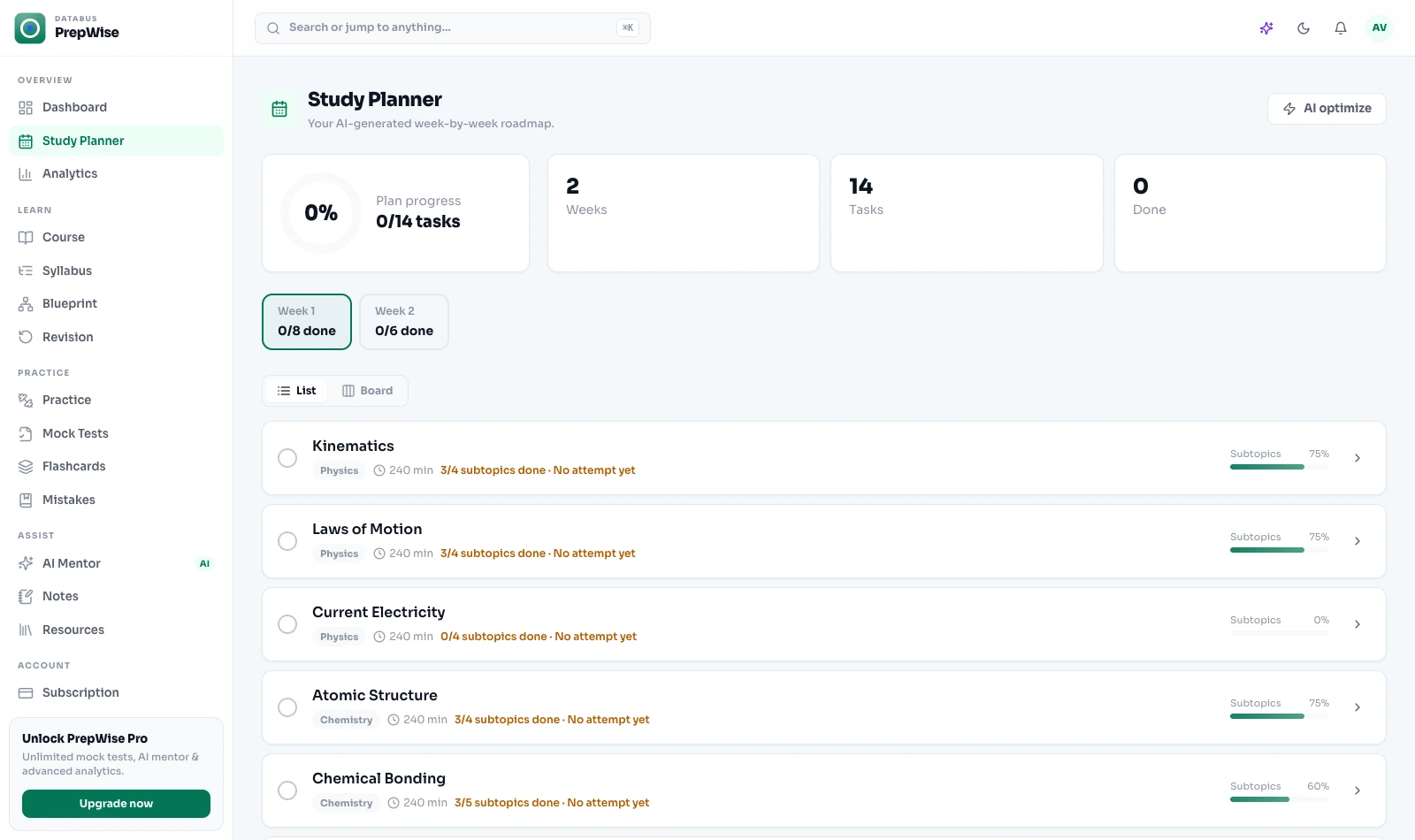
What does the study planner do?
It converts three inputs into a daily schedule: your exam date, the hours you ca truthfully give each week, and the syllabus you are preparing. The planner sequences chapters across the available days, interleaves revision of what you have already covered, and schedules practice tests at sensible intervals. Every day opens with a concrete answer to the only question that matters at 6am: what exactly should I do today? When you miss days or move faster than planned, the schedule recomputes rather than silently drifting into fiction.
Most study plans die of optimism: they assume every day is a good day, and the first bad week breaks them permanently. PrepWise plans for the student who has school, coaching, family and off days, which is every student. The weekly-hours input asks for your real week, the plan front-loads new learning and protects the final weeks for revision and mocks, and the recompute-on-slip behaviour means a bad fortnight costs you a bad fortnight, not the whole plan's credibility.
The planner also changes the emotional texture of preparation, which matters more than it sounds. Ambient guilt, the sense of always being behind everything, is the default state of an unplanned aspirant, and it burns energy that problem-solving needs. A day with a defined edge, finish these three things and today is won, replaces ambient guilt with specific, finishable work. Students describe the shift the same way: the syllabus stopped being a cloud and became a queue.
How the plan gets built
-
1
Tell it the truth
Exam date, real weekly hours (not aspirational ones), and where you currently stand in the syllabus. The plan is only as honest as these three numbers.
-
2
Get the sequence
Chapters ordered across the calendar, harder and heavier ones given room, dependencies respected, revision slots interleaved from week one rather than saved for a mythical final month.
-
3
Live one day at a time
Each day shows its work: the new topic, the revision due, the test if one is scheduled. Done is a tap; the plan learns your pace from it.
-
4
Slip and recover
Missed days trigger a recompute: the plan compresses what can compress and tells you plainly if the hours no longer fit the date, which is information worth having in October rather than February.
A worked example
A Class 12 student in September has boards in late February and roughly 20 real hours a week around school. The planner lays the remaining syllabus across September to December, holds January for full revision cycles and February for mocks. In November a fever costs her nine days. The recompute trims buffer days, moves two light chapters into December evenings and keeps January intact. The plan she follows in February is a descendant of September's, not a stranger, and the final month is revision rather than panic-learning.
Where this fits, and where it doesn't
Built for you if
- ✓ You know the exam date and your hours but not the path between them
- ✓ Plans you make yourself collapse at the first bad week
- ✓ Revision keeps getting postponed to a final month that never comes
- ✓ You want one clear answer each morning, not a wall chart
Not the fit if
- ✕ You want a teacher; the planner schedules learning, your books and classes deliver it
- ✕ You will not tell it real hours; a flattering plan is a broken one
For generating practice papers to sit on schedule, PaperDeck is the paper press and pairs naturally with the plan. Coaching centres organising batches and tests should look at TutorDesk; PrepWise is the individual student's own system.
A note on the honesty the planner asks for, because it is the only hard part: overstating your weekly hours is the one input error the system cannot fully correct, since it plans real days against fictional capacity. The fix is cheap: start with fewer hours than you believe and let two good weeks earn an increase. A plan you beat slightly every day builds the compliance habit; a plan that beats you daily teaches you to ignore plans, which is the expensive lesson to unlearn.
Frequently asked questions
What if I don't know my syllabus position honestly?
Start with your best estimate. The first fortnight of done-and-not-done corrects it. The planner treats your actual pace as data, so early inaccuracy fades instead of compounding.
Can it handle school plus coaching plus self-study?
Yes, the weekly-hours input is whatever self-study time truly remains after everything else. The plan schedules only what it is given.
What happens if I fall badly behind?
The plan recomputes and tells you plainly what still fits. Sometimes the useful output is that the syllabus no longer fits the hours, and the plan proposes what to prioritise; that conversation in advance is the feature.
Does it work for board exams and competitive exams both?
The planning engine is the same; the exam pages show how it shapes JEE, NEET and UPSC preparation specifically. Board-year students use it with their school calendar.
Is the plan fixed once generated?
No, it is a living schedule: every completion, skip and test result feeds the next recompute. A plan that cannot change is a poster.
Can parents or mentors see the plan?
The plan is the student's; sharing progress with a parent or mentor is the student's choice. The system is built to make self-honesty easy, not to surveil.
How far ahead does the plan show?
The full runway is always visible, but the working view is by design today plus the week. Staring at month four solves nothing in month one; doing today's queue does.
Keep exploring
Know what today is for.
Exam date in, daily plan out, recomputed every time life interferes.
Get early access