


Revision as a system, not a scramble
The forgetting curve does not wait for your final month. PrepWise schedules every finished chapter back into your calendar at spaced intervals, so exam season starts already revised.
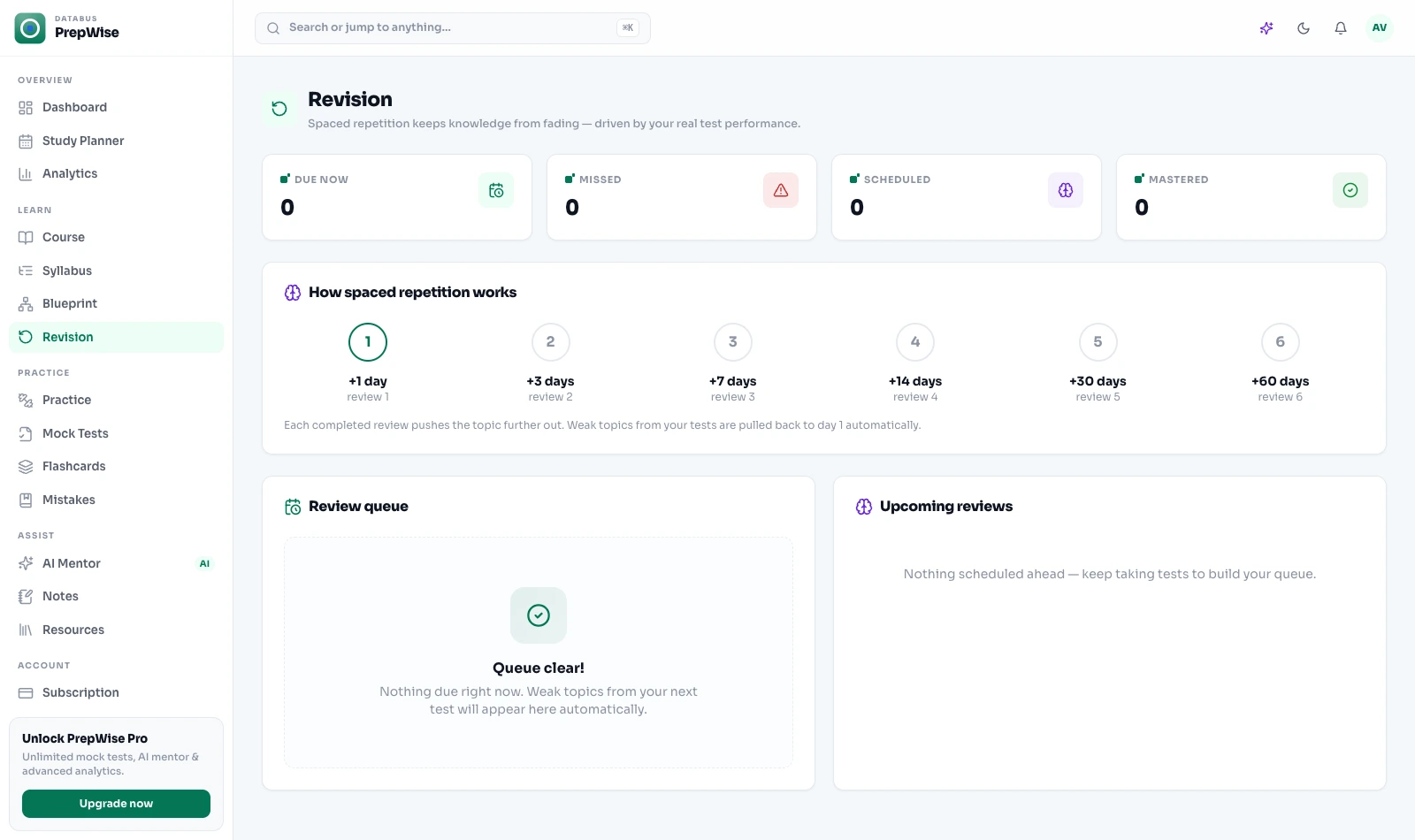
What does the revision system actually schedule?
Every chapter you finish enters a revision cycle: a first return within days, then again at stretching intervals, each pass lighter than the last. Early passes are re-engagement (worked examples, summaries, the chapter's flashcards); later passes are pure retrieval through quick tests. Chapters that test poorly cycle back sooner and more often; chapters you keep acing retreat to maintenance. The plan interleaves all of this with new learning from week one, which is precisely what a hand-made plan never manages to sustain.
The standard failure of self-directed preparation is structural: new learning always feels urgent and revision always feels postponable, so revision compounds into a final-month mountain exactly when mocks need the time. Spacing inverts the cost: many short returns beat one heroic re-read, both in retention and in hours spent. The system's real contribution is not knowing this (everyone knows this) but enforcing it, by making revision passes scheduled tasks with the same standing as new chapters.
The system's least glamorous feature might be its most valuable: the cold-chapter report. Every syllabus has corners nobody chooses to revisit, and in an unmanaged preparation they stay unvisited precisely because nothing forces the encounter. The revision queue forces it gently: the cold chapter surfaces on schedule, gets its twenty-minute pass, and stops being a small dread. Aspirants consistently report that the psychological weight of untouched chapters costs more focus than the chapters themselves ever needed.
How the cycles run
-
1
First return, fast
A finished chapter comes back within days for a short consolidation pass while the trace is warm. This one pass prevents most of the steep early forgetting.
-
2
Stretching intervals
Later returns spread out: the schedule pushes each chapter as far as your test results say it can safely go, no further.
-
3
Weakness bends the cycle
A poor drill result pulls a chapter's next pass closer and adds targeted practice. Strength lets it retreat. The cycle is personal, not calendar-cosmetic.
-
4
Final phase, already light
By the last weeks, revision is confirmation rather than rescue: short passes over a syllabus that never went cold, leaving real time for full mocks.
A worked example
Two students finish Electrochemistry in October. One re-reads it in February and finds a stranger. The PrepWise student met it again in October's consolidation pass, twice in November through drills, once in December inside a mixed mock, and in February needs forty minutes of confirmation. Same chapter, same brain, different schedules; the February hours the second student saved went into two extra full mocks, which is where February hours belong.
Where this fits, and where it doesn't
Built for you if
- ✓ Your revision keeps losing to new chapters until it is too late
- ✓ Re-reading is your only revision mode and it is not working
- ✓ You want weak chapters chased automatically, not remembered occasionally
- ✓ Final months should be mocks, not first-revision
Not the fit if
- ✕ You want a system you can overrule daily; you can adjust, but constant overrides rebuild the scramble you came to escape
- ✕ Your preparation window is days, not months; spacing needs runway to pay
The cycles lean on the flashcard decks for fact retention and on practice tests for the retrieval passes. The planner holds it all in one calendar.
The deeper reframe this system carries: revision is not a phase of preparation, it is preparation's other half, running in parallel from week one. Cultures of cramming treat revision as what you do when learning ends; the evidence says learning is not finished until retrieval succeeds on a delay, which makes every spaced pass part of the learning itself. Aspirants who internalise that stop resenting revision slots as interruptions and start reading their calendar correctly: the passes are the syllabus, arriving on schedule.
Frequently asked questions
How is this different from the flashcards?
Cards hold atomic facts; revision cycles hold whole chapters, mixing summaries, examples and tests. The two run on the same spacing principle at different grain sizes.
Won't revision passes eat my new-learning time?
They cost minutes early instead of weeks later. The total hours over a preparation are lower with spacing, not higher. The plan budgets both honestly from the start.
What does a revision pass actually contain?
Early passes: a guided re-engagement with the chapter's core plus its cards. Later passes: a short timed test, because retrieval is the point. Poor results expand the pass automatically.
Can I see which chapters are 'cold'?
The syllabus view shows every chapter's last visit and next due date, which replaces the vague dread of 'I haven't touched thermodynamics in ages' with a date.
Does this work for a one-month crash preparation?
Frankly, only partially: spacing needs runway. In a crash window the system compresses to short cycles and triage, and it will tell you what it is sacrificing.
Can I trigger an extra revision pass manually?
Yes, any chapter can be pulled forward when a mock or a mood says so; the scheduler folds the manual pass into its future spacing rather than fighting it.
How does the system decide a chapter is 'weak'?
From evidence: drill and mock performance on that chapter's questions, not self-assessment. You can override in either direction, but the default is measured, because self-assessed strength is the most common lie in preparation.
Keep exploring
Start exam season already revised.
Every chapter cycling on schedule, weak ones chased automatically.
Get early access