


The longest syllabus meets a calendar
UPSC preparation fails by drowning: in the syllabus, in current affairs, in resource lists. PrepWise gives the year a structure: what to read, revise, test and write, day by day.
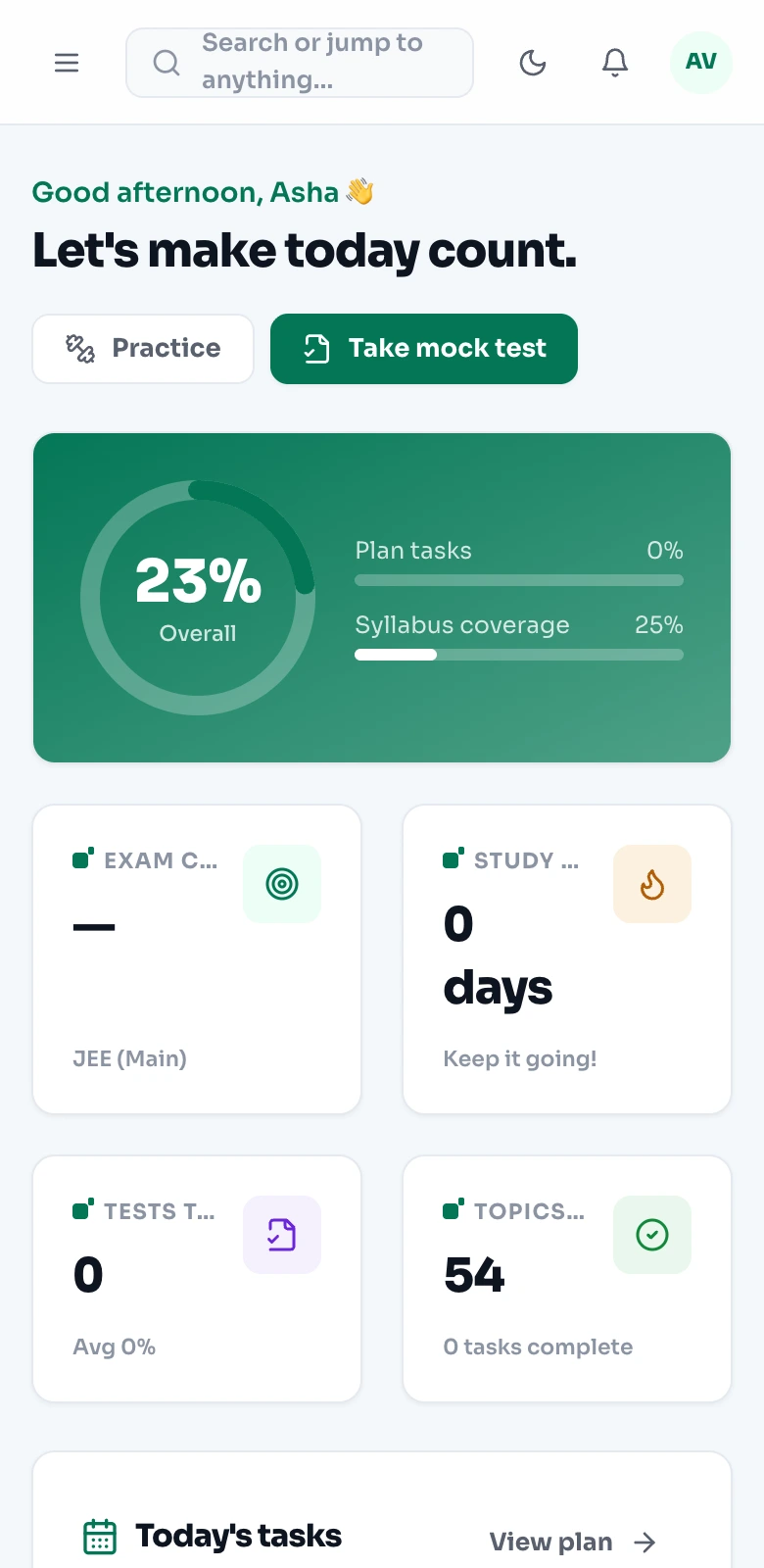
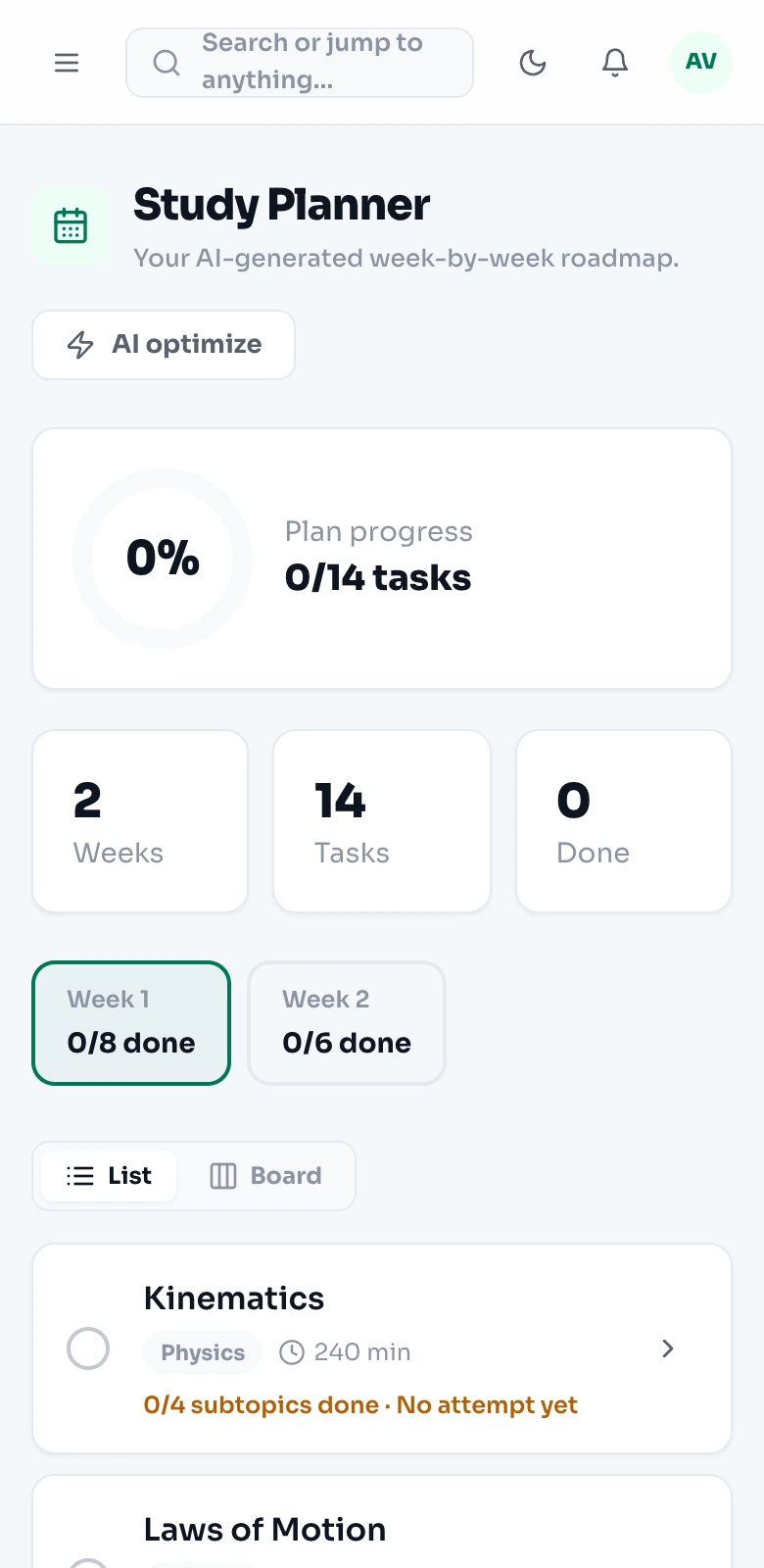
How does PrepWise shape UPSC preparation?
It plans the civil services examination as the multi-stage campaign it is: foundation reading across GS subjects and your optional laid over your runway, prelims-mode intensification with MCQ drills and CSAT practice as that stage approaches, mains-mode answer-writing scheduled as a habit rather than a hope, and current affairs captured continuously into revision-ready notes and decks instead of an unread pile. The static syllabus cycles through spaced revision throughout, because polity read in March must survive to the prelims and beyond. Verify stage dates and pattern details in the current UPSC notification; the plan schedules your work, the notification governs the exam.
What makes CSE unlike JEE or NEET is not difficulty but shape: a year-plus cycle, two very different testing modes (objective prelims, written mains), an optional subject, and a current-affairs stream that never stops flowing. Preparation debt compounds invisibly: skipped answer-writing, unrevised polity, six months of un-noted newspapers. The planner's role is to make those debts visible daily and keep the three tracks (static, current, writing) advancing together, which almost nobody sustains by willpower alone.
The aspirant's real enemy in this exam is not the syllabus but the ecosystem: an infinite supply of new resources, each promising to be the one that matters. The plan's quiet discipline is closure: sources chosen at the start, scheduled to completion, revised on cycle, and everything else consciously ignored. One standard book finished and revised four times beats four acclaimed books abandoned at chapter three, and the system makes the boring, correct choice the default one.
The CSE-shaped plan
-
1
Foundation with cycles
GS subjects and the optional sequence across the runway, each finished area entering spaced revision immediately, because the syllabus is too large to learn twice.
-
2
Current affairs, captured daily
A bounded daily slot turns the news into linked notes and flashcards against the syllabus, so revision before each stage is a deck, not a haystack.
-
3
Answer writing as a scheduled habit
Mains answers improve by volume and feedback: the plan schedules writing from early months, escalating toward mains; evaluation by a mentor or peer is scheduled too, because self-marking descriptive answers has honest limits.
-
4
Stage-mode switching
The plan reshapes around prelims (MCQ volume, CSAT, elimination discipline) and again for mains (writing, optional depth), instead of preparing for both modes averagely at once.
A worked example
A working aspirant gives the planner 25 real weekly hours and a target cycle. The plan runs polity, economy and geography through the year with revision cycles attached, holds a nightly 45-minute current-affairs capture, and starts one written answer a day in month four, escalating to daily full questions before mains season. When prelims mode engages, the writing track parks, MCQ drills take its hours, and the static decks tighten. Her February self is revising from her own linked notes rather than buying a third compilation, which is the quiet difference between cycles.
The cycle, phase by phase
The foundation phase, the longest, builds the static core: polity, economy, geography, history and the optional advance in parallel tracks, each finished area entering revision cycles immediately, with the daily current-affairs capture running from day one so the pile never forms. Answer-writing starts here too, one answer a day, because the mains skill compounds slowly and cannot be summoned in the mains season. The phase's enemy is resource wandering, and the plan's closed source list is the defence.
Prelims mode engages months before that stage: MCQ volume rises sharply, CSAT gets its honest slots (the qualifying paper that fails the unpractised every year), elimination technique becomes a drilled skill, and the static decks tighten to prelims-relevant facts. The writing track parks by design. The day after prelims, the plan flips: writing resumes at full volume, the optional deepens, GS answers get structure practice against the clock, and evaluation loops with a mentor take scheduled priority, because unexamined writing plateaus.
Between mains and interview, and between cycles for repeaters, the plan keeps the current-affairs thread warm and schedules the human work: mock interviews, DAF-based preparation, peer discussion. A repeater's next cycle starts from an honest post-mortem of stage scores, and the plan rebuilds around the measured weakness rather than instinct's guess.
Where UPSC preparations actually fail
The syllabus is rarely the killer. The ecosystem is. Resource churn leads every failure list: the fourth economy book purchased before the first was revised, each new acquisition resetting progress to zero while feeling like work. Current-affairs debt is second: six unread months of newspapers that no compilation ca truthfully replace, accumulated one skipped evening at a time. Third, answer-writing postponed to 'after coverage', which arrives weeks before mains, leaving the exam's actual output skill untrained. Fourth, the optional chosen late or reconsidered mid-cycle, burning months either way.
The pattern under all four is the same: unbounded inputs and unmeasured progress. The system's whole contribution is bounds and measures: sources fixed at the start and scheduled to completion, the capture slot bounded to its daily minutes, writing scheduled from month one with its evaluation loop, and every track's progress visible enough that drift shows in days rather than seasons. Working aspirants, who cannot afford a single wasted month, feel this discipline's value first.
Your first two weeks on the plan
The first fortnight establishes the three tracks at survivable intensity: one static subject opens (not three), the current-affairs capture slot runs from day one at its bounded length, and the first written answer happens in week one, ugly by design, because the only way to month-forty answer quality runs through month-one answers nobody should read. The plan resists the classic opening-week error, inhaling three subjects and four sources in enthusiasm's window, by simply not scheduling it.
Treat the fortnight as a contract test with yourself: if the daily capture survives fourteen days, it will survive the cycle; if it does not, better to renegotiate the hours now than discover the debt in prelims season. Working aspirants especially should let the recompute see their real weeks early, night shifts, travel and all, because a plan that knows your Tuesdays are short is a plan you will still be following in month nine.
Where this fits, and where it doesn't
Built for you if
- ✓ The syllabus's breadth defeats your self-made schedules
- ✓ Current affairs accumulates faster than you process it
- ✓ Answer-writing keeps getting postponed to 'after coverage'
- ✓ You are balancing preparation with a job and every hour must count
Not the fit if
- ✕ You want evaluated mains copies and interview guidance; humans do that irreplaceably, and the plan schedules around them rather than replacing them
- ✕ You want shortcuts through a syllabus that has none
Stage dates, pattern and eligibility live in the official UPSC notification and change on their own schedule: read the current one before anchoring your cycle. Mains answer evaluation and interview preparation deserve human mentors; PrepWise schedules that work and tracks it, and claims nothing more.
Preparation cycles this long change people, and it is fair to plan for that too. The aspirants who finish the campaign healthy treat it like a working professional treats a demanding job: fixed hours, a weekly off, physical movement scheduled like a subject. The plan will happily schedule six-day weeks and protect the seventh, and taking that seriously is not softness; a two-year campaign lost to burnout in month fourteen costs more than every rest day ever taken.
Frequently asked questions
Does PrepWise cover the optional subject too?
Yes as a scheduled track: your optional's syllabus lays into the calendar with its own revision cycles and writing practice. Content depth comes from your chosen sources; the system makes sure they actually get read and revised.
How does the current-affairs capture work?
A bounded daily slot with linkage: each item files against syllabus topics and can spawn flashcards. Before each stage, revision draws from your own capture instead of last-minute compilations.
Can it evaluate my mains answers?
Frankly, no, and be wary of anything that claims otherwise for descriptive civil-services answers. The plan schedules writing volume and the evaluation loop with your mentor or peer group, and tracks both.
Is it useful for working aspirants?
Especially: with 20-odd real hours a week, unplanned preparation is fatal. The plan triages ruthlessly against your actual hours and tells you early if the target cycle needs revisiting.
What about prelims-to-mains transition?
The plan flips modes the day after prelims: writing resumes at volume, optional deepens, static revision narrows to mains-relevant areas. The transition being pre-planned is worth a fortnight most aspirants lose to drift.
How does the plan handle optional subject choice?
It schedules whatever optional you choose but stays clear about its limits: choosing the optional is a strategy decision for mentors and toppers' guidance, not a scheduling engine. Once chosen, the plan treats it as a first-class track.
Can I run the plan through a full attempt cycle including interview?
The plan runs prelims through mains. The interview phase is human work, mocks with people, and the system's role shrinks to scheduling those sessions and keeping current affairs warm.
How does the plan schedule newspaper reading realistically?
As a bounded daily slot with a capture output, notes and cards filed against the syllabus, not as open-ended reading. The bound matters: an hour that produces filed material beats three hours of virtuous reading that produces a pile, and the plan treats the output, not the time, as the completed task.
Can the plan handle a repeater coming off a mains or interview attempt?
That is where measurement helps most: the next cycle starts from a stage-wise account of where marks were lost, and the plan weights accordingly, a mains-writing cycle for a mains-margin miss, a prelims-accuracy rebuild for a cutoff miss. Repeating the same year harder is the pattern it exists to prevent.
Keep exploring
Structure the campaign.
Static, current and writing tracks, scheduled from your runway to result.
Get early access