Databus Logo
Blog Login →
TRAI DLT compliant · Official WhatsApp Business API · 500+ Indian schools

School Communication Software for Indian Parents & Teachers

"I never received that message." Actually, you did. We have the timestamp.

Replace 28 chaotic class WhatsApp groups with one secure parent app + official WhatsApp Business API + TRAI DLT compliant SMS. Digital circulars, homework dispatch, exam results, attendance alerts, emergency broadcasts — all from one platform with sent/delivered/read receipts per parent.

Number masking + office hours protect teachers. When a teacher leaves, the communication history stays with the school — not on their personal phone. Built for the Indian Communications Coordinator who is tired of being the parent-escalation lightning rod.

4
Channels (App / WhatsApp / SMS / Email)
8+
Indian languages supported
TRAI
DLT compliant SMS
10 days
Live deployment

Four hidden costs of class WhatsApp groups

The 28 class WhatsApp groups your school runs aren't free. They're a liability.

🔓

Privacy breach

In standard groups, every parent's personal phone number is visible to every other parent — including parents you didn't choose to include in the group. Marketing spam, unsolicited contact, and inappropriate messages follow. This is a DPDP Act 2023 violation that becomes enforceable May 13, 2027.
📢

Information overload

Important exam schedule changes get buried under 50 "Good Morning" messages, religious forwards, parent disputes, and stranger-to-parent chatter. When the actual notification matters most, parents miss it inside the noise. The school still gets blamed.

🌅

Teacher burnout

Parents ping teachers at 10:30 PM on Sundays about homework doubts. Teachers feel obligated to respond because the message is on their personal WhatsApp. Within 18 months the best teachers are looking for jobs at schools that don't put their personal numbers in parent groups.

🚪

Institutional data walks out

When a class teacher resigns, they leave with: the parent contact list, the full conversation history with every parent, photos and documents shared in the group. The replacement teacher inherits nothing. Months later, the departed teacher can still personally contact those parents.

4-Channel Multi-Modal Delivery

One platform. Four channels. Reaches every parent — including the ones who don't have smartphones.

No single channel works for every parent demographic. A 1,800-student CBSE school has urban parents who live on WhatsApp, working parents who only check SMS, grandparents who handle pickup and use feature phones, and overseas relatives who prefer email. The platform routes each message through the right channel for each parent automatically.

  • Parent App push notification: Zero per-message cost. Daily updates, homework dispatch, low-urgency alerts. Most engaged parents prefer this channel — they get a clean feed without spam.
  • Official WhatsApp Business API: Approved utility templates with rich media (PDF report cards, exam timetables, event images). For specific dunning workflows like fee reminders, see Auto Fee Reminders.
  • TRAI DLT compliant SMS: Transactional templates for fees, attendance, exams, emergency. Works on DND-registered numbers. Falls back automatically if WhatsApp undelivered.
  • Email: Formal documents, audit copies, PDF report cards for parents who file communication.
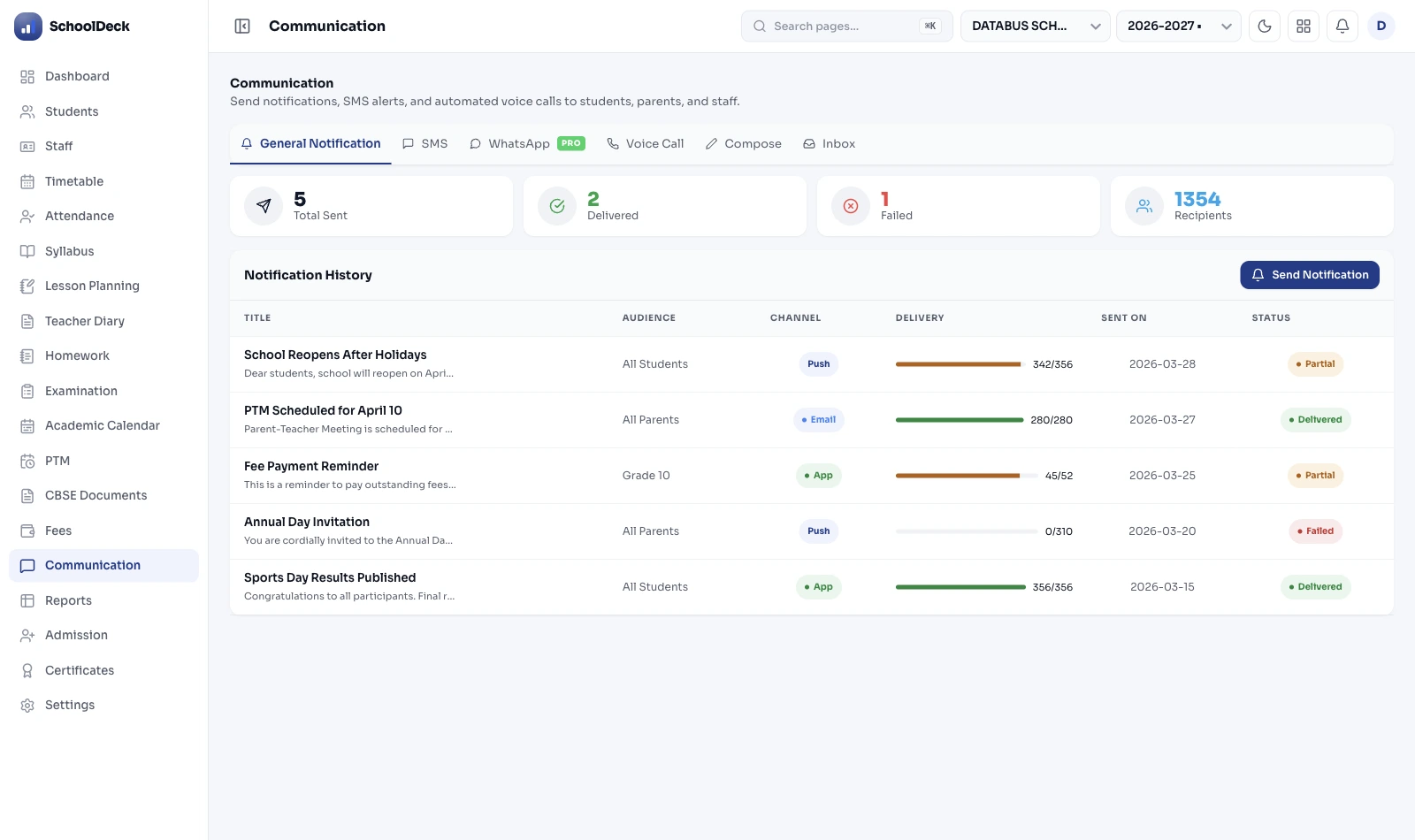
SchoolDeck communication platform showing multi-channel parent message delivery
TRAI TCCCPR 2018 · Distributed Ledger Technology (DLT) Framework

Every school sending bulk SMS in India must be DLT-registered. Most aren't, until they're fined.

TRAI's Telecom Commercial Communications Customer Preference Regulations 2018 mandate that all commercial SMS in India route through the blockchain-based DLT platform. Schools sending unregistered SMS face penalties up to ₹10 lakhs per violation, ₹50 lakhs for repeated breaches, and permanent sender ID blacklisting.

Step 1 · 2-5 days

Principal Entity registration

School registers as Principal Entity with KYC documents. Receives unique Entity ID in TM-XXXXXXXXXX format. Approval typically 2-5 business days. Required by FSSAI for canteen communication and by TRAI for ALL bulk SMS.

Step 2 · 1-48 hours

Header & template approval

Branded Sender ID (e.g., DPSDLH for DPS Delhi) approved on each operator portal. Message templates per category. From May 6, 2025+ headers carry suffixes: -T (Transactional), -P (Promotional), -S (Service), -G (Government).

Step 3 · go-live

PE-Telemarketer binding

Entity linked to Business Solution Provider via PE-TM chain on DLT portal. One registration syncs across Airtel, Jio, Vi, BSNL DLT platforms automatically — no separate per-operator registration.

SchoolDeck handles the entire DLT registration

Most school admin staff don't have time to navigate four telecom operator portals, prepare KYC documents to each operator's specifications, and chase template approvals across Airtel, Jio, Vi, and BSNL DLT platforms. SchoolDeck's onboarding team handles the full process — typical end-to-end approval 5-7 business days. Once approved, no annual re-registration required for templates already in the library.

Reference: TRAI Telecom Commercial Communications Customer Preference Regulations 2018 (TCCCPR 2018). Distributed Ledger Technology mandate. Header suffix system per TRAI directive effective May 6, 2025+. Penalty figures per TRAI enforcement framework.

Number Masking + Office Hours

Two-way teacher-parent chat — without giving parents your teachers' personal phones.

Parents want to ask the maths teacher a question about tonight's homework. The school wants to enable that conversation. The teacher doesn't want their personal WhatsApp pinging at 10:30 PM with parent questions about a single child's homework doubts.

Three boundary mechanisms make this conversation healthy for both sides:

  • Number masking: Conversations route through the SchoolDeck app. Neither party sees the other's actual phone number. When a teacher leaves the school, parents can't continue to contact them on personal WhatsApp.
  • Configurable office hours: Teachers receive no notifications outside set working hours (typically 8 AM to 5 PM Mon-Fri). Messages arrive in the queue but trigger no buzz until office hours resume. Weekend messages wait until Monday 8 AM.
  • Auto-escalation + audit: If a teacher hasn't responded within 48 hours, the conversation auto-escalates to the class teacher or HoD. All conversations are auditable by school admin — important for safeguarding and DPDP compliance.
SchoolDeck app showing number-masked parent-teacher chat with office hours indicator
"We have 1,800 students from Nursery to Class 12, 32 class WhatsApp groups, and 78 teachers. My job for three years was to be the human bridge between angry parents who said they'd never received a notice and exhausted teachers who said they'd posted it ten times. Every disputed message was a 30-minute investigation across multiple groups, screenshots, and forwarded messages. When we moved to SchoolDeck I expected the WhatsApp groups to die slowly — they died in two weeks. The number masking changed everything. Three of our best teachers had been quietly looking for jobs because parents would WhatsApp them at 9 PM about homework doubts. Once we configured office hours and routed all teacher-parent chat through the app, the late-night pings just stopped. The read receipts also stopped the parent disputes — when a parent now claims they never got a circular, I can show them the exact timestamp when their phone showed it as delivered and read. Two of our Hindi-medium parent families have told me they finally feel included because their notifications come in Hindi. The whole communication function has gone from being my full-time crisis-management job to a 30-minute daily review."
S
Mrs. Sunitha Rao
Communications Coordinator — CBSE Sr Sec School, Bengaluru · 1,800 students · 78 teachers · 32 WhatsApp groups retired · Deployed September 2024

Why class WhatsApp groups stop working past 500 students

Class WhatsApp groups feel free, fast, and familiar. For a small school with 200 students and tight community, they actually work reasonably well. But as the school grows — past 500 students, past 15 sections, past 40 teachers — the model collapses for structural reasons that no amount of group discipline can fix:

  • Privacy breach scales with group size. A 35-parent group means 35 strangers see every parent's personal phone number. By Class 5 your parents have been added to 5 successive years of groups exposing them to ~200 strangers. Marketing scrapers harvest these numbers continuously.
  • Signal-to-noise ratio collapses. Important exam timing changes get buried under religious forwards, "Good Morning" stickers, and parent-to-parent chatter unrelated to school. When you most need parents to see the message, they don't.
  • Teacher boundaries vanish. A teacher's personal WhatsApp number sits in 5-6 active class groups. Late-night homework doubts, weekend parent questions, holiday photo requests — all arrive on their personal phone. Teacher attrition rises.
  • Institutional data walks out with the teacher. When a class teacher resigns in March, they leave with the parent contact list, the full conversation history, and three years of academic correspondence about specific students. The April replacement teacher inherits nothing.
  • Read receipts are impossible. When a parent says "I never got the fee notice," the school cannot prove delivery. Disputes consume admin time and erode trust both ways.

4-channel delivery — because no single channel reaches every parent

A 1,800-student school in a tier-1 Indian city has parent demographics ranging from tech-savvy urban professionals to grandparents using feature phones, working parents in 12-hour shifts who only check SMS, and overseas relatives who prefer email. The platform routes each message through the right channel for each parent automatically.

The four channels operate as a cascade — each parent has a primary channel and a fallback, configured per their preferences:

  • Parent app push notification — Zero per-message cost, high visibility, ideal for daily updates and homework dispatch. Most engaged parents prefer this — the feed is clean (only their school's messages, no group chatter).
  • Official WhatsApp Business API — Utility templates with rich media (PDF report cards, exam schedules, event photos). Used for medium-urgency alerts.
  • TRAI DLT-compliant transactional SMS — Works on DND-registered numbers because fee/attendance/exam alerts are transactional. Fallback for parents without smartphones.
  • Email — Formal documents (report cards, fee receipts) for record-keeping.

TRAI DLT compliance — what your school must legally do

India's Telecom Commercial Communications Customer Preference Regulations 2018 (TCCCPR 2018) mandates that all commercial SMS in India route through a blockchain-based Distributed Ledger Technology (DLT) platform. Any organisation sending bulk SMS — including schools — must register on DLT or face penalties up to ₹10 lakhs per violation and ₹50 lakhs for repeated breaches with permanent sender ID blacklisting.

The DLT registration process has four mandatory steps:

  • Principal Entity (PE) registration: School registers with KYC documents, receives unique Entity ID in TM-XXXXXXXXXX 13-character format. Approval typically 2-5 business days.
  • Sender ID / Header approval: School's branded alphanumeric identifier (e.g., DPSDLH for DPS Delhi) approved on each telecom operator's DLT portal. From May 6, 2025+ headers carry category suffixes: -T Transactional, -P Promotional, -S Service, -G Government.
  • Template approval: Each SMS template approved per category. Typical 1-48 hours per template. Templates must include the brand name and dynamic field placeholders.
  • PE-Telemarketer binding: Entity linked to the BSP/aggregator via PE-TM chain on DLT portal — required for traceability.

One registration syncs automatically across Airtel, Jio, Vi (Vodafone Idea), BSNL, Tata, and Videocon DLT platforms — schools don't need separate registration per operator. SchoolDeck's onboarding team handles the entire process. Most school admin staff don't have time to navigate four operator portals and chase template approvals individually.

Number masking architecture and teacher office hours

The single most underrated feature of professional school communication platforms is what they explicitly prevent — direct phone-number exchange between parents and teachers. The platform implements number masking at three levels:

  • Parent-to-parent: Parents see other parents only by name in shared messages — never personal phone numbers. Each conversation is a private channel routed through SchoolDeck infrastructure.
  • Parent-to-teacher: Parents can initiate a chat with any of their child's subject teachers, but both parties see only the in-app contact name. Neither knows the other's actual phone number.
  • Outgoing school communications: Parents see the school's verified Sender ID (the DLT-approved header) as the source, not any individual teacher or admin's personal number.

Three additional boundary mechanisms protect teachers from burnout:

  • Configurable office hours per role: Teachers receive no notifications outside set working hours (typically 8 AM to 5 PM Mon-Fri). Messages sent at 9:30 PM Saturday arrive in the teacher's queue but trigger no buzz until Monday 8 AM.
  • Response time SLA: If a teacher hasn't responded within a configured window (e.g., 48 hours), the conversation auto-escalates to the class teacher or HoD.
  • Topic boundaries: Teachers can mark conversations as 'requires admin review' for sensitive disciplinary or medical matters — automatic forward to school admin.

Emergency broadcast system — when seconds count

During a crisis — sudden extreme weather, civic unrest, transport breakdown, campus security incident — rumours spread faster than facts. Parents panic. Phone lines jam. The school's normal communication channels get overwhelmed by inbound calls.

The Emergency Broadcast module is a high-priority cross-channel override accessible to authorised users (typically Principal + VP only, configurable). Three-click activation: select audience (whole school / specific grades / parents only / staff only) → select template (sudden closure, weather alert, transport breakdown, security incident, evacuation drill) → confirm. The platform overrides normal communication queues and dispatches the message simultaneously via parent app push + WhatsApp utility template + SMS — ensuring delivery even if a parent doesn't have the app installed or has notifications muted.

Estimated time from activation to first delivery: under 30 seconds for parent app, 1-2 minutes for WhatsApp and SMS depending on telecom load. The module integrates with the Transport module — if a bus is logged as broken down on its route, the emergency broadcast can auto-target only affected route students' parents.

Multilingual support — Hindi, Tamil, Bengali, Marathi, Telugu, Kannada, and more

India's educational landscape is incredibly diverse. Sending a complex formal English circular to a parent demographic that primarily speaks Hindi or Marathi or Tamil renders the communication useless — and the school still gets blamed when the parent misses the deadline.

Full Unicode support for Hindi, Tamil, Marathi, Bengali, Telugu, Kannada, Malayalam, Gujarati, Odia, Punjabi, Assamese, and any other Unicode-supported language. Each parent configures their preferred language in their app settings. A school can have 70% Hindi-preference parents and 30% English-preference parents, and each receives messages in their chosen language automatically — same circular, two language variants generated from one template.

This matters most in Tier-2 and Tier-3 city schools where English-only communication systematically excludes a portion of the parent demographic from understanding important academic, fee, and exam communications. SMS templates need separate DLT approval per language but the platform's template library includes pre-approved variants for the major Indian languages — no extra DLT navigation required for schools.

Read receipts and accountability — ending the "I never got it" dispute

The single most expensive recurring cost in Indian school communication is the "I never received that message" dispute. Under WhatsApp group workflow, the school cannot prove the parent saw the message — making every dispute a 30-minute investigation across multiple groups, screenshots, and forwarded messages.

For every circular, homework assignment, fee reminder, or attendance alert sent, the platform tracks the precise delivery funnel per parent: Sent → Delivered → Read — with timestamps. When a parent later disputes receiving a notice, the school can show the exact second when their phone marked the message as delivered and read. The dispute ends in 30 seconds instead of 30 minutes.

The analytics dashboard also surfaces patterns: which classes have parents with low engagement, which channels work best for which demographic, which times of day get the highest read rates. Most schools discover that 9-10 AM (after morning rush) and 7-8 PM (after dinner) significantly outperform mid-day messaging.

DPDP Act 2023 readiness — May 13, 2027 enforcement deadline

India's Digital Personal Data Protection Act 2023 (DPDP) substantive compliance enforcement begins May 13, 2027. Schools sending communications to parents on personal staff WhatsApp numbers are creating multiple DPDP violations: unverified sender identity, no consent record, no auditable communication log, no breach reporting capability.

All communications route through the school's verified official channels with immutable audit trail of every message sent — parent ID + message content + delivery status + read receipt + timestamp. When a parent files a DPDP Data Principal access request (DSAR) asking for their full communication history, the audit log provides this directly. The platform integrates with the broader SchoolDeck audit logging architecture — every message is part of the immutable institutional record.

Communication vs Auto Fee Reminders vs WhatsApp Integration — which page do you need?

Three closely-related modules in the communication cluster share infrastructure but serve different needs:

Communication Software (this page) is the general school↔parent communication platform — digital circulars, homework dispatch, exam result publication, attendance alerts, emergency broadcasts, controlled two-way teacher-parent chat, multilingual notifications. Answers: "How do we send any kind of message to any parent or staff member through any channel?"

Auto Fee Reminders specializes in the 3-stage fee dunning cycle — Pre-Due Nudge + Due Date Alert + Overdue Escalation — with Family ID consolidation, cheque bounce workflow, and real-time fee ledger sync. Answers: "How do we collect outstanding fees without manual accountant calls?"

WhatsApp Integration is the API infrastructure layer — Meta Business API setup, green tick verification, BSP partnership, template management. Answers: "How do we set up our school's official WhatsApp Business Account?"

All three modules share one parent contact database and the same DLT-registered sender ID. Pricing is bundled within the standard SchoolDeck plan.

Class WhatsApp groups vs SchoolDeck Communication

Capability Class WhatsApp groups SchoolDeck Communication
Parent phone privacy Exposed to 35 strangers per group 100% hidden & masked
Teacher personal number protection Exposed in 5-6 active groups Number masking architecture
Message delivery accountability Lost in group chatter Sent/Delivered/Read per parent
Teacher off-hours protection 24/7 pings on personal phone Configurable office hours
Institutional data ownership Walks out with departing teacher Stays with the school permanently
Multilingual support Manual translation per group 8+ Indian languages per parent
TRAI DLT compliance Not applicable (illegal at scale) Fully DLT-registered SMS routing
DPDP Act 2023 readiness Multiple violations Immutable audit trail

Frequently asked questions

What communications coordinators ask before switching.

What is school communication software and how is it different from WhatsApp groups?

+

A unified platform that replaces chaotic class WhatsApp groups with a multi-channel system (parent app + WhatsApp Business API + TRAI DLT-compliant SMS + email). Critical differences: (1) parents and teachers communicate without seeing each other's actual phone numbers (number masking — DPDP-compliant), (2) the school owns the communication history rather than it sitting on a teacher's personal phone, (3) configurable teacher office hours prevent weekend pings, (4) every message has Sent/Delivered/Read receipts per parent for accountability, (5) bulk segmentation by class/section/grade rather than 28 separate WhatsApp groups, (6) TRAI DLT compliant SMS, (7) immutable audit trail for DPDP Act 2023 readiness before May 13, 2027.

How is this different from Auto Fee Reminders and WhatsApp Integration?

+

Three modules — same WhatsApp infrastructure, different communication needs. (1) Communication Software (this page) — general school↔parent communication: circulars, homework, exam results, attendance, emergency broadcasts, two-way teacher chat, multilingual. (2) Auto Fee Reminders — 3-stage fee dunning cycle (Pre-Due + Due Date + Overdue) with Family ID consolidation and cheque bounce workflow. (3) WhatsApp Integration — Meta API infrastructure: BSP setup, green tick verification, template management. All three share one parent database + DLT-registered sender ID.

Is the WhatsApp integration official? Will our school number get banned?

+

100% official. Uses Meta WhatsApp Business API via approved BSP partnerships — not unofficial WhatsApp Web automation or scraping hacks which cause permanent number bans. Schools using personal staff WhatsApp numbers to message hundreds of parents daily routinely get permanently banned by Meta's anti-spam algorithms. The platform protects the school's number through: (1) only Meta-approved utility templates sent (no free-text bulk), (2) all messages correctly categorized per Meta's pricing model effective July 1, 2025, (3) verified official school WhatsApp Business Account with green tick eligibility. Utility template messages cost ~₹0.125 per delivered message in India.

How does the controlled two-way chat with number masking work?

+

Parents initiate a chat with any of their child's subject teachers entirely within the SchoolDeck app. Neither party ever sees the other's actual phone number — both see only the in-app contact name. School admin can audit every conversation (important for safeguarding + DPDP). Three boundaries: (1) Office Hours — teachers receive no notifications outside set hours (typically 8 AM-5 PM Mon-Fri). Messages sent Saturday evening arrive in queue but trigger no buzz until Monday 8 AM. (2) Response SLA — if teacher hasn't responded within 48 hours, conversation auto-escalates to class teacher/HoD. (3) Topic boundaries — teachers mark sensitive conversations as 'requires admin review' for auto-forward.

Does the software support regional languages?

+

Yes — full Unicode support for Hindi, Tamil, Marathi, Bengali, Telugu, Kannada, Malayalam, Gujarati, Odia, Punjabi, Assamese, and any Unicode-supported language. Each parent configures preferred language in app settings. A school can have 70% Hindi-preference parents and 30% English-preference parents, and each receives messages in their chosen language automatically — same circular, two language variants generated from one template. Especially important in Tier-2 and Tier-3 city schools where English-only communication systematically excludes part of the parent demographic. SMS templates need separate DLT approval per language but the platform's library includes pre-approved variants for major Indian languages.

What is TRAI DLT and do we need to register our school?

+

TRAI DLT (Distributed Ledger Technology) is a blockchain-based registration system mandated by TRAI under TCCCPR 2018. Any organisation sending bulk SMS in India — including schools — must register on DLT. Process: (1) Principal Entity registration with KYC → unique Entity ID in TM-XXXXXXXXXX format, 2-5 business days approval. (2) Sender ID/Header registration (school's branded identifier like DPSDLH). (3) Message template approval per category, 1-48 hours each. (4) PE-Telemarketer binding. From May 6, 2025+ headers carry suffixes (-T/-P/-S/-G) per category. Penalties: ₹10 lakhs per violation, ₹50 lakhs for repeated breaches. SchoolDeck's onboarding handles the entire DLT registration.

How does the emergency broadcast system work?

+

High-priority cross-channel override accessible to authorised users (typically Principal + VP only, configurable). Three-click activation: select audience → select template → confirm. Platform overrides normal queues and dispatches simultaneously via parent app push + WhatsApp utility template + SMS — ensuring delivery even if a parent doesn't have the app or has notifications muted. Time from activation to first delivery: under 30 seconds for app, 1-2 minutes for WhatsApp and SMS. Use cases: sudden weather closures, transport breakdowns, civic emergencies, security incidents, evacuation drills. Integrates with Transport module — if a bus is logged as broken down, the emergency broadcast can auto-target only affected route parents.

What happens when a teacher leaves the school?

+

The most underrated benefit. Under WhatsApp group workflow, when a class teacher leaves, they take: (a) parent contact list on personal phone, (b) entire conversation history with every parent about specific students, (c) photos/documents shared in group. New teacher inherits nothing. Departing teacher can technically still contact those parents months later. Under SchoolDeck: when teacher account is deactivated, the entire communication history stays with the school. New teacher inherits full context — every prior conversation about each student. Parent contacts were never on departing teacher's phone (number masking). Institutional knowledge transfers cleanly. Also a DPDP compliance point — schools can demonstrate which staff member contacted which parent.

Can we send attachments like timetables and report cards?

+

Yes. Rich media support: high-resolution images, PDF documents (timetables, syllabus, exam schedules, report cards, fee receipts, school policy), audio files (voice notes from class teacher), short video clips (event highlights). All attachments host on SchoolDeck cloud with encrypted delivery. Report cards published from Examination module auto-attach as PDFs to parent app notification — parents don't visit separate portal. For WhatsApp: Meta's media size limits apply (16 MB images/video/PDF, 100 MB documents via document type). For SMS: attachments aren't possible — SMS includes short tracked link to PDF hosted on SchoolDeck cloud (link expires after configurable period for security).

What does pricing and deployment look like?

+

Pricing: Communication module bundled within standard SchoolDeck plan starting at ₹30 per student per month — no separate per-module charge, no per-conversation fees. Parent app push notifications unlimited at zero per-message cost. WhatsApp utility templates billed at Meta's actual rates (~₹0.125/message in India) with no markup. SMS billed at TRAI DLT operator rates (~₹0.18-0.25 per transactional SMS in India). Email free. Deployment: typically 10 working days including DLT registration window (PE 2-5 days + templates 1-48 hours + parent onboarding 2-3 days + 2-3 day soft pilot). SchoolDeck onboarding handles DLT across four operator portals. No annual re-registration required.

Communication cluster

Specialised communication modules.

For communications coordinators tired of WhatsApp group chaos

28 WhatsApp groups. One parent app.

Multi-channel delivery. Number masking. Office hours. TRAI DLT compliant SMS. Multilingual notifications. Emergency broadcast. Immutable audit trail. Built for Indian school communications coordinators.

From ₹30/student/month · 500+ Indian schools · Live in 10 days including DLT registration