Databus Logo
Blog Login →
The K-12 School Admissions CRM for Admissions Offices

Admission season: a stack of paper forms, a diary of enquiries, and the family who visited but you never called back.

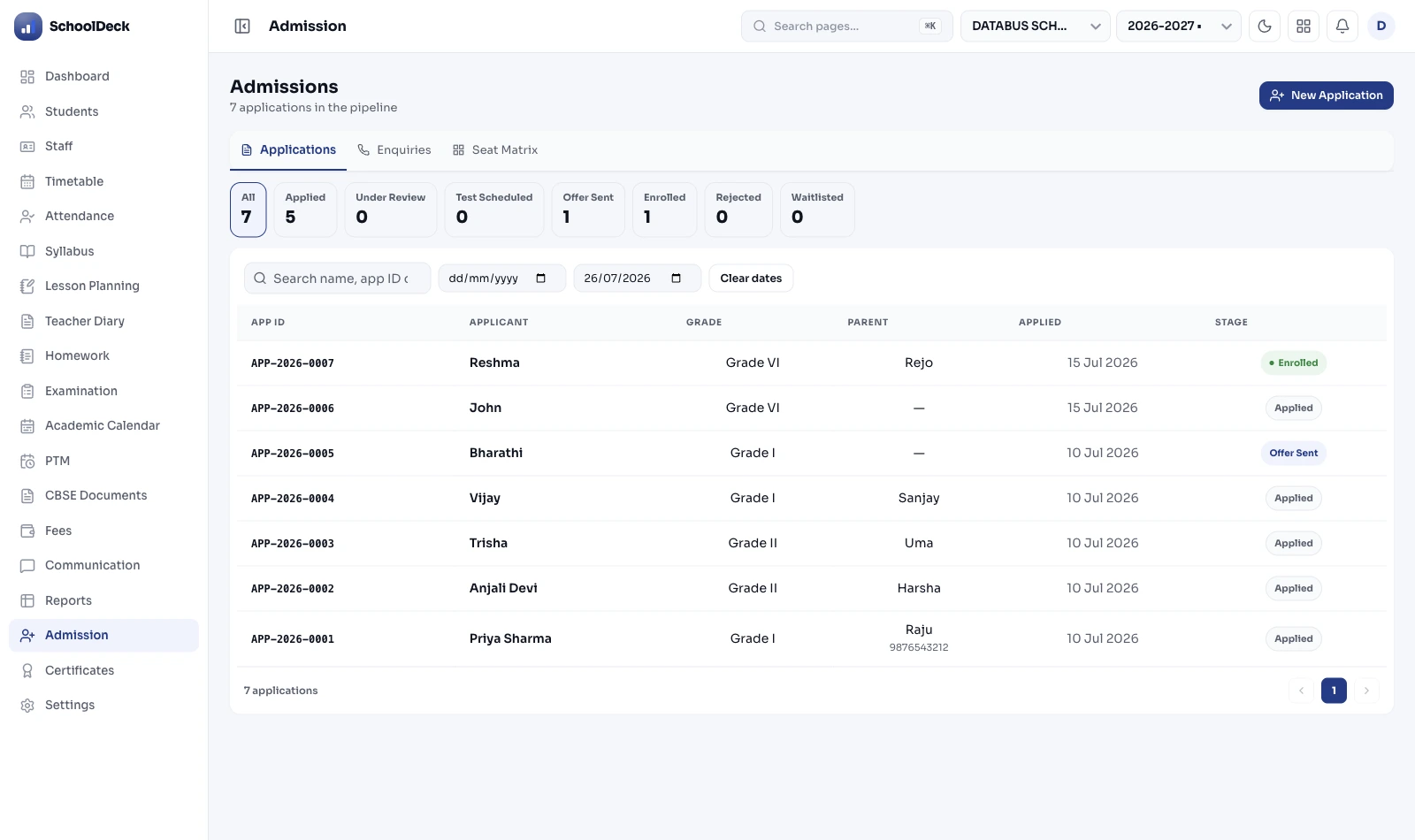
This is the admissions mechanism — one digital CRM that captures every enquiry, tracks follow-ups, collects documents online, generates merit lists, and converts to enrolment — for CBSE, ICSE and State Board schools. The school admissions pipeline, not a coaching one.

For admissions in-charge & front office · enquiry → follow-up → documents → merit list → enrolled · hands the enrolled student to the SIS.
See the enquiry-to-enrolment flow →
In plain English

Online admissions is the K-12 school admissions CRM — the digital pipeline that takes a family from first enquiry to confirmed enrolment without paper forms and a manual register. It captures every enquiry (website, phone, walk-in), tracks follow-ups so none is lost, collects documents online, generates merit or selection lists, and converts an accepted applicant into an enrolled student. It owns the pre-enrolment pipeline. It is a school module, not a coaching one — the coaching equivalent is TutorDesk, a separate product. Once a student enrols, their record lives in the student information system; the fee is the fees feature; follow-up messages go over the communication-tool channel.

One CRM
every enquiry —
website, phone, walk-in
Documents online
not photocopies
across a counter
Merit lists
generated by criteria,
not ranked by hand
Schools, not coaching
coaching admissions
is TutorDesk
A real admission season · K-12 school · the pipeline

From scattered enquiries to enrolled students — and where the pipeline hands over.

Mrs D'Souza runs admissions. Instead of a diary and a document tray, she works one pipeline. Here are its stages — and notice the last one: admissions ends where enrolment begins, handing the student to the modules that own what comes next.

Admission pipeline · enquiry → enrolment · one season School admissions CRM
1 · Enquiry
captured: website · phone · walk-in
one list, none lost
2 · Follow-up
tracked through stages
3 · Documents
uploaded online: BC · TC · report card
complete before offer
4 · Merit list
generated by criteria
explainable to parents
5 · Enrolled
converted → handed over
SIS + fees
The pipeline's job ends at stage 5: an accepted applicant becomes an enrolled student, and at that moment the canonical record passes to the student information system and the fee becomes payable in the fees feature. Admissions captures how they got in; it doesn't own who they are afterwards or the money. (Bar widths illustrate the funnel shape, not a performance claim.)
Where a paper admission season leaks

Four ways enquiries turn into lost enrolments.

The enquiry nobody called back

A family visits, their details go in a diary, and in the season's rush nobody follows up. They enrol elsewhere — and the school never even knows it lost them, because there's no list of who wasn't contacted.

The incomplete document file

Documents arrive as photocopies across a counter, half are missing or illegible, and the gap surfaces only after a seat's been offered — when chasing a transfer certificate becomes a problem.

The merit list nobody can explain

A selective admission is ranked by hand on a spreadsheet, and when a parent asks how their child was placed, there's no consistent, reconstructable basis to point to.

Re-typing the enrolled student

Once a student is admitted, their details are typed again from the paper form into the student record — the same data entered twice, with the transcription errors that invites.

How the admissions pipeline works

Capture, follow up, collect, select, enrol.

1

Capture every enquiry in one place

Enquiries from the school website form, phone calls and walk-ins are captured into one admissions CRM, so the season's interest is in a single list rather than scattered across a diary, a notepad and someone's phone.

2

Follow up so no enquiry is lost

Each enquiry is tracked through its stages with follow-ups, so a family that visited but didn't return is visible and can be contacted — using the communication-tool channel for the WhatsApp or SMS follow-up rather than a personal phone.

3

Collect documents online

Required documents — birth certificate, previous report card, transfer certificate, photographs — are collected through an online upload rather than photocopies across a counter, so the file is complete and legible before the seat is offered.

4

Generate the merit or selection list

Where the school admits by criteria, the merit or selection list is generated from the captured applications rather than ranked by hand, so the basis of selection is consistent and explainable to parents who ask.

5

Convert to enrolment and hand over to the record

When an applicant accepts, they're converted from an admissions record into an enrolled student — at which point their canonical record lives in the student information system, fees are handled by the fees feature, and admissions has done its job.

The frame this runs inside

Built for the school admission season — and the minors' data it handles.

A school season, not a coaching pipeline

This is built for the CBSE/ICSE/State Board admission season — merit lists, document files, board context. The coaching enquiry pipeline (demo class, counselling, batch enrolment) is a different workflow, owned by TutorDesk, a separate product.

DPDP Act 2023 — minor applicant data

Applicant and document data is personal data about minors, handled under the DPDP Act 2023 — kept for the admission, access-controlled to the admissions staff who need it, India-hosted with backups, and not sold or used beyond the admission.

One entry, handed onward

An enrolled student's details aren't re-typed — the pipeline hands the record to the SIS and the fee to the fees feature, so the data captured at admission flows onward rather than being entered twice. Access is governed by role-based access; changes are in the audit trail.

Framework references: DPDP Act 2023 (minor applicant + document data — purpose-limited, access-controlled). This is a school admissions module for CBSE, ICSE and State Board schools; the coaching-centre equivalent is TutorDesk. The post-enrolment student record is owned by the student information system feature, fee payment by the fees feature, and the bulk messaging channel by the communication-tool feature.

School admissions pipeline vs coaching vs SIS vs fees vs comms · what this page owns

The school admissions CRM ≠ coaching admissions ≠ the student record ≠ fee payment ≠ the messaging channel.
This page owns the school enquiry-to-enrolment pipeline; the rest are their own pages.

SchoolDeck keeps the admissions pipeline distinct from the post-enrolment record, from payment, and from the coaching cluster on purpose — so this feature ranks for "school admissions software" and never competes with TutorDesk's coaching admissions or with the SIS.

This page owns

  • The K-12 school enquiry-to-enrolment CRM — capture, follow-up, conversion.
  • Online document collection before the seat is offered.
  • Merit / selection list generation by the school's criteria.
  • The admission season for CBSE, ICSE and State Board schools.
  • The hand-over to enrolment — converting an applicant into a student.

This page defers to

  • Coaching admissions — the enquiry-to-admission journey for a tuition/test-prep institute — lives in TutorDesk, a separate product. School ≠ coaching.
  • The post-enrolment student record — identity, academic history, the document vault — lives in Student Information System. Admissions hands the new student over and stops.
  • Fee payment — the UPI/card collection, receipt, reconciliation — lives in Fees. Admissions captures the enrolment; fees collects the money.
  • The messaging channel — the DLT-registered WhatsApp/SMS that carries follow-ups — lives in Communication Tool. Admissions triggers; that channel sends.
Three admission-season realities

The same pipeline, three kinds of school.

The enquiry-to-enrolment flow is the same; the pressure point shifts with the school.

Sought-after school

More applicants than seats

A popular school's challenge is selection — many applicants, limited seats — so the merit-list generation by stated criteria, explainable to every parent who asks, is what matters most, sitting on top of clean document files.

Growing school

Chasing every enquiry

A growing school's challenge is conversion — making sure no enquiry is lost — so capturing every website and walk-in enquiry and following up over the comms channel is what fills the seats.

Multi-section school

Volume without re-typing

A large school admitting hundreds across sections needs the enrolled applicant to flow straight into the student record and fees without re-keying — so the season's data entry isn't done twice.

From the field

Vasai, Maharashtra · ICSE school · admissions in-charge.

"Admission season used to live in a fat register and a tray of document photocopies on my desk. The thing that bothered me most wasn't the volume — it was the families who came, seemed keen, and then we simply never called back because their slip was buried under fifty others. Now every enquiry, whether it comes from our website or a parent walking in, lands in one list, and the follow-ups go out on the school's proper WhatsApp channel rather than from my own number. Documents come in online, so the file's complete before we offer a seat, and our merit list is generated on the criteria we set — which I can actually explain to a parent who asks, instead of 'the committee decided'. The part I'd flag to anyone comparing: it knows where it stops. Once a child is admitted, they become a proper student record in the system and the fee goes to the fees module — admissions doesn't try to be the whole ERP. And it's a school tool; our sister coaching wing uses a different Databus product for their enquiries, which is right, because that's a different kind of admission."
Mrs Felicia D'Souza Admissions In-Charge · ICSE school · Vasai West, Palghar-401202, Maharashtra
Enquiry-to-enrolment CRM · website + walk-in capture · online document collection · criteria-based merit list · converts to enrolment then hands the student to the SIS + fees
Quick answers

School online admissions, asked and answered.

What every admissions in-charge and Principal asks before they move the admission season off paper.

What does the online admissions feature do?
It is the K-12 school admissions CRM — the digital pipeline that takes a family from first enquiry to confirmed enrolment without paper forms and a manual register. It captures every enquiry from website, phone or walk-in into one place, tracks follow-ups so none is lost, collects required documents online, generates merit or selection lists where a school admits by criteria, and converts an accepted applicant into an enrolled student. It owns the pre-enrolment pipeline; once a student is enrolled, their record lives in the student information system.
Is this for coaching centres too, or only schools?
Only schools. This is the K-12 school admissions module. The coaching-centre and tuition equivalent — the enquiry-to-admission journey for a JEE, NEET or test-prep institute — is owned by TutorDesk, which is a separate Databus product built for coaching, with its own admission-enquiry solution. The two are kept apart deliberately because a school admission season (merit lists, document files, board-school context) and a coaching enquiry pipeline (demo class, counselling, batch enrolment) are different workflows for different buyers.
How is this different from the student information system?
Admissions is the pre-enrolment pipeline; the student information system is the post-enrolment record. This feature handles the applicant — enquiry, follow-up, documents, selection — up to the moment they accept and enrol. At that moment the student becomes a canonical record in the SIS, which then owns their identity, academic history, attendance and the rest. Admissions hands the new student over to the SIS and stops; it does not duplicate the ongoing student record. One is how they got in; the other is who they are once in.
Does it collect the admission fee?
It captures the admission, but the fee payment and receipt are owned by the fees feature. Admissions records that an applicant has accepted and is enrolling; the fees feature handles the actual UPI or card payment, the receipt and the reconciliation. The two connect at the point of enrolment — an enrolled student becomes payable in the fees module — but collecting money is a separate, RBI-context job kept on its own page, so admissions is not re-implementing payment.
How are documents collected and stored?
Required documents — birth certificate, previous report card, transfer certificate, photographs — are uploaded online by the family rather than handed over as photocopies, so the file is complete and legible before a seat is offered. Because this involves personal data about a minor, the documents are handled under the DPDP Act 2023, access-controlled and India-hosted; once the student enrols, the document vault is part of their student information record rather than a loose folder in the admissions office.
Can it generate a merit list?
Yes, where the school admits by criteria. The merit or selection list is generated from the captured applications against the school's stated basis, rather than ranked by hand on a spreadsheet, so the selection is consistent and explainable to a parent who asks how it was done. The school sets the criteria; the feature applies them to the applicant pool to produce the list. This keeps a selective admission defensible rather than dependent on a manual sort nobody can later reconstruct.
Does it send the follow-up messages itself?
It triggers them, but the sending channel is the communication-tool feature. When an enquiry needs a follow-up, admissions decides that and the message goes out over the school's DLT-registered WhatsApp or SMS channel, which the communication-tool feature owns and manages. This means follow-ups go through the proper, compliant channel with number masking, rather than a counsellor messaging families from a personal phone — admissions orchestrates the follow-up; communication-tool carries it.
What happens to an enquiry that doesn't convert?
It stays in the CRM as a record of interest rather than being lost. A family that enquired but did not enrol this season is visible — which matters because they may return next season, or for a sibling, and because a school wants to understand how many enquiries became enrolments. The point of capturing every enquiry in one place is precisely that the ones that didn't convert are as visible as the ones that did, instead of vanishing from a diary.
Is the applicant data safe, given many are minors?
Yes. Applicant and document data is handled under the DPDP Act 2023, kept for the purpose of running the admission, access-controlled so only the admissions staff who need it can see it, and India-hosted with backups. Because applicants are minors, the data is treated accordingly and is not sold or used beyond the admission. Who can view an applicant's file is governed by the role-based-access model, and changes to admission records are captured in the audit trail like any other record in SchoolDeck.

Stop losing the family you forgot to call back.
Run the admission season on one pipeline.

We'll show you enquiry capture from your website and walk-ins, follow-ups over the school channel, online document collection, criteria-based merit lists, and the hand-over to the student record at enrolment — in a demo on your school's actual season.

See the Admissions CRM →