Databus Logo
Blog Login →
CBSE 2025-26 scheme · NEP 2020 HPC · Class 10 Two Board Exams 2026 ready

School Exam Management Software for Indian Boards

Three weeks of marks aggregation. Two days of report card printing. Done in two days, end to end.

CBSE 80+20 assessment scheme configured natively. Class 12 science 70+30. Class 10 skill subjects 50+50. 9-point grading (A1-E2) auto-calculated. 33% passing enforced per subject + aggregate. Class 10 Two Board Exams 2026 ready — most legacy software isn't.

NEP 2020 Holistic Progress Cards for Foundational + Preparatory stages. Maker-checker marks workflow. Immutable audit trail. Fee Defaulter Result Lock for arrears recovery on result day. Built for Indian exam cell coordinators who lose every March and December to spreadsheet aggregation.

80+20
CBSE Class 10 scheme
9-pt
Grading scale auto-calc
2026
Two Board Exams ready
< 10 min
Bulk PDF generation

Four hidden costs of manual exam processing

Every March and December, the same two-week panic. Why?

📊

Marks aggregation chaos

28 teachers email Excel sheets to the exam cell. Three teachers send corrected versions later. Five teachers use slightly different column layouts. The coordinator manually consolidates 1,650 student records across 12 subjects — and every recalculation introduces new errors.

📁

Which Excel is the latest?

"Class10_Marks_FINAL_v3_updated_REAL.xlsx" arrives on Wednesday. Then the Maths teacher sends a v4 on Thursday. The coordinator chooses wrong and rebuilds the file from scratch on Friday. Version control via filenames does not work at 1,650-student scale.

📜

CBSE 2026 changes

Class 10 Science just got a new 3-section paper structure (Physics + Chemistry + Biology separate). Class 10 from 2026 has Two Board Exams (Main + Improvement, best of 2). Most legacy school software hasn't updated. Schools using outdated templates fail board inspections.

🖨️

Report card printing

Once aggregation is finally clean, you face printing 1,650 unique report cards on the school printer over 2-3 days, sorting into 32 stacks by section, and handing them to class teachers for distribution. By the time parents have them, the next term has started.

CBSE 2025-26 Assessment Scheme · Verified

Three different schemes. One platform configured for all.

CBSE 2025-26 standardised that each subject in Class 10 and Class 12 carries 100 marks, but the theory/internal split varies. Get the split wrong, and the report card fails board inspection.

Class 10 · most subjects

80 + 20 scheme

80 theory + 20 internal

Internal 20 breakdown: Periodic Tests 10 (best of 3) + Notebook 5 + Subject Enrichment 5. Class 10 Science from 2025-26 follows new 3-section structure (Physics / Chemistry / Biology separate sections).

Class 12 · science with practicals

70 + 30 scheme

70 theory + 30 practical

Applies to: Physics, Chemistry, Biology with practicals + viva + project work. Class 12 non-science subjects revert to 80 + 20 structure (theory + internal assessment).

Class 10 · skill subjects

50 + 50 scheme

50 theory + 50 practical

Applies to: Artificial Intelligence, Information Technology, Financial Literacy, Cybersecurity, Multi Skill Foundation. Equal weight on practical demonstration of skill.

Plus — verified CBSE compliance specifics

  • 9-point grading scale (A1, A2, B1, B2, C1, C2, D, E1, E2) auto-calculated from absolute marks
  • 33% passing criteria enforced per subject AND on overall aggregate
  • Class 10 Two Board Exams from 2026 — Main (Feb-Mar) + Improvement (May-Jun), best of 2
  • NEP 2020 HPC formats for Foundational (2023) + Preparatory (2024) stages

Reference: CBSE 2025-26 Marking Scheme circular, available on cbse.gov.in. Class 10 Two Board Exams structure announced for 2026 academic year onward. NEP 2020 Holistic Progress Card formats released by CBSE for Foundational stage (2023) and Preparatory stage (2024). 9-point grading scale and 33% passing criteria per CBSE assessment guidelines.

Marks Entry Workflow

Teachers enter what they teach. Class teachers verify. Principal locks. No grade tampering possible.

The single biggest exam-cell pain isn't entering marks — it's preventing chaos in the entry process. Excel sheets get emailed around. Different teachers use different column layouts. Three teachers correct their marks after submission. Two teachers cannot find the latest version. Every term, the exam cell rebuilds the master sheet from scratch.

The platform replaces this with a strict 3-stage workflow that prevents grade tampering and version chaos by design:

  • Stage 1 — Subject teacher entry (RBAC): A Mathematics teacher can only see and enter marks for their specifically assigned Mathematics sections. They cannot see any other subject or section. Eliminates the "I accidentally entered into the wrong section" problem.
  • Stage 2 — Class teacher verification (Checker): Once subject teacher submits, the class teacher reviews and approves. Until verified, marks are flagged as 'pending'. After verification, the subject teacher cannot alter without explicit Principal override.
  • Stage 3 — Principal lock + audit trail: Once Principal locks the module after deadline, no further alteration possible without OTP-based override. Every mark change logged in the immutable audit trail with user + timestamp + IP + before/after values for DPDP Act 2023 compliance and forensic board inspection backup.
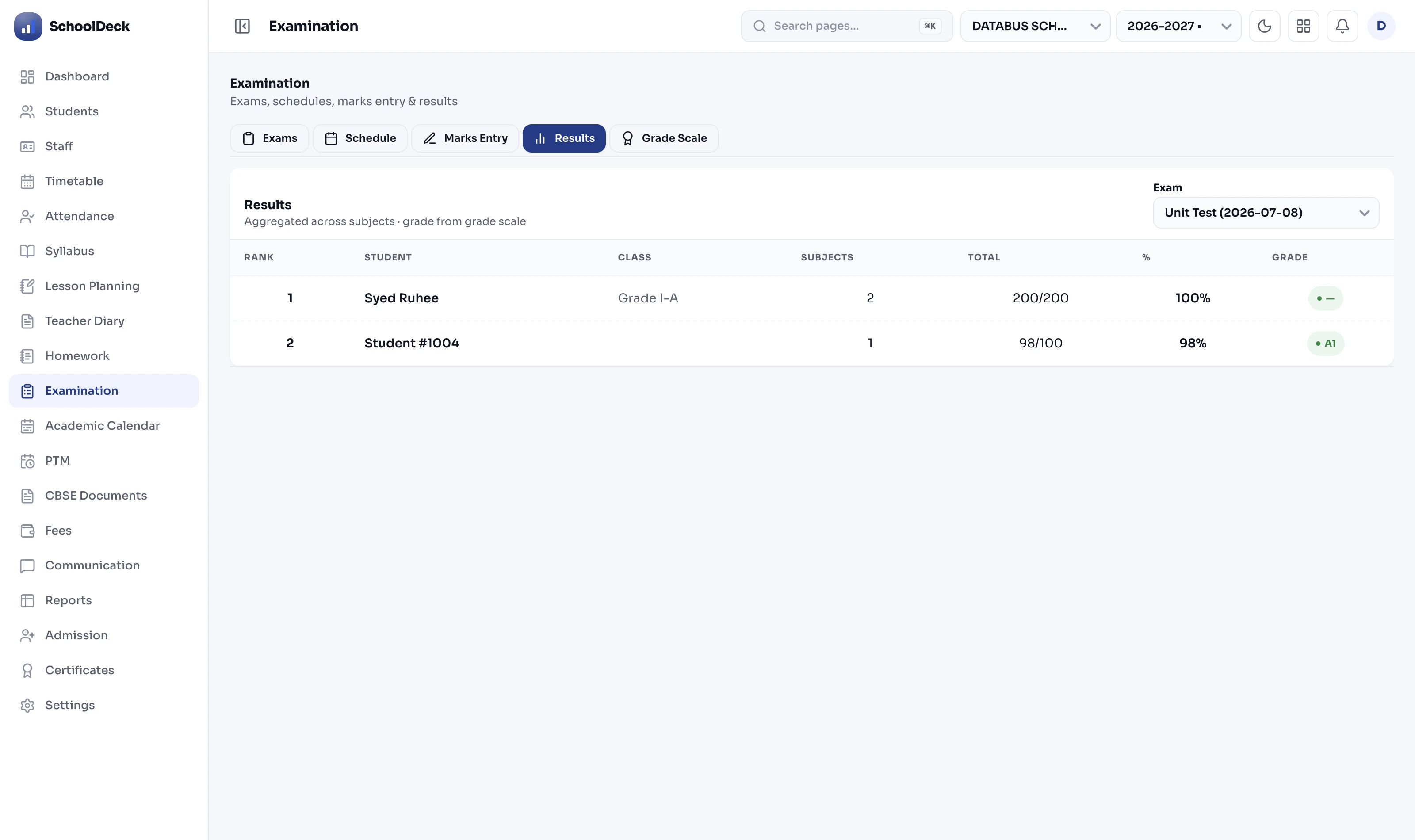
SchoolDeck marks entry workflow with maker-checker authorization
"I have been an exam cell coordinator for fourteen years. Until 2023 our process was: 32 teachers email Excel sheets to my office account, my assistant and I consolidate them across 12 subjects and 1,650 students, and we rebuild the master sheet at least three times because somebody sends a corrected version after we have already calculated grades. Then printing started — 1,650 unique PDFs, sorted into 32 stacks, taking two more days. December and March were two-week marathons. I had no life. Once we switched to SchoolDeck the workflow inverted. Teachers enter marks directly into their assigned sections — there is no Excel coming to my account at all. The class teacher verifies, the marks lock, the grading is calculated automatically using the right CBSE scheme per class (80+20 for Class 10, 70+30 for Class 12 Science, 50+50 for AI/IT). When CBSE announced the Class 10 Two Board Exams change for 2026, SchoolDeck had it configured before we even thought to ask. Report card generation for 1,650 students now takes about seven minutes. Last December I finished the entire term-end exam cycle in two working days. My family forgot what I look like during the exam season — they had to relearn."
P
Mrs. Padmavati Sundaram
Exam Cell Coordinator — CBSE Sr Sec School, Coimbatore · 1,650 students · 32 sections · 14 years as coordinator · Migrated September 2023

Why manual marks aggregation breaks at 800+ students

For a small school with 200 students and 8 teachers, Excel-based marks aggregation actually works reasonably well. The exam coordinator collects 8 spreadsheets, consolidates manually, and runs a calculator for the grades. End-to-end maybe a week.

Past 800 students the structural failure starts. A 1,650-student CBSE school typically has 32 teachers entering marks across 12 subjects, multiplied by 32 sections — that's nearly 12,000 individual mark entries per term. Manual aggregation fails for compounding reasons:

  • Column-layout drift: Different teachers use slightly different column headers, decimal formats, or subject codes. The coordinator manually realigns 28 incompatible spreadsheets every term.
  • Version control via filenames: "Class10_Marks_FINAL_v3_updated_REAL.xlsx" lands on Wednesday. A v4 lands Thursday. The coordinator chooses wrong and rebuilds.
  • Calculation errors compound: Manual VLOOKUPs, manual grade boundary lookups, manual aggregate computation. Each step introduces 1-3% error rate. Across 1,650 students, that's 16-50 wrong grades per term.
  • Board scheme drift: CBSE updates assessment schemes regularly. Class 10 Science just got a new 3-section structure. Class 10 has Two Board Exams from 2026. Old Excel templates fail board inspections.
  • No audit trail: When a parent disputes "my child got 78, not 76", the school has no way to prove the original mark. Files can be edited silently.

CBSE 2025-26 assessment scheme — verified specifics

The CBSE assessment scheme is more granular than most school software pages reflect. Verified specifications for the 2025-26 academic year:

  • Class 10 most subjects: 80 marks theory + 20 marks internal assessment = 100 total per subject. The 20 internal marks break down into Periodic Tests 10 (best of 3 tests), Notebook Submission 5, and Subject Enrichment Activity 5.
  • Class 10 skill subjects: Artificial Intelligence, Information Technology, Cybersecurity, Financial Literacy, Multi Skill Foundation — 50 theory + 50 practical = 100 total. Equal weight on practical demonstration.
  • Class 10 Science new structure (2025-26): The Science paper is now restructured into three distinct subject-specific sections — Section A (Biology), Section B (Chemistry), Section C (Physics). Students attempt each section systematically.
  • Class 12 non-science subjects: 80 theory + 20 internal assessment = 100 total.
  • Class 12 science subjects (Physics, Chemistry, Biology): 70 theory + 30 practical = 100 total. The 30 practical marks include hands-on practical examination, project work, and viva voce.
  • 9-point grading scale: A1, A2, B1, B2, C1, C2, D, E1, E2 — auto-calculated from absolute marks based on CBSE grade boundaries (which themselves are set per subject after exam analysis).
  • Passing criteria: Minimum 33% per subject AND 33% overall aggregate. A student who scores 80% overall but 31% in one subject must clear that subject in compartmental exam.

Class 10 Two Board Exams from 2026 — major NEP-aligned change

CBSE confirmed that from the 2026 academic year, Class 10 will conduct two board examinations per year — Main exam in February-March + Improvement exam in May-June. Both attempts are logged, and the best of the two scores is counted for the final result and promotion eligibility.

This is a NEP 2020-aligned change designed to reduce single-exam pressure on Class 10 students and provide an opportunity to improve scores without losing an academic year. Operationally for schools, this means:

  • Dual exam scheduling: Schools need to plan both the Main exam window (typically late Feb to mid-March) AND the Improvement exam window (typically May-June, often overlapping with summer vacation).
  • Two sets of marks: The platform stores Main and Improvement attempts separately per student per subject, then auto-computes the best-of-2 result for the final report card.
  • Revised report card workflow: Students taking the Improvement exam receive a Revised report card after their second attempt, with the higher value used. The original Main result remains in the audit trail.
  • Compartmental still applies: Students who fail individual subjects in BOTH Main and Improvement exams still go through the compartmental exam pathway.

Most legacy school exam software hasn't been updated for this 2026 change. The platform handles it natively from the day the CBSE circular was published.

NEP 2020 Holistic Progress Cards (HPC)

The National Education Policy 2020 (released July 29, 2020) mandates a multidimensional Holistic Progress Card replacing the traditional scholastic-only report card. CBSE released HPC formats for the Foundational stage in 2023 and for the Preparatory stage in 2024 — both natively supported by the platform.

The HPC tracks four domains throughout the academic year:

  • Scholastic domain: Traditional subject performance (where the CBSE 80+20 assessment scheme applies).
  • Co-scholastic domain: Work Education, Visual Arts, Performing Arts, Physical Education, Health & Wellness, Discipline.
  • Affective domain: Emotional intelligence, empathy, social-emotional development.
  • Psychomotor domain: Physical coordination, motor skills, fine motor and gross motor development.

The HPC also includes structured self-assessment (student rates own learning across domains), peer-assessment (classmates provide structured feedback per defined rubric), and teacher remarks (qualitative observations across all four domains). The platform tracks each domain at multiple checkpoints throughout the year, then auto-generates the HPC at term-end.

ICSE and ISC support

The Council for the Indian School Certificate Examinations (CISCE) uses a distinctly different assessment methodology from CBSE. Generic exam software often fails to handle ICSE specifics. The platform's flexible architecture configures correctly for ICSE / ISC schools:

  • Group I, II, III subject division: ICSE divides subjects into compulsory Group I (English, Second Language, History/Civics/Geography), elective Group II (Mathematics, Physics, Chemistry, Biology, Commercial Applications, Economic Applications, etc.), and elective Group III (Computer Applications, Economic Applications, Art, Performing Arts, etc.).
  • Best-of-4 aggregate calculation: The ICSE percentage is calculated using English (compulsory) + the best four performance subjects from the remaining subjects. The platform dynamically identifies the best four per student rather than using a fixed list.
  • Internal assessment per subject: ICSE internal assessment structure varies by subject — configurable per school.
  • SUPW grade entry: Socially Useful Productive Work as a mandatory non-elective grade.
  • ISC stream specifics: Science, Commerce, Humanities — each with stream-specific aggregate calculation.
  • Raw mark percentage (not absolute grading): ICSE uses raw mark percentages rather than CBSE's 9-point absolute grading — handled correctly in report card generation.

Maker-checker marks workflow with audit trail

The single most underrated benefit of exam management software is what it prevents — grade tampering and version chaos. The platform implements a strict 3-stage workflow:

Stage 1 — Subject teacher entry (Role-Based Access Control): A teacher can only see and enter marks for the specific subjects and sections they teach. A Class 9B Mathematics teacher cannot see or alter Class 10A Physics marks. RBAC eliminates the "I accidentally entered into the wrong section" problem and prevents lateral access to other teachers' subjects.

Stage 2 — Class teacher verification (Maker-Checker): Once the subject teacher submits marks, the class teacher reviews and approves. Until verified, marks are flagged as 'pending'. After verification, the subject teacher cannot alter without explicit Principal override. This prevents post-submission tampering by the teacher who entered the marks originally.

Stage 3 — Principal lock + immutable audit: Once the Principal locks the marks entry module after the configured deadline, no further alteration is possible without OTP-based override. Every mark change throughout the cycle is logged into the immutable audit trail with user identity + timestamp + IP address + before/after numerical values — providing forensic backup during board inspections, parent disputes, and DPDP Act 2023 Data Principal access requests.

Fee Defaulter Result Lock — exam-specific recovery mechanism

One of the most persistent operational challenges is collecting outstanding fee dues that have aged past the standard reminder cycle. The platform bridges the gap between the Accounts Department and the Exam Cell through the Fee Defaulter Result Lock — a mechanism activated only at result publication time.

Configurable rules: "Withhold report card visibility on the parent app if outstanding dues exceed ₹2,000". When a parent logs into the parent app to view the report card on publication day, the system checks the live financial ledger from the Fee Management module. If dues exist above the threshold, the report card is replaced by a Pay Now overlay that drops the parent into the fee payment flow.

Schools that implement Fee Lock typically see meaningfully accelerated fee recovery around result declaration — the exact uplift varies by parent payment behaviour, but the mechanism consistently surfaces aged dues that would otherwise stay uncollected for another quarter. Note: this is distinct from the broader Auto Fee Reminders dunning cycle which runs throughout the term — Fee Lock is exam-specific and activates only at result publication.

How this connects to other SchoolDeck modules

The Exam Management module integrates with five specialist modules — each owning a distinct function rather than being duplicated here:

  • AI Question Paper Generator: Generates exam papers with question types, blueprints, and Bloom's taxonomy distribution. The Exam module calls this specialist when papers need to be created — no duplication of AI paper logic here.
  • AI Report Card Narration: Generates personalized teacher remarks for each student's report card. Eliminates feedback fatigue. The Exam module integrates the AI specialist for the qualitative remark section.
  • Audit Logs: Stores every marks change with user + timestamp + IP + before/after values. The Exam module writes into this immutable trail; the Audit Logs module owns the DPDP forensic compliance specialty.
  • Auto Timetable: The exam-week timetable is a special version that overrides the regular master timetable. Hall ticket generation reads from the Exam module; exam hall scheduling reads from the Timetable module.
  • Multi-Branch: For school chains, the Super Admin Dashboard standardises assessment schemes, grade boundaries, and exam calendars across campuses. Academic Directors push uniform configurations from headquarters.

Migrating from legacy spreadsheets — zero data loss

The primary hesitation school leaders have when upgrading is the fear of losing historical student records. The platform's Bulk CSV / Excel Import Utility ingests years of legacy data:

  • Student master data: from your existing Student Information System or admission records.
  • Previous term marks: historical marks from past years preserved as read-only records — useful for multi-year transcript generation (Class 9-12 consolidated PDF for graduating students).
  • Historical grading structures: if your school changed grading schemes over time, old structures are preserved for historical accuracy in transcripts.
  • Old report card archives: imported as PDFs and tagged to student profiles for permanent digital record.

Migration typically takes 3-4 working days for a 1,500-student school depending on data quality of legacy spreadsheets. The onboarding team handles column-mapping discrepancies, missing data flags, and grade-scheme reconciliation — schools don't write SQL or manipulate CSVs themselves.

Manual Excel vs SchoolDeck Exam Management

Capability Manual Excel SchoolDeck Exam Mgmt
Term-end cycle time 2-3 weeks of late nights 2-3 working days end-to-end
CBSE 80+20 / 70+30 / 50+50 Manual formula per subject Natively configured per board
Class 10 Two Board Exams 2026 Manual best-of-2 calculation Auto best-of-2 from both attempts
9-point grading (A1-E2) Manual VLOOKUP per student Auto-calc with grade boundaries
NEP 2020 HPC generation Not possible in Excel Foundational + Preparatory ready
Grade tampering prevention Files silently editable Maker-checker + immutable trail
Report card generation (1,650 students) 2-3 days of manual printing ~7-10 minutes for bulk PDFs
Fee defaulter recovery on result day No mechanism Result Lock + Pay Now overlay

Frequently asked questions

What exam cell coordinators ask before switching.

Does it support the CBSE 2025-26 scheme and the new Class 10 Two Board Exams 2026?

+

Yes. CBSE 2025-26 scheme natively configured: Class 10 most subjects 80 theory + 20 internal (with 20-mark breakdown: Periodic Tests 10 best-of-3 + Notebook 5 + Subject Enrichment 5), Class 10 skill subjects (AI/IT/Cybersecurity) 50 + 50, Class 12 non-science 80 + 20, Class 12 science with practicals 70 + 30. 9-point grading (A1-E2) auto-calculated. 33% passing enforced per subject + aggregate. From 2026, Class 10 Two Board Exams — Main (Feb-Mar) + Improvement (May-Jun), best of 2 counted automatically. The platform supports this new structure natively; most legacy software hasn't been updated yet.

How does this differ from Auto Timetable and AI Question Paper modules?

+

Five Academic Suite modules orchestrated by the Academic Management hub. (1) Exam Management (this page) owns scheduling + hall ticket + marks + grading + report cards + result publication. (2) Auto Timetable owns master schedule + substitutions — during exam weeks it activates a special exam-week timetable. (3) AI Question Paper owns paper creation specialty. (4) Report Card Narration owns the AI remarks generation specialty. (5) Audit Logs owns the immutable forensic trail — this page writes every mark change into that trail. No duplication.

Does it support the NEP 2020 Holistic Progress Card (HPC) format?

+

Yes. CBSE released HPC for Foundational stage in 2023 and Preparatory stage in 2024 — both natively supported. HPC replaces traditional report cards with multidimensional tracking: scholastic (subject performance), co-scholastic (Work Education, Visual Arts, Performing Arts, Physical Education, Health & Wellness, Discipline), affective (emotional intelligence, empathy, social-emotional development), and psychomotor (physical coordination, motor skills). Plus structured self-assessment, peer-assessment, and teacher remarks. The platform tracks all four domains at multiple checkpoints throughout the year, then auto-generates the HPC at term-end.

How does the software handle ICSE / ISC schools?

+

ICSE / ISC use distinctly different methodology from CBSE. Platform handles: (1) Group I, II, III subject division. (2) Dynamic best-of-4 aggregate — English compulsory + best 4 performance subjects from remaining. (3) Internal assessment per subject per ICSE specifications. (4) SUPW (Socially Useful Productive Work) grade entry as mandatory non-elective. (5) ICSE raw mark percentage (not CBSE absolute grading). (6) ISC stream-specific aggregate (Science/Commerce/Humanities). System identifies board at setup and applies correct logic automatically.

Can we define different passing criteria and grading for different classes?

+

Yes. Independent assessment groups per class section: Primary (Nursery-Class 5) — no-fail policy with descriptive grading; Middle (Classes 6-8) — 30% passing with letter grades; Senior Secondary (Classes 9-12) — 33% per subject + 33% aggregate (CBSE norm) with 9-point scale. Grace marks configurable per class. Subject-specific minimums configurable (e.g., minimum 40% in Hindi language). Grade boundary tables editable per class and board. Platform enforces rules consistently — no manual decisions per student.

Is the student examination data secure?

+

Multiple protection layers. (1) Encryption at rest and in transit. (2) RBAC — Mathematics teacher sees only assigned Math sections. (3) Maker-checker — subject teacher enters → class teacher verifies → no third party alters once verified. (4) Principal lock — once Principal locks the module, OTP-based override required for any change. (5) Immutable audit trail integrated with Audit Logs module — every mark change logged with user + timestamp + IP + before/after values. Provides forensic backup during board inspections, parent disputes ('my child got 78 not 76'), and DPDP Act 2023 Data Principal access requests.

How does Fee Defaulter Result Lock differ from Auto Fee Reminders?

+

Two different mechanisms targeting fee collection at different points. Auto Fee Reminders runs throughout the term — WhatsApp + SMS + app push reminders 5 days before due, on due date, 7 days after with late fines. Fee Defaulter Result Lock runs only at result publication — when parent opens app to view report card, system checks live fee ledger. If dues exceed threshold (e.g., > ₹2,000), report card replaced by Pay Now overlay. Leverages moment of maximum parent attention (result anxiety) to surface aged dues. Schools typically combine both — Auto Reminders for proactive collection during term, Fee Lock as safety net at result publication.

Can parents see results immediately when teachers enter marks?

+

No — by design. Marks remain hidden from parents throughout teacher entry + class teacher verification + Principal review. Only when Principal explicitly Publishes the result module does parent app + email + WhatsApp notification go live simultaneously. Protects schools from premature escalations ('my child only got 72 — when can I dispute?') during verification phase. Phased publication supported: Class 12 first (board-pressure students), then Class 11, then down to Primary across 2-3 days. One click per class group.

Does the software handle compartmental exams and Revised report cards?

+

Yes. After main exam result published, system auto-identifies students who failed individual subjects (below 33% per CBSE). Exam Cell Coordinator schedules specialized compartmental re-tests per subject. Re-test marks follow same RBAC + maker-checker workflow. Platform generates Revised report card showing original main exam AND post-re-test results with higher value used for promotion. Original remains in audit trail. For Class 10 from 2026 Two Board Exams, same handling — both Main and Improvement attempts logged, best of 2 used for final result.

What does deployment look like and what's the pricing?

+

Deployment: 7-10 working days including legacy data import (years of student records + previous term marks), assessment scheme configuration per board/class, custom report card template setup with school branding + watermark + digital signature + QR code for verification, RBAC role configuration (teacher/class teacher/exam coordinator/Principal), end-to-end pilot with one section before whole-school rollout. Pricing: Exam Management module bundled within standard SchoolDeck plan starting at ₹30 per student per month — no separate per-module charge, no per-exam-cycle charge, no per-report-card charge. Bulk CSV/Excel import included. Multi-year transcript generation (Class 9-12 single PDF) included. No annual re-licensing for board scheme updates.

Connected modules

Exam Management connects to the rest of the suite.

For exam cell coordinators who lose every March and December

Compress 3 weeks of exam-cell work into 2 days.

CBSE 2025-26 scheme. NEP HPC. 9-point grading auto-calc. Class 10 Two Board Exams 2026 ready. Maker-checker workflow. Immutable audit trail. Fee Defaulter Result Lock.

From ₹30/student/month · 500+ Indian schools · Live in 7-10 days