


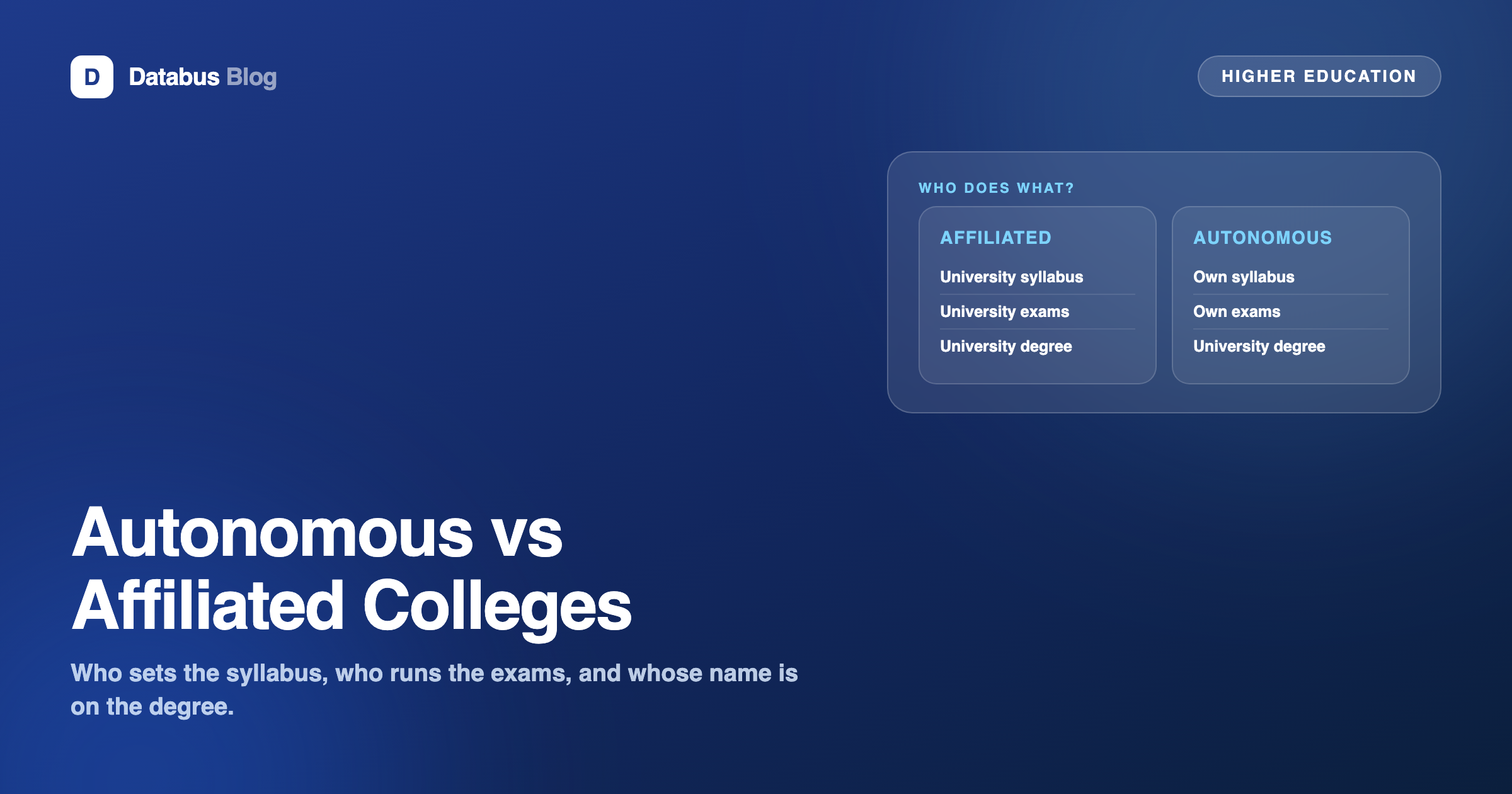
Every college brochure that says "autonomous" is making a specific legal claim, and most explanations of it are vaguer than they need to be. The difference comes down to three questions: who sets the syllabus, who conducts the exams, and whose name is on the degree.
Affiliated colleges: the default model
Most Indian colleges are affiliated to a parent university. The university prescribes the syllabus, sets and evaluates the examinations, declares results on its calendar, and awards the degree. The college's job is teaching and local administration. The practical consequences students feel: a syllabus that updates at the university's pace, exam schedules synchronised across dozens or hundreds of colleges, and results that arrive when the university's central evaluation finishes.
Autonomous colleges: academic freedom, borrowed degree
An autonomous college — a status conferred under the UGC's autonomy framework, with the parent university's concurrence — gains the right to design its own curriculum, set and conduct its own examinations, and declare its own results. What it does not gain is degree-awarding power: the degree still comes from the parent university, with the college's name typically mentioned on it. Autonomy is academic and operational, not the power to print degrees — that requires becoming a university (or deemed university) in its own right.
What it means in practice
- Curriculum speed: autonomous colleges can revise syllabi, add electives and adopt industry-aligned courses without waiting for a university-wide revision cycle.
- Exams and results: conducted in-house, so schedules are tighter and results usually faster — but the college now owns the entire examination machinery it once outsourced to the university.
- Continuous assessment: autonomy typically comes with internal-assessment weightage the college designs itself.
- Accountability: autonomy is granted based on the institution's track record — accreditation performance, governance and academic standards — and is periodically reviewed. It can be extended, and it is expected to be earned continuously. NEP 2020's direction of travel is more graded autonomy for more institutions, so this model is expanding, not shrinking.
How to check a college's actual status
- The UGC's list of autonomous colleges — the authoritative register, published on ugc.gov.in.
- The college's own disclosures — the autonomy order and its validity period are usually on the website's mandatory-disclosure or IQAC pages.
- The parent university's affiliation list — confirms the relationship the degree will rest on.
Related context: a college's NAAC accreditation record is a core input to autonomy decisions, and its AISHE code is how it appears in every national database that tracks any of this.
The operational bill of autonomy
The under-discussed part: the day an affiliation-era college becomes autonomous, it inherits the university's examination department — question paper workflows, evaluation, moderation, grading rules, result processing, transcripts, revaluation — at institutional scale, usually with the same staff it had before. That is an operations problem as much as an academic one, and it is exactly the layer CampusAlly runs for colleges: examination management and academic administration on one system, so autonomy's freedoms don't arrive bundled with spreadsheet chaos.
A note on accuracy: autonomy criteria, processes and lists are governed by UGC regulations and evolve under NEP implementation. Verify current status and rules on ugc.gov.in and the institutions' official disclosures. Databus is not affiliated with the UGC.
Frequently Asked Questions
Does an autonomous college award its own degree?
No. An autonomous college designs its own syllabus and conducts its own exams, but the degree is still awarded by the parent university, usually with the college's name mentioned on it. Degree-awarding power requires university or deemed-university status.
Is an autonomous college better than an affiliated one?
Neither is automatically better. Autonomy usually means faster syllabus updates and quicker results; affiliation means university-standardised curriculum and evaluation. The individual institution's quality matters more than the label.
How is autonomy granted to a college?
Under the UGC's autonomy framework, based on the institution's track record — accreditation performance, governance and academic standards — with the parent university's concurrence. The status is periodically reviewed and extended.
How can I verify a college is really autonomous?
Check the UGC's published list of autonomous colleges on ugc.gov.in, and the autonomy order on the college's own mandatory-disclosure pages.
Do marks and grading differ in autonomous colleges?
Often, yes — autonomous colleges design their own assessment schemes, typically with continuous internal assessment alongside end-semester exams, within UGC norms. The scheme is published by the college itself rather than the university.