Databus Logo
Blog Login →
The Academic Compute Core — CO-PO, NEP-ABC, CBCS

"We attained the outcomes." The assessor asks: show me the number. Academics computes it — accreditation reports it.

This is the academic compute core — the CBCS/OBE CO-PO attainment calculation, the NEP Academic Bank of Credits, course registration, and syllabus completion. It computes the figures the rest of the campus reads — and feeds them to accreditation.

For Deans of Academics, IQAC & HODs · CO-PO attainment · NEP-ABC · CBCS course registration · syllabus completion · feeds accreditation, doesn't report.
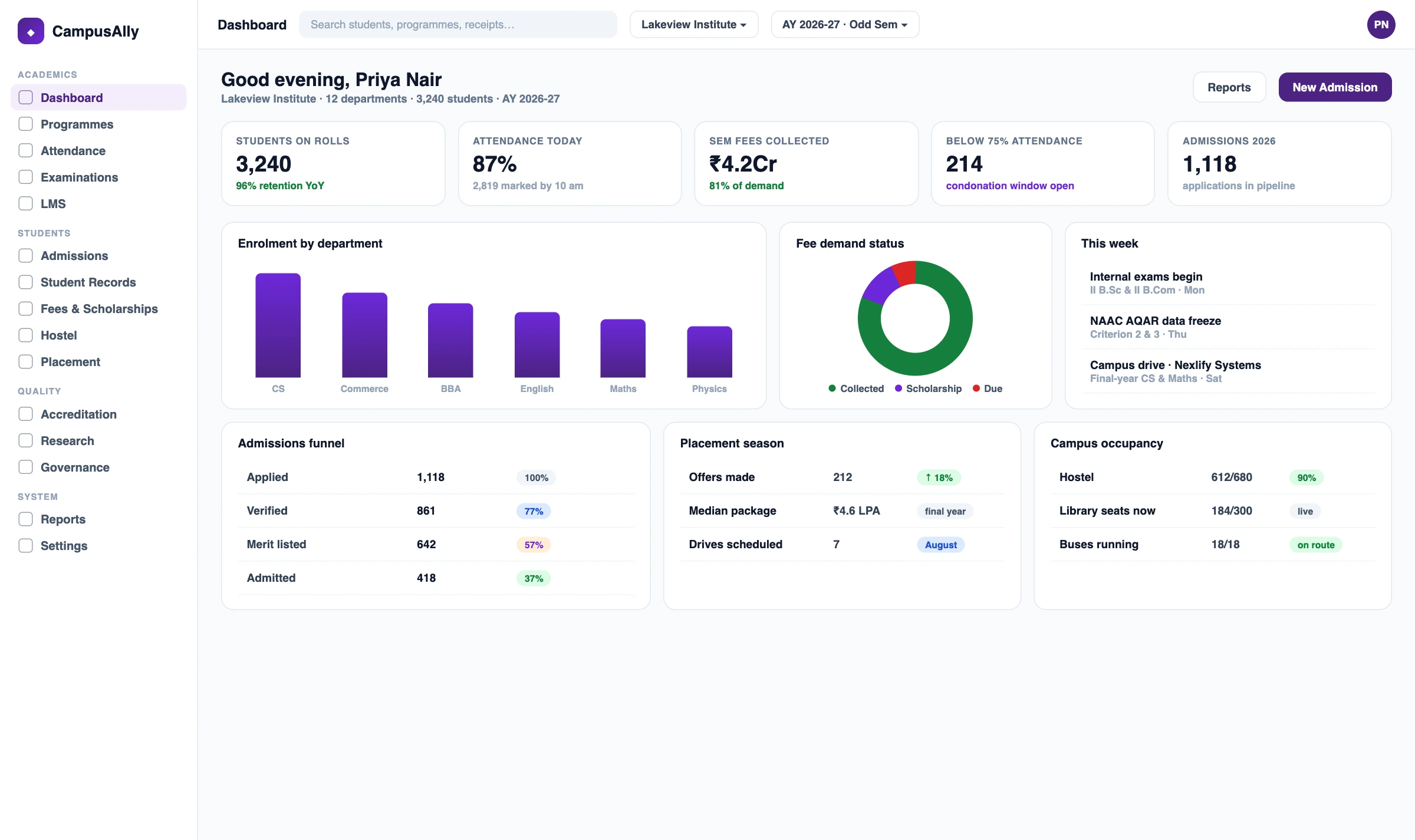
See the CO-PO calculation →
In plain English

Academics is the academic compute core — it owns the CBCS/OBE CO-PO attainment calculation (computing how far course outcomes mapped to programme outcomes were actually achieved, from assessment data), course registration under the choice-based credit system, the NEP Academic Bank of Credits (ABC), and department-wise syllabus completion. It's the head academic module the campus reads from. It does not generate the NAAC/NBA reports — the accreditation feature owns AQAR/SSR generation and the NIRF/NBA parameters; this computes the CO-PO figures and feeds them there. And it doesn't own exam results — the examination feature runs the marks and feeds back CO-tagged data for the calculation. Academics computes the outcomes; accreditation reports them; examination produces the marks.

CO-PO attainment
computed from data,
not asserted
NEP-ABC
Academic Bank of Credits
accumulation + transfer
CBCS registration
choice-based
credit system
Computes, not reports
NAAC/NBA reports
are accreditation
A real OBE department · the CO-PO calculation

From mapped outcomes to a defensible figure — and the column that shows where it goes.

Dr. Bhatt's office doesn't want to claim the outcomes were met — it wants the computed number an assessor can trace. Here's what academics calculates per course — and the last column shows the one thing it does not do: turn these into the NAAC report. That's accreditation's job.

CO-PO attainment · computed from CO-tagged marks Academics computes
CourseCO → PO mapComputed fromAttainment → goes to
CS — DSACO1–5 → PO1,2,3CO-tagged marksaccreditation
CS — DBMSCO1–4 → PO2,5internal + end-sem→ accreditation
Mech — ThermoCO1–6 → PO1,4CO-tagged marks→ accreditation
Commerce — AccCO1–3 → PO3,6internal + end-sem→ accreditation
DepartmentCO-PO matrixattainment computed herereports → accreditation
The boundary is the last column: academics computes the attainment from the examination feature's CO-tagged marks, and then feeds the figures to accreditation, which assembles the NAAC AQAR / SSR / NBA documentation. This page is the calculation engine; the report engine is accreditation. The attainment is arithmetic from real marks — not an AI prediction. (Course mappings shown are illustrative; the live engine follows the institution's CO-PO rules.)
Where outcome-based academics breaks down

Four ways CO-PO attainment becomes a spreadsheet nightmare.

Attainment claimed, not computed

A department asserts its outcomes were met, but when an assessor asks for the actual attainment figure traced to marks, it has to be reconstructed by hand at the last minute — if it can be at all.

The CO-PO spreadsheet maze

Each HOD keeps their own outcome-mapping spreadsheet with their own formulas, so attainment is computed inconsistently across departments and nobody can reconcile them institution-wide.

Marks re-typed for attainment

Exam marks live in one place and the CO-PO calculation in another, so marks are re-keyed to compute attainment — introducing exactly the errors an outcome figure can't afford.

Credits not banked to NEP-ABC

Credits earned aren't recorded against the Academic Bank of Credits, so when a student transfers or the institution reports under NEP, the credit ledger doesn't line up.

How CO-PO attainment is computed

Map, register, read marks, compute, feed onward.

1

Map course outcomes to programme outcomes

Each course's outcomes (COs) are mapped to the programme outcomes (POs), establishing the matrix on which attainment will be computed — the structural basis of outcome-based education.

2

Register students under CBCS

Students register for courses under the choice-based credit system, with credits recorded so the academic record reflects the actual courses and credits each student is taking each semester.

3

Read CO-tagged marks from examination

The examination feature runs the assessments and feeds back the CO-tagged marks — which component maps to which course outcome — so attainment is computed from real assessment data. Examination owns the marks; academics owns what they mean for outcomes.

4

Compute CO-PO attainment

Attainment is computed from the CO-tagged assessment data against the CO-PO matrix, producing the attainment levels per outcome — the actual figures a department can stand behind, rather than a claim that outcomes were achieved.

5

Feed the figures to accreditation

The computed attainment, with syllabus completion and the credit/ABC records, is fed to the accreditation feature, which assembles the NAAC AQAR, SSR and NBA documentation. Academics computes the figures; accreditation turns them into reports.

The frameworks this is built on

CBCS, OBE and NEP — the academic structure, computed correctly.

OBE / CO-PO attainment

Outcome-based education with course-outcome to programme-outcome mapping and attainment computed from assessment data — traceable, explainable arithmetic, not an opaque prediction, so the figures hold up to an assessor.

NEP 2020 + Academic Bank of Credits

Course registration under the choice-based credit system, with credits accumulated and transferable through the NEP Academic Bank of Credits — the credit ledger aligned to the way NEP structures higher education.

Feeds, doesn't report

The computed attainment, syllabus completion and credit records are fed to the accreditation feature for NAAC/NBA/NIRF documentation. Academics owns the calculation; accreditation owns the report — two engines, two pages.

Framework references: CBCS (choice-based credit system); OBE CO-PO attainment (computed from assessment data, traceable and explainable, not predicted); NEP 2020 Academic Bank of Credits (ABC); UGC academic norms. The CO-tagged marks are produced by the examination feature; the NAAC AQAR/SSR and NBA/NIRF reports are generated by the accreditation feature, which reads these computed figures. This page owns the academic calculation core, not the reporting or the marks.

Academics compute core vs accreditation reporting vs examination results vs connected modules · what this page owns

The academic calculation ≠ the NAAC/NBA reporting ≠ the exam results ≠ the timetable.
This page computes the outcomes and credits; the report, the marks and the schedule are their own pages.

CampusAlly keeps the academic calculation engine distinct from the accreditation reporting engine on purpose — one computes CO-PO attainment, the other turns it into the NAAC submission. Keeping them apart means this page ranks for the academic calculation and never competes with accreditation over "NAAC reports."

This page owns

  • The CBCS/OBE CO-PO attainment calculation from assessment data.
  • CO → PO mapping — the outcome matrix.
  • The NEP Academic Bank of Credits (ABC) credit ledger.
  • CBCS course registration — choice-based credits.
  • Department-wise syllabus completion tracking.

This page defers to

  • The NAAC AQAR/SSR & NBA/NIRF reporting lives in the Accreditation feature. It generates the reports; this page computes and feeds the CO-PO figures.
  • Exam results & marks — hall tickets, marks entry, results — live in the Examination feature. It produces the CO-tagged marks; this page computes attainment from them.
  • The 75% eligibility engine lives in the Attendance feature — a connected module, not the academic record.
  • The semester timetable lives in the Scheduling feature; the student's self-service view is the student portal. Each is its own connected module.
Three academic-core realities

The same compute core, three offices.

The calculation is the same; what each office needs from it differs.

Dean of Academics

Attainment across departments

A Dean needs CO-PO attainment computed the same way across every department, so the institution-wide outcome picture is consistent and reconcilable — not a patchwork of HOD spreadsheets.

IQAC

Figures ready for accreditation

The IQAC needs the attainment and syllabus-completion figures computed and ready to feed the accreditation feature — so the AQAR/SSR is assembled from real academic data, not assembled by hand.

HOD

One CO-PO matrix, no re-keying

An HOD wants the CO-PO matrix mapped once and attainment computed straight from the examination marks — no re-typing, no parallel spreadsheet, just the figure traced to the data.

From the field

Mysuru, Karnataka · NEP-adopting autonomous college · Dean of Academics.

"Outcome-based education lives or dies on one question: when the assessor asks for your CO-PO attainment, can you show a number traced to actual marks, or are you waving a claim? For years ours lived in a maze of departmental spreadsheets, each HOD computing attainment slightly differently, and every accreditation cycle we rebuilt it under pressure. What I value about this is that it is the calculation core and it knows it is only that — it computes attainment from the CO-tagged marks the examination module sends over, it maintains our NEP Academic Bank of Credits, and then it feeds those figures to the accreditation module, which is what actually produces the NAAC documents. It doesn't pretend to be the reporting tool, and it doesn't try to own the marks. That clean separation is exactly right: my attainment figures are computed once, consistently, and they're arithmetic from real assessment data, not some black-box prediction I'd have to defend."
Dr. Mohan Bhatt Dean of Academics · NEP-adopting autonomous college · Mysuru-570005, Karnataka
CBCS/OBE CO-PO attainment calculation · CO → PO mapping · NEP Academic Bank of Credits · CBCS course registration · syllabus completion · feeds figures to accreditation, reads marks from examination
Quick answers

University academics, asked and answered.

What every Dean of Academics, IQAC coordinator and HOD asks before they move CO-PO attainment off spreadsheets.

What does the academics feature do?
It is the academic compute core — it owns the CBCS/OBE CO-PO attainment calculation, course registration under the choice-based credit system, the NEP Academic Bank of Credits (ABC), and department-wise syllabus completion tracking. It is the head academic module the rest of the campus reads from. It does not generate the NAAC or NBA reports (that is the accreditation feature, which reads these figures), and it does not own examination results (that is the examination feature, which feeds CO-tagged marks back here).
How is this different from the accreditation feature?
Academics computes; accreditation reports. This page owns the CO-PO attainment calculation, the ABC credit records and syllabus completion — the underlying academic figures. The accreditation feature owns the generation of the NAAC AQAR and SSR, and the NIRF and NBA parameters — the documentation an institution submits. Academics feeds its computed figures to accreditation, which assembles them into reports. They are deliberately separate: one is the calculation engine, the other is the reporting engine, so each ranks for its own job rather than competing over "NAAC academic reports".
What exactly is CO-PO attainment and does this calculate it?
Course outcomes (COs) are what a course intends students to achieve; programme outcomes (POs) are the broader programme-level competencies. CO-PO attainment is the measured degree to which those outcomes were actually achieved, computed from assessment data against the CO-PO mapping. Yes — this feature owns that calculation. It takes the CO-tagged marks and computes attainment levels, so a department has defensible attainment figures rather than an assertion. This is the calculation other modules, including accreditation, depend on.
Does it handle the NEP Academic Bank of Credits?
Yes. Under NEP 2020, the Academic Bank of Credits (ABC) allows credits to be accumulated and transferred across the student's academic journey. This feature owns the ABC records — the credits a student has earned and banked under CBCS — so the institution maintains an accurate credit ledger aligned to the NEP framework. The credit and ABC records sit here, in the academic core, alongside course registration and the CO-PO calculation.
Where do the marks come from for the attainment calculation?
From the examination feature. Examination runs the assessments — hall tickets, marks entry, results — and feeds back the CO-tagged marks, recording which assessment component maps to which course outcome. Academics then computes attainment from those tagged marks. So the division is clean: examination owns producing and publishing the marks, and academics owns what those marks mean for outcome attainment. This page reads the marks; it does not run the exams.
Does it track syllabus completion?
Yes — department-wise syllabus completion is part of the academic core. Faculty record progress against the planned syllabus, so a Dean or HOD has a live view of how far each department and course has covered the curriculum, rather than discovering gaps at the end of a semester. This completion data is also among the academic figures fed to the accreditation feature as part of the institution's quality documentation.
How does it connect to attendance, timetable and the student portal?
They are connected modules, each owning its own job. The attendance feature owns the 75% eligibility engine; the timetable and scheduling feature owns the semester schedule; the student portal owns the student's self-service view. Academics is the academic record and calculation they orbit — course registration and outcomes here, scheduling there, attendance there, the student's view there. Academics does not duplicate those; it is the curriculum, credit and outcome core they each read from or write to.
Is the CO-PO attainment an AI prediction?
No — it is a calculation from real assessment data, not a prediction. Attainment is computed from the CO-tagged marks against the CO-PO mapping using the institution's chosen attainment rules, so the figures are traceable to actual student performance and explainable to an assessor. There is no opaque model guessing outcomes; the attainment is derived arithmetically from the marks, which is exactly what makes it defensible in an accreditation context.
Is it built for NEP 2020 and CBCS specifically?
Yes — it is built for NEP-adopting colleges and universities running the choice-based credit system and outcome-based education. Course registration follows CBCS, credits are banked through the NEP Academic Bank of Credits, and the outcome calculation follows the CO-PO framework. The feature is designed around the way Indian higher education actually structures academics under NEP and UGC, rather than a generic curriculum tool adapted afterwards.

Stop rebuilding CO-PO attainment in a spreadsheet every accreditation cycle.
Compute it once, from the marks, and feed it onward.

We'll show you CO → PO mapping, CO-PO attainment computed from your examination feature's CO-tagged marks, NEP Academic Bank of Credits, CBCS registration and syllabus completion — feeding the figures to accreditation — on your institution's actual data.

See Academics →