


The National Institutional Ranking Framework (NIRF) is the Ministry of Education's official ranking of Indian higher-education institutions, published annually since 2016. It is the rank colleges print on hoardings — and, like every ranking, it is only as meaningful as an understanding of what it measures.
The five parameters
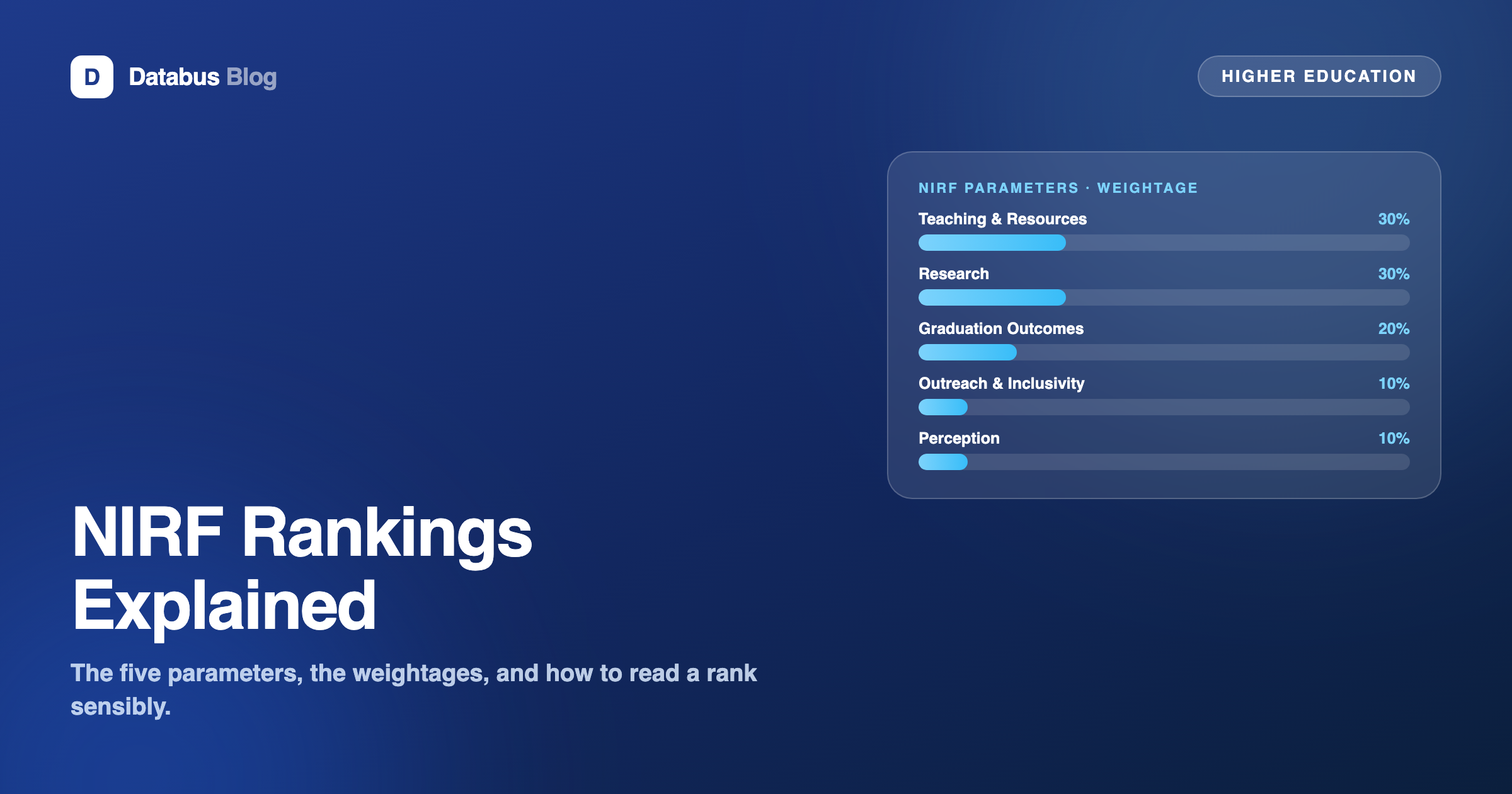
Every NIRF rank is built from five parameter groups:
- Teaching, Learning & Resources (TLR) — 30%. Faculty-student ratio, faculty qualifications and experience, financial resources per student.
- Research & Professional Practice (RP) — 30%. Publications, citations, patents, sponsored research — the parameter that separates research universities from teaching colleges.
- Graduation Outcomes (GO) — 20%. Pass rates, on-time graduation, placements and higher-studies progression, median salaries.
- Outreach & Inclusivity (OI) — 10%. Regional and gender diversity, students from disadvantaged backgrounds, facilities for differently-abled students.
- Perception (PR) — 10%. Reputation surveys of academics and employers.
Sub-weightages vary somewhat by category (Engineering, Management, Medical and so on each tune the mix), but the five-pillar structure holds across the framework, which now spans over a dozen categories — including a recent Sustainable Development Goals (SDG) category.
The integrity turn: rankings can now go down for bad research
A significant recent change: retracted papers and excessive self-citation now attract negative scoring under the research parameter. Volume-at-any-cost publication strategies, which once inflated RP scores, can now subtract from them. For institutions, the message is blunt — research integrity is a ranking variable.
How to read a NIRF rank sensibly
- Check the category. Rank 40 in the University category and rank 40 in Engineering are different populations; the Overall list mixes apples and oranges by design.
- Look at parameter scores, not just the rank. Two institutions with the same rank can be opposites — one strong in placements (GO), the other in research (RP). The score sheet says which one fits your purpose.
- Watch trajectories. A college climbing steadily says more than one holding a familiar rank on reputation.
- Cross-reference accreditation. NIRF is a ranking; NAAC accreditation is a quality certification, and autonomy status tells you who controls the academics. The three together give a fuller picture than any one.
The institution's side: NIRF is a data exercise
Participation means submitting verifiable data — enrolment, faculty, finances, placements, publications — every cycle, on the same records that feed AISHE and accreditation. Institutions that keep those records live in one system spend NIRF season exporting; the rest spend it reconstructing. That data backbone — students, faculty, outcomes, accreditation workflows — is what CampusAlly maintains for colleges year-round.
A note on accuracy: parameter definitions, category lists and methodology evolve between NIRF cycles — the framework's published methodology documents for the current year are the authority. Databus is not affiliated with NIRF or the Ministry of Education.
Frequently Asked Questions
What are the five NIRF parameters and their weightages?
Teaching, Learning & Resources (30%), Research & Professional Practice (30%), Graduation Outcomes (20%), Outreach & Inclusivity (10%) and Perception (10%). Sub-weightages vary by category, but the five-pillar structure is constant.
Is a NIRF rank the same as NAAC accreditation?
No. NIRF is an annual comparative ranking; NAAC is a quality accreditation of the institution. An institution can rank modestly in NIRF while holding strong accreditation, and vice versa — they measure different things.
Can bad research hurt a NIRF rank?
Yes. Retracted papers and excessive self-citations now carry negative scoring in the research parameter, so integrity problems can actively reduce an institution's score rather than merely not helping it.
Why does an institution appear in multiple NIRF lists?
NIRF publishes category-wise rankings (Overall, University, Engineering, Management, Pharmacy and more). An institution participates in every category it qualifies for, so it can hold different ranks in different lists.
How should students use NIRF rankings when choosing a college?
Open the parameter scores. If placements matter to you, weigh Graduation Outcomes; if research does, weigh RP. Then cross-check the college's NAAC grade and autonomy status — the rank alone compresses too much into one number.