Academic Management System for Indian Schools
Timetable in one spreadsheet. Lesson plans in physical diaries. Homework on a WhatsApp group. Library in a register book. Exam marks in Excel files emailed at term-end. When a parent asks "is my child on track?" — your office staff opens four tabs.
One platform. One database. One login. SchoolDeck unifies all five academic operations — AI timetables, digital lesson planning, mobile homework, library automation, and examinations — into a single connected system. NEP 2020 + NCF-SE 2023 ready. CBSE / ICSE / IB / Cambridge / State Board agnostic.
The 5 academic modules
Each module is a specialist tool — but they share one database, one student profile, and one login. Click any module to explore deeper specifications.
Module 1 · Scheduling
Generate conflict-free schedules in minutes. Hard constraints (teacher availability, lab capacity) + soft preferences (morning slots, back-to-back periods). Dynamic substitution suggestions when teachers are absent.
Module 2 · Curriculum
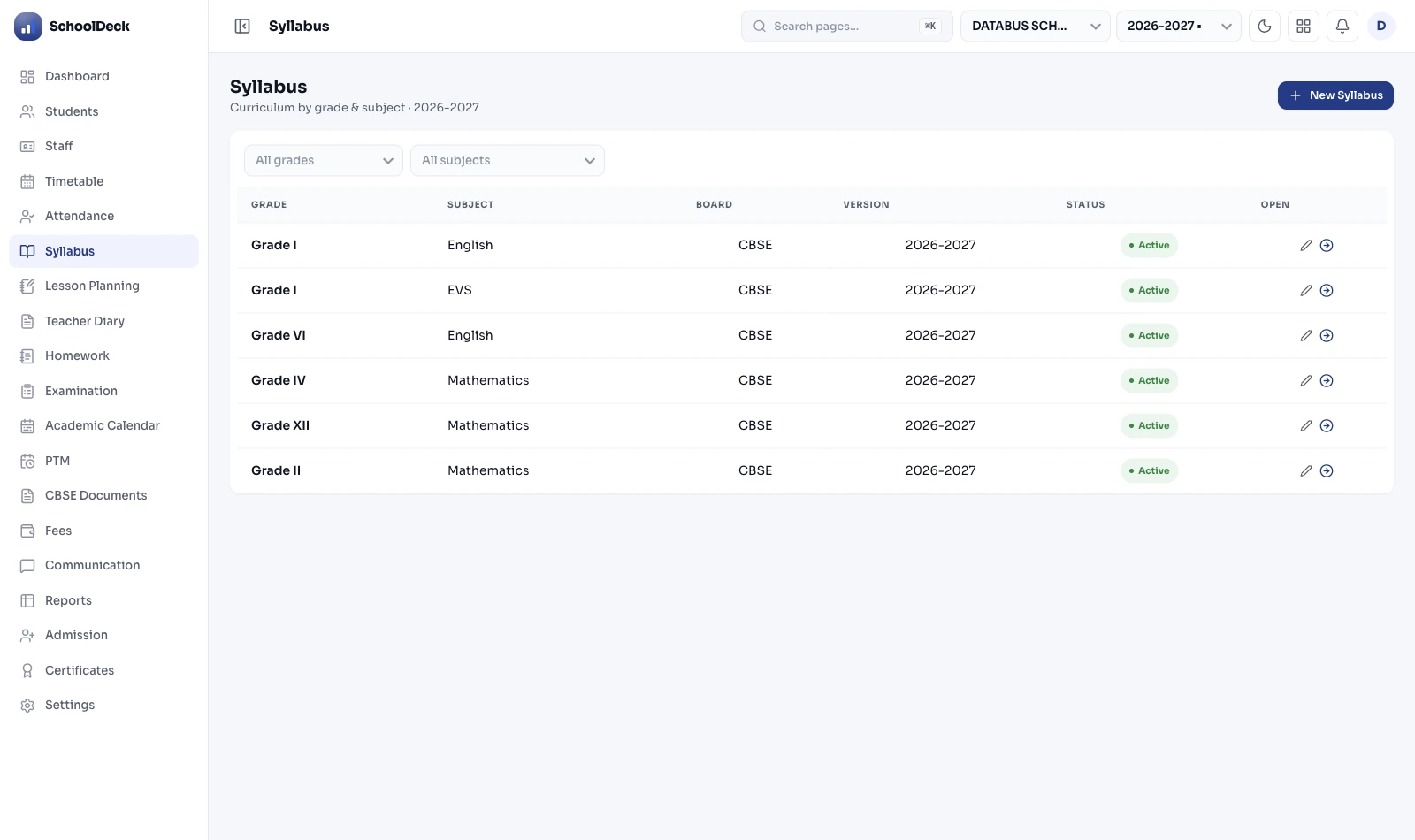
Replace physical teacher diaries. Pre-load year's syllabus by subject + chapter + topic. Teachers mark topics complete; principals get a live syllabus completion heatmap across all grades.
Module 3 · Assignments
Stop the WhatsApp homework groups. Dispatch via parent mobile app — text, image, document, voice note. Students submit digitally. Timestamped portfolio per child. Auto-tagged to specific timetable periods.
Module 4 · Resources
Barcode-based issue and return. OPAC catalogue searchable from student mobile app. ISBN auto-fetch for new acquisitions. Automatic fine calculation. Bulk Excel import for legacy book catalogues.
Module 5 · Assessment · Largest sub-cluster
Continuous and Comprehensive Evaluation (CCE) + FA/SA blending + one-click report card generation per board (CBSE/ICSE/State). Includes the dedicated AI Question Paper Generator sub-cluster with 9 specialist generators — Maths, Science (Code 086 new 3-section), Social Science (Code 087 new 4-section), English, Hindi, plus JEE Mains/Advanced, NEET UG, SSC + Banking, and UPSC mock test generators.
NEP 2020 was released July 2020. NCF-SE 2023 (the operational document) arrived August 2023. CBSE released Holistic Progress Card formats in 2024. Schools that don't update their systems risk non-compliance and inspection findings.
Foundational (ages 3-8), Preparatory (8-11), Middle (11-14), Secondary (14-18). Each stage gets distinct curriculum mapping, timetable rules, and report card formats.
CBSE board papers now: 50% competency-based + 20% objective MCQ + 30% short/long answer. Lesson plans + question papers configured to this ratio automatically.
CBSE released HPC formats in 2024 for Foundational + Preparatory stages. Assesses affective + psychomotor + cognitive domains — not just marks. Auto-generated per stage.
References: NEP 2020 released July 29, 2020 by Ministry of Education; NCF-SE 2023 released August 2023; CBSE Holistic Progress Card formats released 2024 for Foundational and Preparatory stages; CBSE 50/20/30 board assessment blueprint applied 2025-26 onwards.
Three audiences · one platform
For Principals + Academic Heads
For Teachers + Coordinators
For Parents + Students
Multiple tools vs unified platform
| Workflow | 5 disconnected tools | Unified Academic Suite |
|---|---|---|
| Timetable creation | Excel, 2-3 weeks of manual scheduling | AI conflict-free in minutes |
| Syllabus tracking | Physical teacher diaries, checked sporadically | Real-time heatmap dashboard |
| Homework dispatch | WhatsApp groups, forgotten by parents | Parent app push notifications |
| Library tracking | Register book, untracked overdue fines | Barcode + OPAC + auto-fine |
| Report cards | Excel templates, hours of manual entry | One-click per board format |
| Cross-module data flow | Manual re-entry across 5 systems | One database — auto-syncs |
| NEP 2020 compliance | Not possible — no HPC, no LO mapping | HPC + 5+3+3+4 + LO mapping built-in |
| Mobile access | None or 5 separate logins | One app, offline-capable |
| Inspection-readiness | 2 weeks of frantic data assembly | One afternoon, exported PDF |
Frequently asked questions
An Academic Management System (AMS) is a unified software platform that runs the 5 academic operations every K-12 school depends on daily — (1) timetable scheduling, (2) lesson planning and syllabus tracking, (3) homework dispatch, (4) library management, (5) examinations and report cards. Unlike generic school ERPs that focus on fees and attendance, an AMS specifically digitises the academic delivery workflow — what's being taught, who's teaching it, when, with what materials, and how it's being assessed. SchoolDeck Academic Suite unifies all 5 modules in one database so a teacher marking a topic complete in the lesson planner automatically updates the principal's syllabus dashboard.
Yes — board-agnostic. CBSE: subject code recognition (Science 086 NEW 3-section structure, Social Science 087 NEW 4-section, Maths 041/241, Class 12 PCB 042/043/044, Humanities 027/028/029/030/039/037, English 184/301, Hindi 002/085/302), NEP 50/20/30 blueprint, Continuous and Comprehensive Evaluation (CCE), Holistic Progress Card (HPC) generation. ICSE/ISC: ICSE grading + report formats. State Boards: Maharashtra, Gujarat, UP (UPMSP), MP (MPBSE), Rajasthan (RBSE), Tamil Nadu, Karnataka (KSEAB), AP (BSEAP), Telangana (BSETS), West Bengal (WBBSE/WBCHSE), Bihar (BSEB), Kerala. IB and Cambridge: flexible competency tracking with bilingual support.
Handles hard constraints (teacher can't be in two rooms simultaneously; lab single-section at a time; weekly workload caps; lab block requirements) and soft preferences (teacher preference for morning slots; back-to-back periods for senior subjects; no math last period). For substitutions when teacher absent: system instantly cross-references all teachers' availability + subject competency + workload, suggests optimal cover candidates ranked by fit. For deeper specifications including NEP 5+3+3+4 stage support, multi-shift schools, and external invigilator scheduling, see the Timetable Software page.
NEP 2020 (released July 29, 2020) and NCF-SE 2023 (National Curriculum Framework for School Education, released August 2023) define the operational shift. Platform supports — (1) 5+3+3+4 stage structure with separate Foundational (ages 3-8) + Preparatory (8-11) + Middle (11-14) + Secondary (14-18) curriculum mapping. (2) Holistic Progress Card (HPC) generation matching CBSE's 2024-released formats for Foundational and Preparatory — assessing affective + psychomotor + cognitive domains. (3) Bagless Days scheduling for NEP's 10-bagless-days/year mandate. (4) Competency-based assessment with Learning Outcome mapping per topic. (5) 50/20/30 blueprint (50% competency + 20% MCQ + 30% short/long answer). (6) Interdisciplinary subject pairings. (7) Mother-tongue/regional language support for Foundational stage.
Yes — native iOS and Android apps with offline capability for critical workflows. Teachers can take attendance, draft homework assignments, update lesson progress, submit substitution requests offline — data caches locally and syncs to cloud when WiFi restored. Essential for schools with patchy connectivity. Separate apps for principals (dashboards), coordinators (section oversight), accountants (fees + payroll), parents (homework + attendance + report cards). Single sign-on across all academic modules.
Bulk Excel/CSV import ingests legacy data — student database (admission numbers, parent contacts, batch assignments), staff profiles (qualifications, subject competencies, salary), historical exam data (previous year grades, attendance, remarks), library catalogue (ISBN, title, author, publisher, copies), timetable preferences, fee history. Onboarding team assists with field mapping. Migration typically 3-5 days for schools under 1,500 students; 7-10 days for larger. Zero downtime — old system continues running until new system goes live.
Native mobile apps have offline capability for time-critical workflows — teacher attendance marking, homework drafting, lesson updates, library issue/return (barcode scanner with local cache). Data writes locally and syncs when connectivity returns. For web-based admin functions (report generation, payroll) that require server processing, brief gap = delay not data loss. Platform hosted on enterprise cloud with 99.9% uptime SLA — server-side outages rare.
This page is the directory and orchestration overview — for principals and school admin heads evaluating the academic suite holistically. For deeper specifications on specific modules see — Timetable software (AI scheduling, NEP 5+3+3+4 support), Lesson Planning (curriculum mapping, syllabus heatmap), Homework Management (mobile dispatch, digital submission), Library Management (barcode, OPAC, fines), Examination Management (CCE, FA/SA, report cards, includes the AI Question Paper Generator sub-cluster with 9 specialist generators). Hub page evaluates orchestration; child pages evaluate depth.
Full deployment 7-14 days from contract signing for schools under 1,500 students; 14-21 days for 2,000-5,000 students. Steps — (1) Day 1-2: kickoff + field mapping. (2) Day 3-5: bulk Excel import (student database, staff, library, exam history). (3) Day 5-7: board-specific configuration (CBSE/ICSE/State report formats, grading patterns, subject code mapping). (4) Day 8-10: faculty training via 2-hour live sessions per role. (5) Day 10-14: staggered rollout per stage (Foundational → Preparatory → Middle → Secondary). Old system parallel for 30 days post-go-live for safety. No school operations downtime.
Per-student monthly pricing starting at ₹24,999 per year. Academic Management Suite bundled with broader SchoolDeck product (Student Information System + Fee Management + Parent Communication + Transport + HR/Payroll). No separate per-module pricing — pay one rate, access everything. No setup fees for schools under 1,500 students. Volume pricing for larger institutions. Annual billing preferred (10% discount vs monthly). For exact pricing including any board-specific or institutional discounts, see pricing page or book a demo.
Beyond academics
Academic Management is one suite within the complete school ERP. Browse adjacent modules.
NEP 2020 + NCF-SE 2023 ready. CBSE / ICSE / State Board agnostic. Bulk Excel import. 7-14 day deployment. Native mobile apps with offline capability.
From ₹24,999/year · 500+ Indian schools · Built in Chennai, used across India


