Databus Logo
Blog Login →
CBSE Affiliation Bye-Laws Ch. 8 + 9 · 500+ schools across India 🇮🇳

Multi-Branch School Management Software for Indian Trusts

Three things change when you open branch number two. Most Trusts only plan for one.

This module owns the operational data-partition layer — single Super Admin login, branch-fenced RBAC at the API level, 1-click staff transfer, pin-code admission routing, inter-branch asset transfers. The Trust executive hub (consolidated P&L, Tally bridge, Maker-Checker) is owned by /features/finance-management/. The trustee-buyer scenario lives at /use-cases/multi-branch-school-management/.

Open campus number two on Monday, run admissions for both on Tuesday, transfer a teacher between them on Wednesday. One login. No re-entry. No spreadsheet emails on the 5th of every month.

Multi-branch school management software is a cloud-based ERP that lets a single Indian educational Trust operate every K-12 campus from one Super Admin login while keeping each branch's student, staff and financial data partitioned at the API level via RBAC fencing. SchoolDeck is used by Trusts running 2 to 100+ branches across CBSE, ICSE and State Boards.

1 login
Super Admin role
for entire Trust
API-level
RBAC branch fencing
not just UI-level
2–100+
Trust campuses
per single account
7-10 days
From signup to
live across branches

Four operational problems when running a Trust on disconnected software

What actually breaks at branch number two.

Not finance reporting — that's a Trust-hub problem owned by /features/finance-management/. These four are the operational ones.

🔐

Pain 1 · The data partition

Branch A's principal accidentally seeing Branch B's salary list.

Two campuses on the same ERP, same login domain, weak partitioning — and the senior principal of the flagship branch opens a salary report and sees the second campus's payroll. Awkward at best, a confidentiality breach at worst. Most ERPs handle this with UI-only role gating; it fails the moment someone alters a URL or queries the API.

🔁

Pain 2 · The staff transfer

Re-entering a teacher's PF history every time she moves.

A teacher transfers from the Mohali campus to the Chandigarh campus mid-year. On disconnected software her record is deleted from one database and manually re-entered in the other. Her seven months of PF + ESI continuity, her accumulated leave, her biometric attendance history — all get fragmented. By year-end her consolidated Form 130 (was Form 16) has to be reconstructed by hand.

📍

Pain 3 · The admissions enquiries

Forty leads in the Trust's WhatsApp, three follow-ups by Friday.

A Trust runs a city-wide admissions campaign. Parents from across the city respond to the same landing page. With no central routing, the Trust office coordinator manually decides which branch each lead belongs to, forwards them by WhatsApp, and the leads sit in branch principals' inboxes unactioned. By the time anyone follows up, half the parents have already enrolled their child elsewhere.

📦

Pain 4 · The procurement story

"Centralised procurement" that exists only in the memo.

The Chairman wants 500 laptops bought centrally for six campuses at wholesale rates. In reality, each branch principal has separate vendor relationships, separate POs, separate GRNs. The Trust pays retail. When the auditor asks who owns the 14 laptops listed in Branch D's FAR, nobody can show the dispatch challan that says they came from the central warehouse.

Built on verified frameworks

Governance a Trust auditor recognises.

Multi-branch operations sit on real Indian regulations — CBSE governance bye-laws, DPDP child-data protection, the new Income Tax Act 2025 codes that took effect April 2026.

CBSE Affiliation Bye-Laws

Chapter 8 + 9 — Trust governance

Chapter 8 (School Management Committee) and Chapter 9 (Roles) define how a CBSE-affiliated school's governance committee operates. For a Trust running multiple CBSE branches, each branch's SMC composition, meeting minutes and decisions are recorded per-branch yet visible to the Super Admin.

DPDP Act 2023

Branch data fenced, child consent

Assented August 11, 2023. Phase III full-compliance deadline May 13, 2027. A Branch Principal cannot access another branch's minor-student data — branch RBAC is the technical guardrail. Verifiable parental consent is collected per branch through the unified parent app.

Income Tax Act 2025

Section 392 — multi-branch salary TDS

Effective April 1, 2026; IT Act 1961 repealed March 31, 2026. Section 392 with Numeric Payment Codes 1001-1004 covers salary TDS. For a teacher who worked in two branches in the same financial year, Form 130 (was Form 16) consolidates earnings — no fragmented certificates.

Companies Act 2013 Schedule II

Inter-branch asset depreciation

When an asset moves from Branch A to Branch B mid-year, the Fixed Asset Register entry re-tags branch ownership while keeping the original acquisition date and depreciation schedule (Schedule II — IT 3yr, furniture 10yr) intact. Owned by /features/inventory-management/.

Section 12A / 12AB

Trust audit — consolidated FAR

Educational Trusts registered under Section 12A / 12AB require a Fixed Asset Register for annual audit. The Trust audit needs branch-level FARs that roll up to a consolidated Trust FAR — both views available from the same data, no reconciliation needed.

TRAI DLT

Trust-level SMS template approval

TRAI TCCCPR 2018 + DLT (Distributed Ledger Technology). One Trust DLT registration covers all branches. PE registration takes 2-5 business days; template approval 1-48 hours. Header suffixes (-T transactional / -P promotional / -S service) apply Trust-wide. Owned by /features/communication-tool/.

References: CBSE Affiliation Bye-Laws Ch. 8 + 9 · DPDP Act 2023 (Phase III 13.05.2027) · Income Tax Act 2025 (eff. 01.04.2026) Sec 392 · Companies Act 2013 Schedule II · IT Act Sec 12A/12AB · TRAI TCCCPR 2018 + DLT

"
It was 7:47 PM on a Friday in October. I was on the phone with the principal of our Patiala branch, asking her to send the September fee collection report. She told me her office accountant had emailed it that morning. He had — to the wrong Trust email address, a discontinued one from 2019. We were heading into a Board meeting on Monday with three branches' numbers missing. I remember that evening because I decided then: this is not a hiring problem, it is a software problem. We had six schools running on three different vendors. Eight months later we are on one system. On Friday evening now I open my phone, and the dashboard shows Friday's collection for all six campuses. The number is there before I even ask.
R
Mr. Rajiv Kapoor
Chairman · 6-school CBSE Educational Trust, Punjab + Haryana + Chandigarh · 8,400 students total · Migrated August 2024

What is multi-branch school management software?

It is a cloud-based ERP that lets one educational Trust operate every K-12 campus from a single Super Admin login, while keeping each branch's student, staff and financial data strictly partitioned at the API level — not just hidden in the user interface. The Trust Chairman or Group Director logs in once and sees the whole organisation. A Branch Principal logs in and sees only her campus.

The SchoolDeck multi-branch module owns one specific layer: the operational data partition. How branches are configured, how RBAC fences each branch session, how staff move between branches with statutory history intact, how admissions enquiries route by pin code, how procurement moves between Trust warehouse and branch FAR. The Trust executive hub — consolidated P&L, departmental budgets vs actuals, Maker-Checker dual control, Tally bridge — is owned by /features/finance-management/. This module feeds that hub; it does not duplicate it. For the trustee-buyer scenario ("running a 2-10 campus Trust from one dashboard"), see /use-cases/multi-branch-school-management/.

The Super Admin role — what the Trust Chairman actually logs into

The Super Admin is a Trust-level role that exists once per Trust. The person assigned this role is typically the Chairman, the Group Director, the Trust CFO or the operations head — someone whose responsibility is the whole organisation rather than one campus.

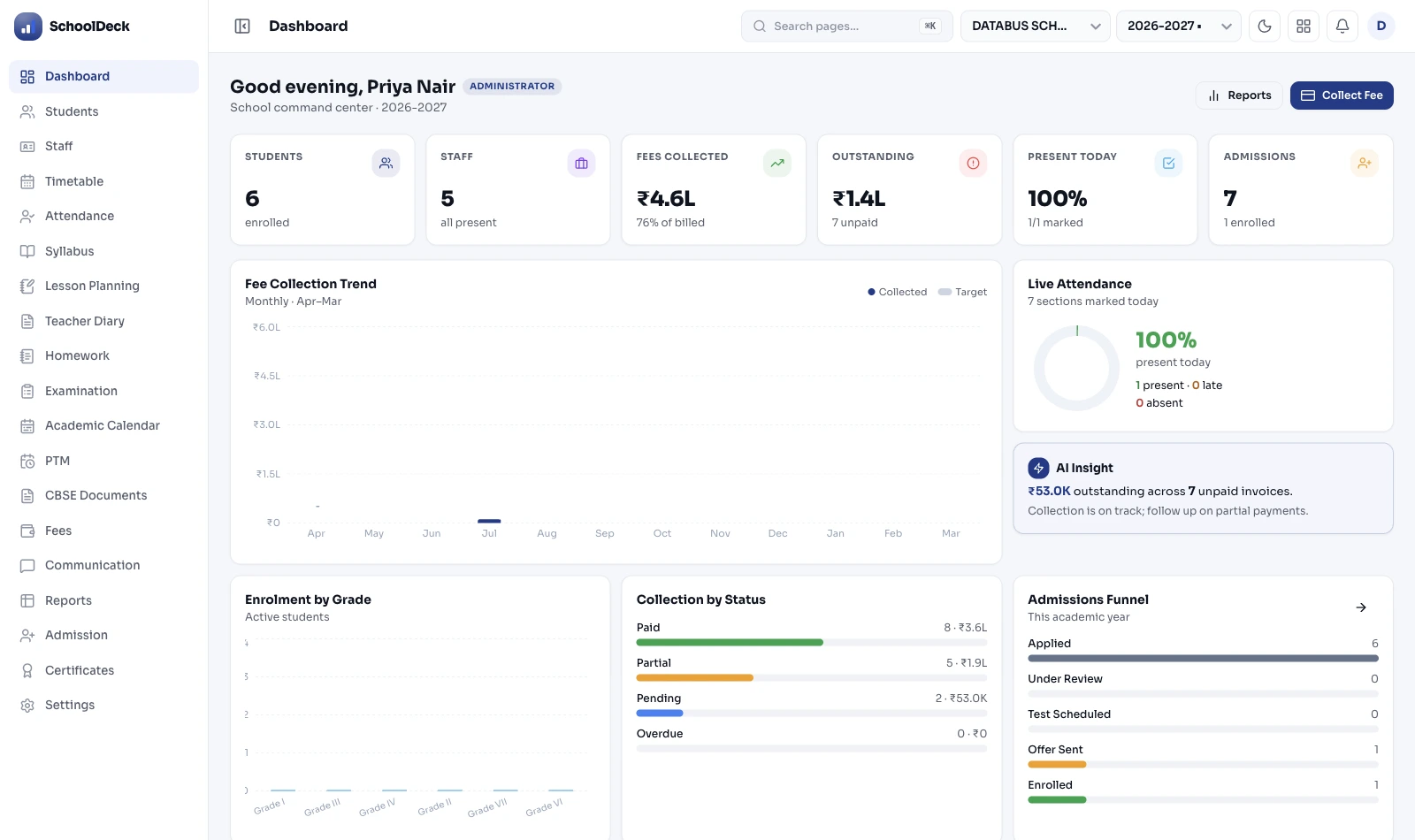
On login the Super Admin sees a consolidated view: total Trust enrolment, today's collection across all branches, outstanding dues per branch, today's attendance percentage per branch, and any escalation flags from branch RBAC violations or audit-log anomalies. Filters let the view be narrowed to one city, one academic board, one branch — or pivoted to compare branches side-by-side.

Critically: every drill-down query the Super Admin runs is itself logged. Every viewing of cross-branch data, every modification, every export. The forensic edit trail across all branches is owned by /features/audit-logs/ for DPDP Act 2023 compliance — including the Super Admin's own activity.

API-level RBAC fencing — the technical detail that matters

Most multi-branch ERPs talk about "role-based access" but enforce it only at the user interface — a Branch Principal sees only their campus on screen, but the underlying API still returns data from all branches if queried directly. That is a confidentiality vulnerability, not a security architecture.

SchoolDeck enforces branch fencing at the API layer. When a Branch Principal authenticates, her session carries a branch-partition token. Every API call she makes is filtered against that token — student lists, staff lists, financial reports, admissions queue. If she alters a URL parameter or attempts to query another branch's data directly, the API returns a 403 authorisation error before the database is queried.

Branch-fenced roles include: Branch Principal, Branch Vice-Principal, Branch Accountant, Branch Admissions Officer, Branch Coordinator, Class Teacher. Trust-level roles with cross-branch visibility include: Super Admin (Chairman/Director), Trust Treasurer (financial only), Trust Academic Head (academic only), Trust HR Head (HR only), Trust Auditor (read-only). Role definitions and configuration are documented at the dedicated /features/role-based-access/ page.

1-click inter-branch staff transfer — with statutory history intact

Every staff record in SchoolDeck belongs to the Trust, not the branch. A teacher's employee profile sits in a Trust-level table; the branch is a foreign key. Transferring her from one branch to another is a single field update.

What stays with her in the move: her employee ID, joining date, designation history, PF account, ESI registration, accumulated leave balance, biometric attendance history, salary slip history (with Numeric Payment Code references), and her Income Tax Act 2025 Section 392 salary TDS records. When her annual Form 130 (was Form 16) is generated at year-end, it consolidates earnings across both branches into one certificate. No fragmented documents. No statutory reconstruction.

What changes: her branch assignment, the school address on her appointment letter (regenerated automatically), her access scope under RBAC, and her timetable assignment in /features/auto-timetable/. The Trust HR Head sees the transfer log in /features/audit-logs/. The destination branch principal sees her in her new staff list on her next login.

Pin-code admission routing — leads stop dying in inboxes

For a Trust running a city-wide admissions campaign, the typical flow is: parent fills enquiry form on Trust website → form lands in a generic Trust inbox → Trust office coordinator manually decides which branch the family belongs to → forwards by email or WhatsApp → branch principal sees it next time she opens her inbox. Forty leads in, three follow-ups out by Friday. The other 37 enrol their children elsewhere.

SchoolDeck routes leads by pin code at form submission. The Centralised Admissions CRM looks at the parent's pin code, references the configured catchment map for each branch (set up once during Trust onboarding), and assigns the lead to the nearest branch's admissions queue automatically. The branch admissions officer sees a pre-routed lead in her queue within seconds, follows up via WhatsApp through /features/communication-tool/ over the Trust's TRAI DLT-registered SMS and WhatsApp utility channels.

Source-ROI tracking — which ad campaign generated leads in which catchment — is consolidated at Trust level for the marketing team. Branch admission funnels are visible per-branch for the principal. The Trust Chairman sees both views.

Inter-branch asset transfer — depreciation schedule preserved

When the Trust buys 500 laptops centrally and dispatches 60 to Branch A, 80 to Branch B, 50 to Branch C and so on, each laptop's Fixed Asset Register entry needs to land in the destination branch's FAR — not the Trust warehouse's FAR — with the original acquisition date, original cost and depreciation schedule preserved.

SchoolDeck handles this through the Inter-Branch Asset Transfer workflow in /features/inventory-management/ which owns the asset + stock tracking layer including Fixed Asset Register with Companies Act 2013 Schedule II + Income Tax Rule 5 parallel depreciation. A digital dispatch challan moves stock from the central warehouse FAR to the destination branch FAR. The acquisition date and depreciation start-date stay intact — the only change is the branch ownership flag.

This matters for the Section 12A / 12AB Trust audit. At audit time, the CA wants both the branch-level FAR (per-campus reconciliation) and the Trust-consolidated FAR (Trust-level Schedule II depreciation roll-up). Both views come from the same underlying data — no reconciliation, no spreadsheet matching.

Each branch on its own academic board and fee structure

A Trust running a premium CBSE flagship in central Chandigarh, an ICSE branch in Mohali targeting a different parent segment, and three State Board branches in tier-3 Punjab towns is the normal Indian Trust shape. SchoolDeck does not impose a single curriculum or fee policy on all branches.

Configured per branch: academic board (CBSE / ICSE / any State Board), grading pattern (9-point CBSE / ICSE percentages / state-board format), fee structure with late-fine logic, term calendar with state-specific holidays, report card format (NEP HPC if the branch has adopted it, traditional FA/SA if not), and report card language (English / Hindi / Marathi / Tamil / Bengali etc.). The Class 10 Two Board Exams (effective from 2026 for CBSE branches) is enabled per-branch, not Trust-wide.

What stays Trust-wide: master vendor list, master DLT registration, master payment gateway (with funds reconciled to branch sub-ledgers), staff master, Trust audit trail, and the Super Admin role. Branch-specific exam workflow (CBSE 80+20, ICSE project marks, state-board patterns) is handled by /features/examinations/.

This module ≠ Finance Management ≠ Multi-Branch Use Case

Three SchoolDeck pages mention "multi-branch." Each owns a distinct layer. Understanding the boundary helps a Trust evaluate them correctly and helps search engines stop conflating them.

  • This page · /features/multi-branch/ — Owns the operational data partition. Super Admin login, branch RBAC fencing at API level, 1-click staff transfer, pin-code admission routing, inter-branch asset transfer, branch-specific board configuration. The mechanics of how a Trust runs day-to-day operations across campuses.
  • /features/finance-management/ — Owns the Trust executive hub. Consolidated P&L across branches, multi-branch governance, departmental budgets vs actuals, Maker-Checker dual control on financial transactions, automatic Tally XML bridge. The financial consolidation layer that sits on top of operations. For Treasurers and Trustees specifically.
  • /use-cases/multi-branch-school-management/ — Owns the buyer scenario. "I am a Trust running 4 campuses, what does SchoolDeck do for me?" Tells the story end-to-end with ROI, implementation timeline, customer narratives. For Trust Chairmen evaluating the platform top-down, not researching specific features.

This page assumes you already know your Trust needs multi-branch software and want to understand how it works under the hood. The use-case page is for the earlier stage. The finance-management page is for the parallel concern.

Disconnected software vs SchoolDeck multi-branch

Practical differences when running a Trust with 6 campuses and 8,400 students total.

Operational task Disconnected / standalone software SchoolDeck Multi-Branch
Trust Chairman daily check Wait for 6 branch emails by 5th of month Live dashboard, one login, all branches
Branch data confidentiality UI-only gating, API leaks possible API-level RBAC fencing per branch token
Mid-year staff transfer Delete + re-enter, statutory history fragmented 1-click, PF/ESI/leave/TDS history retained
Year-end Form 130 for transferred staff Manually reconstructed from 2 sources Consolidated across branches automatically
Admission enquiry routing Forwarded by Trust office coordinator manually Pin-code auto-route to nearest branch
Central procurement of 500 laptops "Centralised" in memo, retail pricing in practice Trust PO + digital dispatch challan to FAR
Branches on different academic boards Separate software instance per board type CBSE+ICSE+State per branch, one ERP
Multi-branch parent app experience Separate apps per child, two logins to manage One login, toggle between children
Trust audit at Section 12A/12AB time Branch FARs reconciled by CA in spreadsheets Branch + consolidated FAR from same data
Adding a 7th branch to the Trust Buy new software, hire IT staff, train from zero Hours of configuration in Super Admin console

FAQ

Questions Trust Chairmen ask before switching.

The operational answers schools running 2+ campuses want before committing.

What is multi-branch school management software?

+

Multi-branch school management software is a cloud-based ERP that lets an educational trust or school chain operate every campus from a single Super Admin login while keeping each branch's student, staff and financial data strictly partitioned at the API level. SchoolDeck's module is used by Indian K-12 trusts running 2 to 100+ branches across CBSE, ICSE and State Boards.

Can a Branch Principal see data from other branches in the Trust?

+

No. SchoolDeck enforces Role-Based Access Control at the API level, not just the user interface. A Branch Principal's session is scoped to their branch's data partition. Even if they alter the URL or query the API directly, the request fails authentication for any other branch. Only users explicitly assigned the Super Admin role at Trust level receive the consolidated cross-branch view.

How is this different from SchoolDeck Finance Management?

+

Multi-Branch Management owns the operational data partition — Super Admin login, branch RBAC fencing, staff transfers, asset transfers, admission routing. /features/finance-management/ owns the Trust executive hub — consolidated P&L, departmental budgets vs actuals, Maker-Checker dual control, Tally bridge. Multi-branch feeds finance; finance does not duplicate multi-branch. Different operational layers, complementary modules.

Can each branch run a different academic board and fee structure?

+

Yes. A Trust can run a CBSE branch, an ICSE branch and a State Board branch simultaneously from one Super Admin account. Each branch maintains its own academic calendar, fee structure, late-fine logic, grading pattern and report card format. Fee structures, exam schemes and report formats are configured per branch — not enforced from Trust level.

How does the 1-click staff transfer between branches work?

+

Every staff record belongs to the Trust, not the branch. To transfer a teacher from Branch A to Branch B, the Super Admin changes the branch assignment field. PF, ESI, leave balance, biometric attendance history and Income Tax Act 2025 Section 392 salary TDS records (Numeric Payment Codes 1001-1004) move with the staff member without any re-entry. Form 130 (was Form 16) issued at year-end consolidates earnings across both branches.

How are admission enquiries routed across branches?

+

The Trust's website enquiry form, paid-campaign landing pages and walk-in capture feed a Centralised Admissions CRM. Each lead is routed automatically to the nearest branch by parent pin code. Local branch staff pick up pre-routed leads in their branch queue and follow up via WhatsApp through /features/communication-tool/ over the school's TRAI DLT-registered SMS and WhatsApp utility channels. Source-ROI tracking is consolidated for the Trust marketing team.

Do parents need a separate app per branch if their children study in different campuses?

+

No. The SchoolDeck parent app is unified across the Trust. A parent with one child in Branch A (CBSE) and one in Branch B (ICSE) sees both children in the same login. They toggle between student profiles. Fees, attendance, results and parent-teacher messages for each child appear under that child's branch context.

Can we centralise procurement across all branches?

+

Yes. The Super Admin maintains a Trust master vendor list and approves consolidated Purchase Orders. When stock arrives at the central warehouse, the /features/inventory-management/ module executes inter-branch asset transfers with digital dispatch challans — moving stock to the destination branch's Fixed Asset Register (Companies Act 2013 Schedule II + Income Tax Rule 5 depreciation) electronically. Vendor TDS is handled by /features/expense-management/ with Income Tax Act 2025 Section 393 Numeric Payment Codes 1005-1067.

Is this product different from CampusAlly?

+

Yes. SchoolDeck is the Databus K-12 ERP — built for school chains, primary, secondary and higher-secondary trusts. CampusAlly is the separate Databus product for colleges and universities, with NAAC AQAR/SSR documentation, NEP higher-education curriculum, semester examination workflows, IQAC governance and campus placement modules. They share design language but are distinct products for different institution types.

What does SchoolDeck cost and how long does multi-branch setup take?

+

SchoolDeck starts at ₹30 per student per month across the full ERP. Multi-branch setup typically takes 7-10 days end-to-end — Day 1-2 Trust account + first branch configuration, Day 3-5 staff onboarding training, Day 6-8 admissions + finance go-live, Day 9-10 second branch onboarding. Adding subsequent branches takes hours, not days, once the Trust account is established.

Connected modules in SchoolDeck

The four modules multi-branch operations sit on.

Each owns its own layer. Together they form the Trust ERP.

For Indian Trust Chairmen + Group Directors

One login. Every campus. The 5th of the month stops being report-collection day.

In the demo we'll set up your Trust with two example branches, walk through the branch RBAC test (can a Branch Principal see Branch B's data?), execute a 1-click staff transfer, and show a pin-code admission routing live.

From ₹30/student/month · 500+ Indian schools · Live in 7-10 days