Comparison · EstateDeck vs Generic ERP

Property Management Software vs a generic ERP

A horizontal ERP can bill almost anything — after months of customisation. It cannot run UPI dues, ANPR gates, co-op audits or DPDP masking out of the box. A property is not a generic business.

A factual look at running Indian property and society operations on a generic ERP versus a purpose-built platform like EstateDeck — breadth versus depth, and where each one fits.

India rails, not localisation Live in 7 days, not 7 months No implementation partner Per-unit pricing in ₹
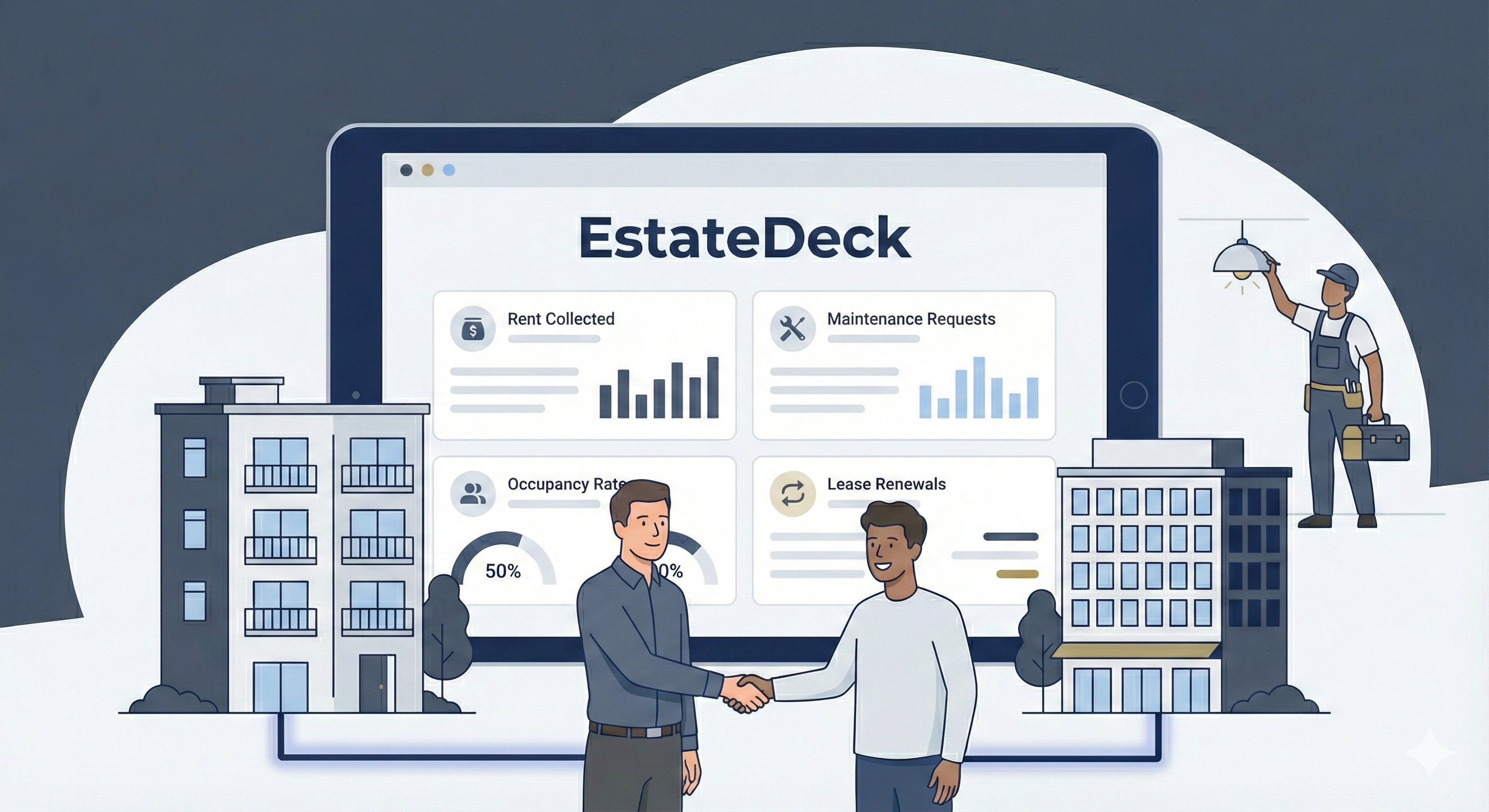
EstateDeck purpose-built property dashboard showing UPI maintenance collection, ANPR gate log and a society audit ledger in one platform, versus a generic horizontal ERP

The short answer

Breadth versus depth — and which one a property needs

A generic or horizontal ERP — SAP, Oracle NetSuite, Microsoft Dynamics, Zoho, Odoo — is a configurable platform that can run finance, inventory and HR for almost any industry. EstateDeck is a vertical platform built around one domain: Indian property and society operations. The ERP can be customised to manage a society; EstateDeck already manages one — UPI maintenance dues, slab-based billing, ANPR gates, co-operative society audit trails and DPDP-aware data handling are native, not a configuration project. The honest rule of thumb: choose the horizontal ERP when property is a minor part of a much larger enterprise already on that system; choose EstateDeck when the property is the business and you want it live in days, not configured for months.

Generic ERP
Horizontal

Broad, configurable, any industry

EstateDeck
Vertical

Deep, ready, property-only

Indian rails
Native

UPI · DLT · co-op acts · Tally

Go-live
7 Days

No implementation project

Feature-by-feature

Generic ERP vs EstateDeck,
on the property jobs that matter

"Native" means in the box for Indian property. "Custom build" means a configuration or development project with an implementation partner.

Comparison of a generic horizontal ERP and EstateDeck across Indian property management jobs
Property job Generic / horizontal ERP EstateDeck (vertical)
UPI maintenance / rent collection, per-flat reconciliation Custom build — payment-gateway integration project Native — UPI in two taps, auto-reconciled
Slab-based maintenance, arrears interest, sinking fund Custom build — no native society billing rules Native — society billing slabs standard
Defaulter list + DLT-registered WhatsApp / SMS reminders Custom build — needs TRAI DLT localisation Native — one-click reminders
Visitor gate register + resident pre-approval Out of scope — not a finance-ERP function Native — same platform as the ledger
ANPR vehicle entry + face recognition at the gate Out of scope — physical-security domain Native — on existing CCTV
State co-operative society audit trail / AGM records Custom build — no Indian co-op act templates Native — built around state co-op acts
DPDP-aware masking + UIDAI Aadhaar masking Configurable — generic access control only Native — masked logs, role-based, audited
Tally-ready export for the society auditor Via integration — depends on connector Native — Tally-ready file
Multi-tower / multi-block hierarchy in one dashboard Configurable — model it yourself Native — nested towers / blocks / wings
Resident mobile app (payments, tickets, circulars) Custom build — ERPs are admin-facing Native — resident-facing app included
Enterprise-wide finance, supply chain, payroll, HR Native — this is the ERP's home turf Not its job — exports to your finance system
Time to live Months — partner, customisation, training ~7 days — import unit list, go live
Cost model Licence + implementation + customisation Per-unit fee in ₹, no upfront — pricing

"Generic / horizontal ERP" refers to the category of broad, multi-industry platforms (e.g. SAP, Oracle NetSuite, Microsoft Dynamics, Zoho, Odoo). Capabilities vary by product and edition — verify any row against the specific ERP and configuration you are evaluating.

The four gaps

A horizontal ERP isn't wrong —
it's just built for a different shape of problem

These are the four places a generic ERP turns a standard property task into a customisation project.

1. The payment rails are wrong

Horizontal ERPs were designed around invoice-and-bank-transfer business cycles, not India's UPI-first consumer payments. Presenting a UPI request to a resident, accepting it, and matching the credit to a specific flat becomes a gateway integration project rather than a feature.

EstateDeck is built on Indian rails — UPI collection with per-unit auto-reconciliation is native. How UPI billing works →

2. The gate doesn't exist in an ERP

A finance-and-operations ERP has no concept of a society gate. Visitor pre-approval, a digital gate register, ANPR vehicle entry and contactless face recognition are physical-security workflows entirely outside its scope — usually a second, separate system bolted on.

EstateDeck runs the gate and the ledger together, so a flagged vehicle and an unpaid bill sit in one system. Visitor & gate →

3. Indian compliance is a localisation project

State co-operative society audit formats, GST on commercial rent, TDS on rent under the Income Tax Act, TRAI DLT-registered messaging, UIDAI Aadhaar masking and the DPDP Act 2023 are not defaults in a global ERP. Each becomes a localisation build before the society can even pass an audit.

EstateDeck is built around this regulatory stack from day one — see the compliance map below. Audit-ready ledger →

4. The treasurer is a volunteer, not an ERP admin

A horizontal ERP assumes a trained finance team and an implementation partner. A society treasurer is usually an unpaid resident who changes every year or two. A platform that needs consultant time for every change does not survive a committee handover.

EstateDeck is built for a volunteer committee and a seven-day go-live, with a resident app that needs no training. Society workflow →

The India stack a generic ERP ships without

Eight regulations a property platform
must speak natively

In a global ERP, each row below is a customisation. In EstateDeck, each is a default.

Indian property regulations native to EstateDeck and absent by default in a generic ERP
Regulation / framework What it governs for a property In a generic ERP
State Co-operative Society Acts Committee, ledger and AGM trails — e.g. Maharashtra MCS Act 1960, Karnataka KCS Act 1959, TN Apartment Ownership Act 1994 Not modelled
DPDP Act 2023 Resident data masked, access-controlled, audit-logged. Rules notified Nov 2025; bulk of obligations targeted 13 May 2027 Generic access control only
UIDAI Aadhaar masking Aadhaar shown as XXXX-XXXX-1234 — full number never stored Not native
GST Act 2017 GST-compliant invoicing on commercial rent above ₹20 lakh annual turnover, HSN per tenant Configurable, not India-default
Income Tax Act § 194-IB TDS on rent above ₹50,000 / month reflected in the tenant ledger Custom localisation
TRAI DLT (TCCCPR 2018) Bulk SMS reminders sent only through registered transactional templates Not native
UPI / RBI payment rails UPI collection with per-flat auto-reconciliation and auto-receipts Gateway integration project
IT Act 2000 § 65B Electronic-record admissibility for gate logs and document audit trails Not modelled

EstateDeck is a software tool that aligns workflows with these frameworks — it does not replace legal counsel. Confirm specifics with your chartered accountant or society auditor.

A three-question test

How to tell which one
actually fits you

Skip the feature-list arms race. Run your own three monthly jobs through this test.

  1. List your three monthly jobs

    Write down the three highest-friction jobs you do every month. For most it is collecting maintenance over UPI, chasing defaulters, and reconciling for audit.

  2. Ask: native or custom build?

    For each job, ask the ERP vendor whether it is in the box for Indian housing or a customisation project. UPI reconciliation, ANPR and co-op audits are native in a vertical platform — and a build in a horizontal one.

  3. Compare time and total cost

    A horizontal ERP needs a partner, a customisation budget and months. EstateDeck imports your unit list and goes live in seven days on per-unit pricing with no upfront fee.

★★★★★

"Our builder handed us a global ERP licence for our 312 flats. Three towers, and we still could not raise a single maintenance bill without a consultant. We moved the whole society onto EstateDeck in a week — UPI dues, the gate register and the auditor's ledger all in one place. The ERP was powerful; it just was never built for a society like ours."

Smt. Lakshmi Venkataraman

Treasurer, Apartment Owners' Association — Kondapur, Hyderabad (312 flats / 3 towers)

Honest scope

Where a generic ERP genuinely wins — and where to read next

A comparison only earns trust if it admits the other tool's strengths and points you to the right page for the rest.

Property inside a bigger enterprise

If a corporate already runs finance, procurement and HR on one ERP and simply owns its offices, folding facilities into that system avoids a second tool. Use the property module inside the ERP you already run.

Developers spanning many functions

A developer running construction, procurement, sales and finance together has genuine horizontal needs an ERP serves well. EstateDeck handles the post-handover operations layer, not the construction enterprise.

This is not a vendor takedown

SAP, Oracle, Dynamics, Zoho and Odoo are strong platforms. This page compares the horizontal ERP category against a vertical platform on property jobs only — not any product overall.

Coming from a spreadsheet, not an ERP?

If you are still on Excel rather than weighing an ERP, the EstateDeck vs Excel comparison is the page for you. This one is strictly about generic ERPs.

Where each topic lives — read next

Frequently Asked Questions

Generic ERP vs EstateDeck — common questions

What is the difference between a generic ERP and property management software?

A generic or horizontal ERP — such as SAP, Oracle NetSuite, Microsoft Dynamics, Zoho or Odoo — is a configurable business platform built to handle finance, inventory and HR for almost any industry. Property management software like EstateDeck is a vertical platform built around one domain: Indian property and society operations. The ERP can be customised to bill a society; EstateDeck already bills one out of the box, including UPI reconciliation, slab-based maintenance, ANPR gates, co-operative society audit trails and DPDP-aware data handling. The trade is breadth versus depth: an ERP is a blank platform you configure; a vertical platform is the workflow already built.

Can a horizontal ERP manage an Indian housing society?

It can, but only after significant customisation. A horizontal ERP has no native concept of a recurring maintenance slab, interest on arrears, a sinking fund, a visitor gate, ANPR vehicle entry, or a state co-operative society audit format. Each of these becomes a configuration or development project with an implementation partner. A purpose-built platform ships these as standard features for Indian societies, so the society is live in days rather than configuring for months.

Why do generic ERPs struggle with UPI rent and maintenance collection?

Most horizontal ERPs were built for invoice-and-bank-transfer business cycles, not for India's UPI-first consumer payment rails. They can record a payment, but presenting a UPI request to a resident, accepting it, and auto-reconciling the incoming credit to a specific flat usually needs a payment-gateway integration project. EstateDeck is built on Indian rails — UPI, cards and net-banking collection with per-unit auto-reconciliation and auto-receipts are native, not an integration to commission.

Is a generic ERP more powerful than EstateDeck?

A horizontal ERP is broader — it can run manufacturing, supply chain, payroll and finance across an entire enterprise, which EstateDeck does not attempt. For property and society operations specifically, that breadth is not an advantage: it means more modules to configure and ignore, a steeper learning curve for a treasurer, and features the property never uses. For the property domain, the depth of a purpose-built platform beats the breadth of a generic one. The honest framing is fit, not raw power.

How long does a generic ERP take to implement versus EstateDeck?

A horizontal ERP implementation for a property business is usually a multi-month project involving an implementation partner, a requirements phase, customisation, data migration and training. EstateDeck imports your existing unit list as CSV and most landlords and societies are live within seven days of a demo, including data migration. The difference is that the property workflow is already built, so there is no configuration project to fund.

Does a generic ERP handle Indian property compliance out of the box?

Rarely. Indian property compliance touches state co-operative society acts, GST on commercial rent, TDS on rent under the Income Tax Act, TRAI DLT-registered SMS for reminders, UIDAI masking of Aadhaar, and the Digital Personal Data Protection Act 2023 — whose rules were notified in November 2025, with the bulk of obligations targeted for 13 May 2027. A horizontal ERP carries none of these as defaults; each is a localisation project. EstateDeck is built around this Indian regulatory stack, so the compliance posture is the starting point, not an add-on.

What about gate security — visitor entry and ANPR — in a generic ERP?

A horizontal ERP has no concept of a society gate. Visitor pre-approval, a digital gate register, ANPR vehicle entry and contactless face recognition are physical-security workflows entirely outside a finance-and-operations ERP's scope. EstateDeck runs the gate and the ledger on one platform, so a flagged unregistered vehicle and an unpaid maintenance bill are visible in the same system. The mechanism is described on the EstateDeck visitor management and ANPR feature pages.

Will a generic ERP cost more than purpose-built property software?

Total cost rarely sits in the licence alone. A horizontal ERP typically adds an implementation partner fee, a customisation budget for the missing property workflows, and ongoing consultant time for changes. EstateDeck uses per-unit pricing in rupees with no large upfront fee and no per-module charge for the core suite, so the cost scales with the units managed rather than with a customisation project. Compare total cost of ownership over three years, not the first invoice.

When is a generic ERP actually the right choice?

A horizontal ERP is the right choice when property is a small part of a much larger enterprise that already runs on that ERP — for example, a corporate that owns its offices and wants facilities folded into the same finance system, or a developer running construction, procurement and sales on one platform. In that case a property module inside the existing ERP avoids a second system. For a standalone society, landlord or property manager whose core business is the property itself, a purpose-built platform fits better.

Can EstateDeck export to the finance system we already run?

Yes. EstateDeck is not trying to replace an enterprise's core finance system. It keeps a per-unit property ledger with receipt trails and exports a Tally-ready file, so the property numbers flow into the accounting tool your auditor already uses. Many buyers run EstateDeck as the property operating layer and keep their existing accounting software as the system of record for company-wide finance.

Is EstateDeck itself an ERP?

EstateDeck is a vertical ERP for property — a full system of record for the property domain rather than a horizontal one that spans every business function. It runs collection, accounting, tenant and lease records, maintenance ticketing, visitor and gate management and society governance on one platform. It is purpose-built for Indian landlords, housing societies, gated communities and commercial property managers, and developed by Databus Technology Solutions in Chennai.

EstateDeck by Databus · Chennai

Don't configure a generic ERP
for six months — go live in seven days

A 30-minute demo on your actual unit list and your three monthly jobs. No card, no slides, no sales pitch.